The Variety 100 Best Horror Movies – Whose Horror Is It Anyway?
For those of you coming to the discourse a little late, let’s summarize some of the little reasons why people got mad at the Variety list. (The list was put together by Siddhant Adlakha, Peter Debruge, William Earl, Owen Gleiberman, Courtney Howard, Tomris Laffly, Amy Nicholson, and Rene Rodriguez. I wish that they, as Slant and Time Out and even The Ringer do, would have shown who wrote which blurb.)
Apparently putting The Texas Chain Saw Massacre first made people unhappy? Now that it’s made the top 250 of a Sight and Sound poll, we know the film is firmly canonized among critics. It’s going to make the top 100 next time. There’s still time for everyone to get on the bandwagon.
Various rankings peeved people. Common complaints include Salo at 9 (a lot of complaints about this), The Thing at 46, A Nightmare on Elm Street at 74, and Suspiria at 99. We should also note the displeasure at the placement of Halloween outside the top ten, and at the perceived disrespect of John Carpenter generally. I think getting mad about where stuff ranks on a list like this is a bit of a rookie move. In the same way that it’s an honor just to be nominated, the order never really matters all that much beyond the top ten or so for a publication. If you went back and asked the people who made this, I seriously doubt they’d tell you there’s some gulf between Repulsion at 100 and The Texas Chain Saw Massacre at 1, let alone between Repulsion at 100 and The Descent at 75, or Scream at 25.
The presence of Hostel 2 and The Human Centipede 2 at 71 and 92, respectively, had people upset. I don’t know that I consider either of those to be “engagement bait,” which is the common line I’ve seen thrown at both, and which we’ll get to next. I’ll grant that they’re both weird outlier choices compared to the rest of this list. I don’t think MCU fans love sequels as much as horror sickos do, and this list has almost none of the regular sequel suspects: no Aliens, no castoffs from the worlds of Jason Voorhees, Freddy Krueger, or Michael Myers. There are three sequels on the Variety list. The other one is Evil Dead 2. One of these things is not like the other.
I want to briefly defend this list against the engagement bait charge. If this were engagement bait, it would look different than this movie does. It would not be swimming in movies from the 1930s. The writers would not have left popular recent movies like The Conjuring and Insidious and Sinister off the list, because it’s a lot easier to get people mad about something coming in too low than it is for them to get mad about something that’s missing. There would be a lot more where Hostel 2 and The Human Centipede 2 came from. The list has forty-two movies that aren’t American, and if they wanted people to interact with the list, it would be more like eighty-five or ninety movies from the United States. Owen Gleiberman is something of a risible figure, and everything Unspooled touches becomes facile and silly. But Adlakha and Laffly are conscientious people, at least. The writing in here is not exactly top-notch, but it’s not careless, and it’s not written to invite our rage or disdain.
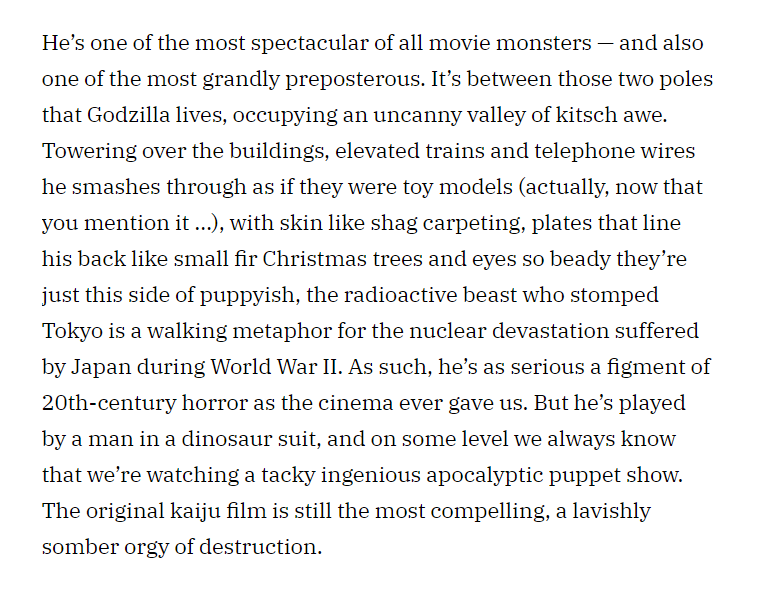
The Godzilla blurb! This one got passed around on Twitter a lot, and honestly…whoever wrote this deserves the dragging. The condescension for this movie is evident, no matter how hastily they slap on the bit about “but it’s about Hiroshima.”
While we’re looking at the shoddier writing from the listicle, here’s an excerpt from the preface:
The question “What is horror?” echoed at the center of every discussion, with long hours spent arguing over where the boundaries lie for a genre that has launched many a career. How often has one of these waking nightmares upset you enough to resurface in your dreams? If we’ve done our job, you’ll want to join the debate.
I mean, shoot, what is “horror” anyway. For Variety, at least, there are favorite subgenres. The subgenres they highlight are the key to understanding what kind of horror the Variety cadre favors.
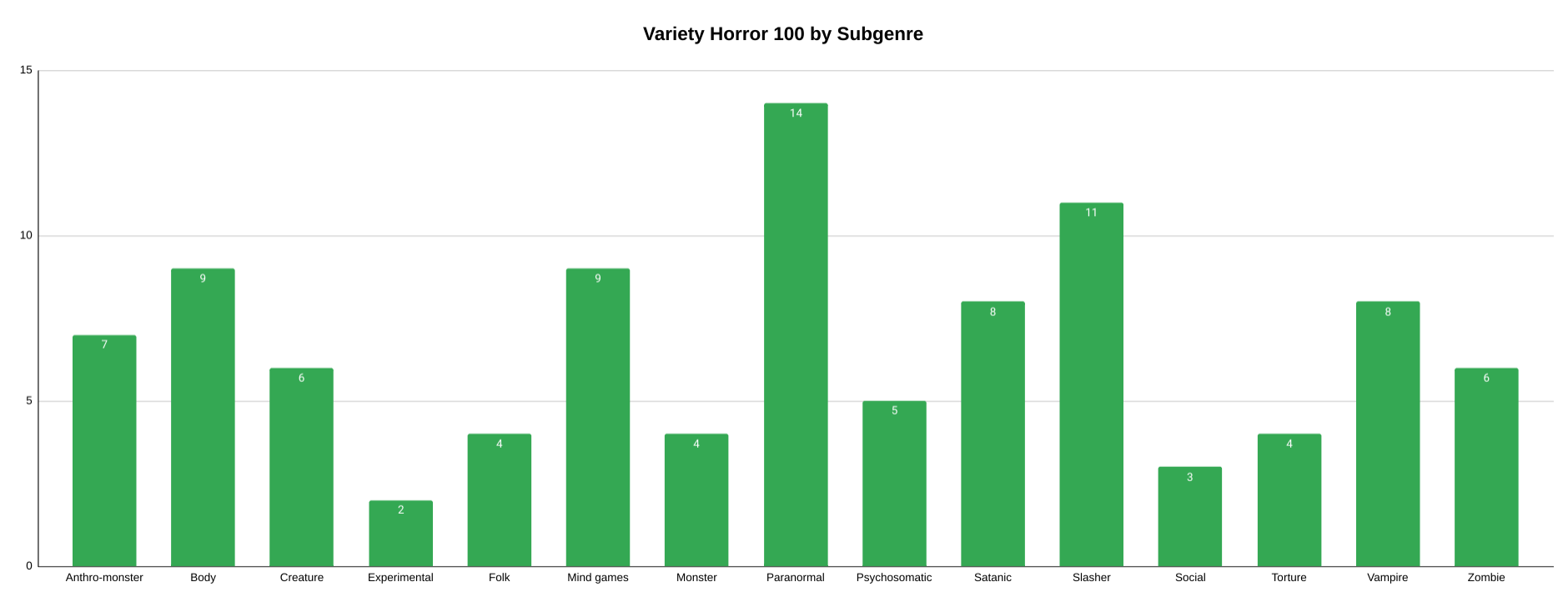
I tried to break down the films from the Variety list, and I tried to do it in ways that were descriptive without getting granular. Thus the distinction between anthro-monsters (Frankenstein, The Mummy, I’m basically trying to say the Universal monster movies without limiting us to Universal monster movies), vampires (Vampyr, Let the Right One In), and zombies (Dawn of the Dead, Planet Terror). Or the one between creatures (Gremlins, The Birds) and monsters (Alien, The Little Shop of Horrors.) The paranormal includes Black Sunday and The Blair Witch Project, but the Satanic has The Exorcist and Rosemary’s Baby. It seemed to me that we could fold witches into the paranormal without creating a new category. I feel similarly about slashers and giallo, sue me.
The reason I like breaking it down this way is that it’s easier to think about the movies Variety wanted to include in terms of percentages. Paranormal films and slashers making up 25% of this list feels about right to me. Zombies and vampires get you to about 40% of the entire list. Add body horror and you’re closer to 50%. Throw in what I call “mind games” (Manhunter, The Vanishing), a term which I think is more evocative than the grab bag of “psychological horror,” and that’s 60%. Creatures and monsters push you up to 70%. Variety is making a varied list, one that doesn’t dip too much into any one type of subgenre. It’s as easy to make a “top 100 creature features” or “top 100 slashers” as it is to make a “top 100 horror movies” list, and to the credit of the listmakers, Variety doesn’t go over the top on any one subgenre.
I was going to make a crack about how, if you took the Twitter mob and told them to come up with a top 100, even they would come up with similar proportions. Then I remembered that the Twitter mob kind of already did, and you can check their work against a hypothesis. It’s the Fangoria list, their top 100 as determined by their readership. I have their scratch-off poster up at my job. And if you stare at my poster and then at the Variety list for a little while, you’ll notice that forty-four movies are on both lists. Just think: all of the horror movies in the world to choose from, and the critics at Variety came up with forty-four of the same titles that horror buffs chose.
For many reasons, the Fangoria list has to be a lot closer to what aggrieved tweeters were looking for from the Variety list. Halloween is first, The Thing second, A Nightmare on Elm Street fifth. Standards like Evil Dead, Hellraiser, An American Werewolf in London, and Black Christmas are there, too. The flagships of more recent popular franchises, like The Conjuring and Insidious, are hanging around. There’s significantly less genre ambiguity on the Fangoria list than there is on the Variety list. No movie like Salo or A Page of Madness is polluting a pretty pure horror roster. The average year of release for a movie on the Fangoria list is 1988; for Variety, that year is 1972.
The Fangoria list is also the product of a predominantly American fanbase. Seventy-five of their movies come from the United States; Variety logs in at fifty-eight. Add in the other English-language films, and that gets you to ninety-two out of 100. (The exceptions are a short enough list that we can name them here: Martyrs, Train to Busan, The Beyond, Nosferatu, Ring, Let the Right One In, When Evil Lurks, Audition. And Nosferatu barely counts given the magic of translated intertitles.) For comparison, Variety includes seventy-four Anglophone movies.
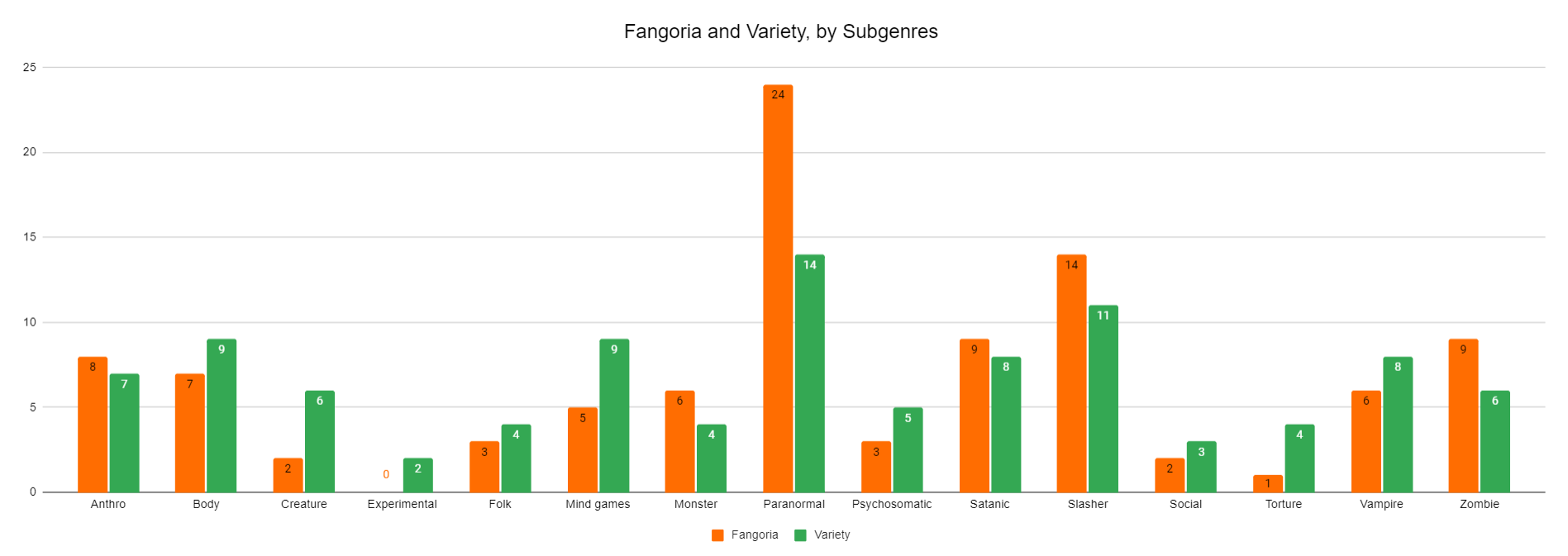
The next two charts tell the story of what I think people wanted versus what they got.
Fangoria and Variety are within two movies of each other in each of the following subgenres: anthro-monsters, body, experimental, folk, monsters, psychosomatic, Satanic, social, and vampire. Those categories make up 44% of Fangoria and 50% of Variety. There are a lot of movies, and if one list chooses Kwaidan for folk horror and the other chooses Midsommar, whatever. What stands out to me is that about half of these lists are proportioned similarly.
The story here is that the Fangoria list is almost one quarter paranormal films, where the Variety list has fourteen. This isn’t literally the difference between the two lists, but it’s instructive nevertheless: Fangoria has ten 21st Century paranormal films, and Variety has two. There is no overlap between them, and even the precise movies we’re talking about feel worlds apart. Variety includes The Devil’s Backbone and The Babadook here, two foreign films which are leading hard with metaphor and use the paranormal elements to dress the metaphors up. Fangoria includes films like the aforementioned The Conjuring and Insidious, as well as movies like It and The Ring and, naturally, Paranormal Activity. People have spent most of the last decade and change going for paranormal movies, although slashers will never cease to be popular. Look no further than the recent success of Terrifier 3, as well as the presence of Terrifier 2 on the Fangoria list. The difference actually isn’t so stark in terms of percentages, although a look back at both lists show that Fangoria is generally taking its slashers from ’80s sequels and Variety tends toward giallo.
Once we get past those two major subgenres, which I think we might fairly say have dominated horror films for…sixty years?…we can find the personality in the Variety list. It has (flips hair) variety that you don’t get from Fangoria, which plays the hits from favored franchises again and again. Of course, whether or not you think Variety has a monopoly on Variety depends on what we can compare their list to. How about another big-name publication which used a stable of established film critics to come up with a top 100 horror list within the past couple months? Time Out published their 100 best horror movies back in August, which seems like such an own goal…people aren’t going to pay attention to a horror list like that until at least September. In any event, here’s how Time Out compares to Variety by subgenres.
On first glance, you look at this and what stands out is that Time Out actually leans on the paranormal even more than Fangoria. And then you look through the rest of it, and the similarities to Variety stick out much more. Five categories with an identical number of films. Four more which are within one movie. This has three Polanski movies, which is a novelty anymore. There are some low-budget movies cracking through, like Session 9 and Lake Mungo. Time Out has a slightly different perspective on the Italians than either of our previous lists, opting for Kill Baby…Kill! and Black Sabbath. Some of the well-remembered horror movies from the recent past that neither Variety nor Fangoria favor are here, like The Invisible Man, which no one would shut up about for a little bit, and A Quiet Place, which has become a reliable franchise.
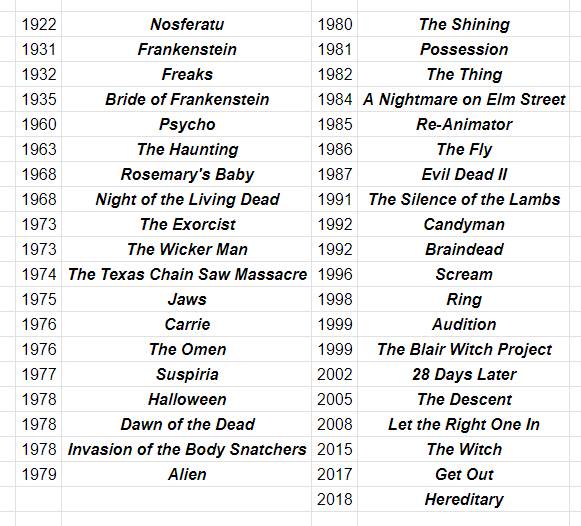
After realizing that I’d seen a lot of these movies before as I was charting them, I decided I would make a note if I had seen a movie on the Time Out list on one or both of the Variety and Fangoria lists. There are thirty-nine movies that are on all three! I realize that three lists is a small sample, but with this much carryover, we’re dangerously close to a canon. I’m sure that for better horror fans than me, looking at the list below is going to inspire some dissatisfaction. (I like to think I’m adequately into horror to at least talk about listicles, and when I look down there and see Hereditary…come on, let’s love ourselves a little more.) Canon and good don’t go together; what’s below is merely what is locked in.
The other results look like this:
The Time Out list has just nineteen movies that do not appear for Variety or Fangoria. You have to go down to #39, Jacob’s Ladder, before you find a movie that’s not represented on either of the lists we’ve talked about already. The average year of release for those movies is 1986, which is funny because none of the unique movies for Time Out came out in the 1980s. Ten of their nineteen unique movies are from the 21st Century, and those are being pulled against by The Unknown and The Old Dark House.
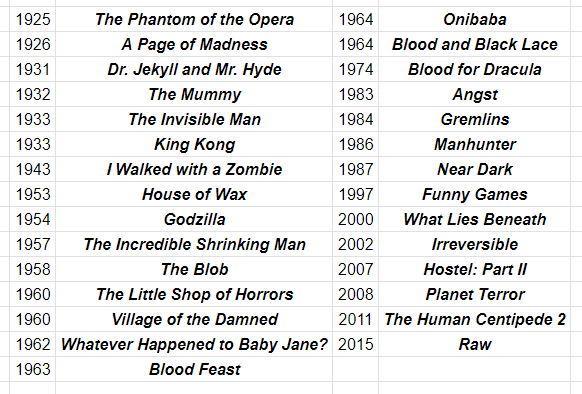
The Variety list has twenty-nine movies that do not appear for Time Out or Fangoria. Those movies have an average year of release of 1968, which is older than the average for the list as a whole. We’re going to get to them in more detail.
The Fangoria list is what makes it seem pretty clear that there’s a sort of critical groupthink. Between them, the Time Out and Variety lists share sixty-six films. The Fangoria list, on the other hand, has forty-four movies all to itself (average year of release: 1998). To use an old example, horror fans are like the monsters of Nightbreed. There’s something a little funky, a little strange about them. They’re recognizable to other movie fans as movie fans, but they immediately look different. And when you peer at their list and see movies like the eminently fine Pumpkinhead, or the voluminously titled Friday the 13th Part VI, you know that you’re dealing with weirdos who absolutely have their own in-group. Don’t Look Now is not their horror movie. Dead Ringers is not their horror movie. They’re watching The Lost Boys. They’re dusting off the Phantasm VHS their grandmas bought for them from a yard sale a thousand weekends ago.
When we look at the following movies, we’re seeing the personality of the Variety list. What actually makes it special, separate not just from the fans but from other critics, is here in these twenty-nine flicks. Set aside the complaints about where entries are ranked, because that’ has nothing to do with Variety specifically. Every list has complaints about where entries are ranked. If people react to the Variety list, they’re really reacting to these movies.
One thing they’re reacting to on this list is the age of the represented movies. Multiple silent entries beyond Nosferatu. Reeling in a number of movies from the ’30s and ’50s, neither of which traditionally stand out as banner decades for horror. No one is more sympathetic than I am to a listmaker who wants to foreground the old instead of the new. Ignorance of movies outside the ones released in your own time is sinful. All the same, I have a question to ask about Dr. Jekyll and Mr. Hyde, or I Walked with a Zombie, or The Blob…are these old movies actually scary? And if they aren’t, then what kind of horror movies are they? How highly may we esteem them?
Some of us have thumbprints which are less individual than our fears, and so I don’t want to dismiss anyone’s fright tastes out of hand. What stands out to me about The Blob (1958) is not fear of the Blob itself but how much Steve McQueen’s fellow teens are trying to get the camera to notice them. But if that movie scares the pants off you, well and good. Of course, what’s scary changes enormously as we change. The first horror movie I ever saw was A Nightmare on Elm Street, which freaked me the heck out when I was a kid. Suffice it to say that it no longer freaks me the heck out, but that doesn’t mean it’s not scary.
Where I think something like The Blob or I Walked with a Zombie comes up short is in the breadth of scares. When I think of a movie that has truly scared me, like The Exorcist or The Texas Chain Saw Massacre, to be entirely basic, I can break down what’s freaked me out into three rough elements: atmosphere, guts, and jumps. I think this is true for basically everyone, although (remember the thumbprints) none of us have the same proportion of all three. Guts don’t do a lot on me, which is why I don’t find the signature scene from Audition all that frightening. Jump scares, on the other hand, are real rough for me. I don’t think The Conjuring is a great movie, but that one had me on edge just about the whole way. In short, a movie like I Walked with a Zombie might have great atmosphere, but it’s missing guts and jumps. The Variety list prizes atmosphere above all else. You could go months without watching a horror movie with the atmosphere of The Mummy (“Is Boris Karloff sexier than Clark Gable?”), but it’s a movie basically devoid of guts and jumps. It took a long time before horror movies started to deliver all three of those with regularity. The complaints about how old the movies are is going to come from the perspective of “I’ve never seen House of Wax, it’s seventy years old, no one watches movies that old.” It’s a bad attitude. But it’s also going to come from a different source: “House of Wax doesn’t deliver blood and jump scares the way I expect them to appear.” I think that’s worth reckoning with.
In going through other lists, it seems like most of them seem content to include one torture movie as a kind of nod to the subgenre, but no more. The Fangoria list has Martyrs, which was brought up multiple times, in all places, in the Variety comments section under the article. Time Out includes Salo. By my count, there are four movies on the Variety list that I’d call torture movies: Salo, Irreversible, Hostel 2, and The Human Centipede 2. Maybe there are better categories to put them under, but all of them put extended human misery via physical subjugation at the center. Given that I’ve seen complaints about all of their inclusions, but especially Hostel and The Human Centipede, the extended look given to torture films makes the Variety list stick out. Four is not a big number or anything, I get it. But a film which, if it is horror, is a torture film, coming in ninth? Two really surprising picks that everyone hated as soon as they read through the list, movies that I’ve never found on any other like list, are both torture films. The list is making room for this especially controversial subgenre, one that had a pretty short shelf life even when it was in, and I’m really curious as to why. Or, more precisely, who is the person who suggested those two and managed to convince everyone else that they should be on their list? It would be funny to imagine that separate people threw Hostel 2 and The Human Centipede 2 out there, but that’s a little preposterous.
We have to go back to that fateful line from the preface: “The question ‘What is horror?’ echoed at the center of every discussion, with long hours spent arguing over where the boundaries lie…” Variety has made the purview of horror much too wide. When I look at the unique movies from Fangoria and even Time Out, I don’t find myself asking if those movies are horror movies in the first place. The personality of the Variety list, on the other hand, is really shaped by movies that I don’t think of as horror movies at all. I understand that my reluctance to call The Silence of the Lambs a horror movie is unorthehodox, but surely it’s not weird that I wouldn’t call Manhunter a horror movie. The Incredible Shrinking Man is, to my mind, very firmly a sci-fi classic. It’s about the horror of the body undergoing a change, surely, but so is Amour. Bodies can change without it being body horror. Speaking of Michael Haneke, Funny Games is about a home invasion, and it’s obviously terrifying, but isn’t it more of a thriller? Same principle with What Lies Beneath. And most of all: why hasn’t anyone else come up with King Kong or Godzilla as horror movies? Run through lists of horror movies on the interwebs, on IMDb or Indiewire or IGN, and you can’t find anyone to back up the calculations Variety is making.
Including The Incredible Shrinking Man, even more than King Kong or Godzilla, is the thing that makes me feel like this endeavor was a little bit lost. There are some tense scenes in the film, mostly involving animals who now feel empowered to attack Scott. The cat tries to get him. In one outstanding scene, Scott is in pitched battle with a spider that is even bigger than he is, and he must feint and parry and stab with a pin in order to keep himself alive. It’s an intense scene, and there’s something kind of gross about the idea of fighting a “human-sized” spider, but it’s not horror. Scott never stops shrinking, either. He continues to shrink past the point where he can no longer be seen, presumably to the microscopic level and beyond. This is existentially frightening, but if existential fright and an intense scene with a spider were all it took to be a horror movie, then Through a Glass Darkly would be a horror movie. The genre is large enough. It contains House, Twin Peaks: Fire Walk with Me, Tremors, and Mad God. Let the multitudes speak for themselves.
4 thoughts on “The Variety 100 Best Horror Movies – Whose Horror Is It Anyway?”
As someone who didn’t have any interest in the list but saw quite a bit of discourse, I’m glad to see a take that doesn’t seem like a kneejerk reaction – and especially one where the take-maker clearly did some homework. Typically thoughtful work from you. I can’t believe anyone would balk at Texas Chain Saw Massacre topping a horror list. Even if it’s not one’s favorite, surely it’s a worthy or at least understandable choice.
I’m deeply curious about one category you created in your subgenre breakdown. How do you define “psychosomatic”? What are examples of it, from the list or your own knowledge?
Also! Loved that the bulk of your analysis is about finding the personalities of these lists based on what they share and where they differ. I never thought of looking at projects like this through that lens. Certainly more interesting than quibbling about rankings.
I was trying to avoid “psychological horror” at all costs, because like, everything is psychological horror. I categorize movies like The Thing, Eyes without a Face, and Audition that way. There’s clear body horror, but the body horror is inextricable from what’s going on in people’s heads. I would also categorize Us that way.
[…] I was inspired by the unveiling of the Variety list of the 100 best horror movies. I was curious why the list had […]




 Seeing Things Secondhand
As someone who didn’t have any interest in the list but saw quite a bit of discourse, I’m glad to see a take that doesn’t seem like a kneejerk reaction – and especially one where the take-maker clearly did some homework. Typically thoughtful work from you. I can’t believe anyone would balk at Texas Chain Saw Massacre topping a horror list. Even if it’s not one’s favorite, surely it’s a worthy or at least understandable choice.
I’m deeply curious about one category you created in your subgenre breakdown. How do you define “psychosomatic”? What are examples of it, from the list or your own knowledge?
Also! Loved that the bulk of your analysis is about finding the personalities of these lists based on what they share and where they differ. I never thought of looking at projects like this through that lens. Certainly more interesting than quibbling about rankings.
I was trying to avoid “psychological horror” at all costs, because like, everything is psychological horror. I categorize movies like The Thing, Eyes without a Face, and Audition that way. There’s clear body horror, but the body horror is inextricable from what’s going on in people’s heads. I would also categorize Us that way.
[…] I was inspired by the unveiling of the Variety list of the 100 best horror movies. I was curious why the list had […]