The Fourth Genre (Just in Case You’re from Space and Haven’t Seen The Avengers)
Before I watched a bunch of DC animated movies, I watched A Personal Journey with Martin Scorsese Through American Movies. In that doc, Scorsese says there are three American genres, genres which sprung up in their fullest forms in American movies: westerns, gangster movies, and musicals. This intellectual thrust comes from 1995, and if he were to update this personal journey, he would need to add a fourth genre. No foolin’: Martin Scorsese is the reason I come to you today to talk about superhero movies with a skip in my step.
The superhero movie is adjacent to science-fiction or fantasy, though not an easy enough fit within either to call it a subsidiary. It centers on one or several people with capabilities that exceed the realistic possibilities of normal human beings, and who use those capabilities to physically fight for what we may generally perceive as a just cause. The creation of the superhero in question must have come from the 20th or 21st centuries. Although there are some supremely powered beings in superhero films who have existed in their timeline for centuries (Vandal Savage, Galactus, Logan), the character must have been thought up in an industrialized, or post-industrial, moment. The superhero exists in a setting where his or her exceptionality is measurable. A superhero must not be faster than other men, but faster than a speeding bullet. A superhero must not be stronger than other men, but stronger enough to lift tons. The character is also a reflection of the fads of 20th Century civics. Most superheroes are American, and many of them, cheerfully or ruefully, work from the values of capitalist democratic-republicanism. The superhero is frequently apolitical (“crime is bad”), although you’ll find examples of Randian superheroes, borderline fascist superheroes, New Deal superheroes, progressive superheroes.
Therefore, The Adventures of Robin Hood is not a superhero film. Although Robin Hood is an exceptional archer and swordsman and a great athlete, and although he has been a folk hero for centuries, his abilities are spectacular rather than super. Zorro, in all of his variations and despite his post-World War I birthdate, is not a superhero either. In The Mask of Zorro, Zorro is a magnificent horseman, a great swordfighter, and a lithe athlete. Like Robin Hood, he fights on the side of the little guy. He is a talented and practiced man, but still only a man. He may only augment his skills through practice and exercise, which are the same qualities that any man might use to become a better rider or fencer.
Superman (Superman, 1978) is a superhero. He has his powers because he was born on a different planet in a different solar system, and thus his natural abilities are augmented by living on Earth, where natural forces have less effect on him. Batman is a superhero. He has no supernatural powers, but through the force of his wealth and his technological prowess, he has augmented himself beyond the capabilities of normal men. (As ever, see The Dark Knight and “I’M NOT WEARIN’ HOCKEY PADS” for further insight.) Spider-Man (Spider-Man: Into the Spider-Verse) is a superhero. He was a regular person who was bitten by a radioactive spider, which changed him from a scrawny nerd to a person with the capacities of a spider brought out to human proportions. And Wolverine (X-Men Origins: Wolverine) is a superhero. He was born with mutations that allow him to heal at incredible speed, as well as claws that come out of his hands and heightened sensory awareness. These four basic categories – alien, equipment, changeling, and mutant – cover the vast majority of the superheroes represented in American film. Regardless of category, the origin of the superhero is an essential element in his or her film. How s/he came to be is almost always detailed, taking up roughly half of the first movie about him or her, and then referenced frequently in the films after. I realize this sounds facetious, but I genuinely don’t mean it to be…the only guy whose origin story I’ve seen more often than Batman’s is Jesus Christ’s.
The superhero’s power places him or her in a difficult position compared to the rest of society. The most efficient way to wield this power is to intercede when crimes are committed, or to protect civilians from supervillains. However, the superhero must exist outside of the social fabric that we are all sewn into. S/He is not an elected figure chosen by the people to defend them. Nor is the superhero like a police officer or a soldier, who wields violence under strict rules of conduct subordinated to higher legal authorities and the public alike. On very rare occasions, superheroes might be invited by the government to act in the interest of public safety, but for the most part, the superhero’s beat or patrol is up to his or her discretion. The superhero has no right to act as s/he does, but part of the superhero’s identity is that s/he must engage in physical combat for the betterment of individuals and society alike. This is different than “might makes right” in its finer points. Many conflicts that the superhero engages in require him or her to fight a supervillain, who is perhaps even mightier than the superhero, and who intends to use that might to subjugate a city, a state, the world. However: I’M NOT WEARIN’ HOCKEY PADS is telling.
I’m starting off with this pedantic section because genre matters. Genre conventions matter. Genre does the work of explaining how a movie exists without bogging us down in plot. Genre is foundational. It’s what keeps salt salty. If the horror film isn’t frightening, then what is it good for? If the musical doesn’t have musical performances, then what is it good for? If the superhero movie doesn’t have the augmented individual working for a good cause, then what is it good for? Great superhero movies might find ways to complicate the augmentation, the cause, or any number of other conventions. They almost always place themselves in knowing dialogue with the keystones of the genre, such as vigilantism and violence. But there must be a superhero, and there must be a grievance that only a superhero can redress.
The Western, the Gangster Film, and the Musical
The superhero movie is as American as the western. The western wrestles with the first sin of white Americans, the genocide of Native American peoples from one coast to the other, while at the same time wrapping that genocide up with a shiny bow that twinkles opportunity. This is why John Ford stands alone. No one has seen, and no one ever will see, that wrestling match as clearly as Ford. There’s no room for Ethan Edwards, the racist’s racist, in the future of a United States fathered by a multiracial Martin Pawley and mothered by Laurie Jorgensen, daughter of immigrants. The Searchers is at the cold center when you look for definitions of “America,” and it’s a story which is virtually impossible to transfer to another genre. In Personal Journey, Clint Eastwood shares that westerns are immutably American, and that it’s fashionable to denigrate this most American of genres. The violence of the western stands out to Eastwood, and Scorsese, who pointedly avoids movies from his peers and friends, does make space to show some of the climactic scene from Unforgiven. We Americans see violence as personally as we view romance (“guns don’t kill people, people with guns kill people”), and the western is an essential genre for soaking in that violence.
Westerns and musicals are functionally dead in American movies, although they can be shocked into zombie form with a really good zap from a cattle prod. Of the two, musicals seem more likely to persevere. As long as Broadway pumps out a hit musical once every fifteen years or so, and as long as people will still pony up for old favorites like Phantom of the Opera and Les Miserables, we can expect to get one between Thanksgiving and Christmas every year. The quality of such a film is dubious at best. The people who knew what they were doing making movie musicals are all dead now, and even the recently dead, like Stanley Donen, had basically been missing from the biz since the ’80s. We’re left with poseurs (Rob Marshall, Jon M. Chu), plagiarists (Damien Chazelle), and whatever the hell Tom Hooper is. It’s hard enough to make a Vincente Minnelli or a Bob Fosse or a Stanley Donen when the material environment is ready for them to step into. If Charles Walters were making movies today, we would venerate him like a god.
Westerns are deader, in my eyes, because the appetite for westerns has dried up. The appetite for revisionist westerns is not robust, exactly, but people would rather see something marketed as a revisionist western than a more straightforward one. Unforgiven, amusingly, killed westerns as we know them. The insistence that Unforgiven was revising the genre in some way when the westerns of the ’30s and ’40s and ’50s were doing all of that work beforehand is insulting, almost childish. Take The Ox-Bow Incident, My Darling Clementine, and The Naked Spur, just to pull three famous examples. What, exactly, would you say Unforgiven is revising from those films? We’re in a dark place with westerns, a very dark place, and it’s a very American problem to have. Americans love the new much more than they love the old, and will flock to what presents itself as new even if it has less value than what is old or, risibly, if what is presented as new is in fact much more stale than what is old.
In 1995, Scorsese identified that the gangster movie as it existed in the ’30s was quite different by the time noir swallowed it in the ’40s. He identifies I Walk Alone, from 1948, as a turning point. Burt Lancaster comes out of prison and finds that the gangster is no longer toting a gun but relying on accountants like a legitimate businessman. That’s only become more true in the seventy-five intervening years. The spattered violence of The Godfather has been replaced by the geopolitical calculation of The Godfather Part II. American’s favorite gangster of the 21st Century is Walter White, whose violence pales compared to the tactics La-Z-Boy critics love to fawn over. Compared to the western and the musical, the gangster film is on life support. The gangster film has been supplanted by the gangster television show. The primary gangster films of the past decade are the John Wick movies, and contrary to Tony Camonte or Tom Powers, John Wick is not a rising member of the criminal syndicates but a loose end of them. The conventional wisdom is that the rise and fall of the gangster is too enormous a story to be boiled down to eight reels, like Scarface or The Public Enemy.
With those three genres at the very least in decline at the end of the 20th Century, attached to life support and beeping dolefully in the early 21st, there was room for a new American genre to be born. Thus the superhero movie, an offshoot of science-fiction, borrowing from American pulp literature as the western did, appealing to current events headliners in the way the gangster movie did, fulfilling the need for overwhelming visual spectacle as the musical did. What sets it apart from these other movies is not its violence, but the scale of its violence. The genre puts its talons into the world with Superman in 1978 for an audience that had watched the footage of the fall of Saigon. The genre carried its prey to its aerie as we turned to the 21st Century. The moviegoers of the 21st Century had had opportunity to watch the Gulf War play out live on CNN, to witness the World Trade Center smolder, to watch the Shock and Awe campaign bomb Iraq on nightly news.
Violence on a vast scale used to be privileged memory, the kind of memory that shattered men from the inside out (Let There Be Light) and from the outside in (Born on the Fourth of July). Violence to level cities and alter civilizations is something all of us have seen on television now, and a genre which used to be for dorky children turned into the center of popular moviegoing in America. A fistfight or gunfight between sheriff and outlaw no longer suffices. The strength of a fist must be amplified by a powerful suit, years of training, and/or godlike power. The crack of a gun must be accompanied by flawless aim, or, better still, supplanted with the pew of “energy.” Yet these fights can never splatter. In the same way that you could watch the nightly news and never be inconvenienced with the sight of a dead Iraqi or Afghan child, the superhero violence must be basically bloodless. Explosions are fine, singeing encouraged, pummeling a must, but anything which recognizes that the human body will bleed like a hog’s cannot be looked at directly, and any understanding of the finitude of death, the blankness in a dead man’s stare, the bloating of a corpse, must never be reckoned with. The violence of the superhero genre is magnificent in scale and tidy in casualties. The dead of the western might be the stagecoach robber, and the dead of the gangster film might be the kingpin laid low. The dead of the superhero movie are skyscrapers.
The superhero movie has a contradiction at its heart as the western does, though it presently lacks the scope of the western. The superhero movie believes that an individual can accomplish great things, and has some obligation to do these great things for the betterment of his community or his people. The superhero has the advantage of the vigilante or, amusingly, the gangster. He can do things which the bureaucracy, the police, the army, and the church cannot do, and those who benefit are grateful for his intercession. The other side of this contradiction is that the superhero is anti-democratic. There are certain people who must not be accountable to the many, who act entirely outside the bounds of rules which traditionally safeguard the rights of all. Their strength justifies them. Because they can, they must; with great power comes great responsibility. In other American genres, these extralegal figures were villains, even if, in the case of the gangster, he is a highly charismatic one. Only in the superhero genre is there an expectation that the anti-democratic, extralegal figure is an unquestioned good. The genre is not immune to self-reflection on these points, although superheroes from outside the Marvel/DC paradigm tend to ask those questions with a little more sharpness than those inside it: take Unbreakable or, better yet, The Incredibles.
What the superhero genre still lacks, and in this it has something in common with musicals, is a truly deep bench. There are about two hundred MGM musicals, give or take a few, and that goes from the 1920s all the way into the 1980s. There are only so many from Warner Brothers, RKO, 20th Century Fox. Add all of the American movie musicals up, all the way to Wicked, and I don’t think you’d hit four digits. The same is true of the superhero movie, which requires the kind of overhead you used to reserve for Biblical epics. Kick-Ass, which is about DIY caped crusaders, had a budget of about $30 million, or, in other words, six Get Outs. There are big-budget gangster movies, but Martin Scorsese would tell you to look to cheapie classics like Murder by Contract and Detour to see a crime play out economically. There are more westerns than you can shake your spurs at, and if The Rider is any indication, it’s still possible to make a genuinely decent one if you, Chloe Zhao, and a few friends max out your credit cards. (For those of us keeping track of this trivia, you could make nearly 3,000 The Riders for the cost of Eternals.) But the superhero genre, like the musical, can’t exist outside of a studio, a conglomerate, an industry. It requires the real muscle of capital. Superhero movies do not play nicely with low-budget affairs, for flights of fancy cost more.
Could The Dark Knight Beat Singin’ in the Rain or The Searchers in a Fight?
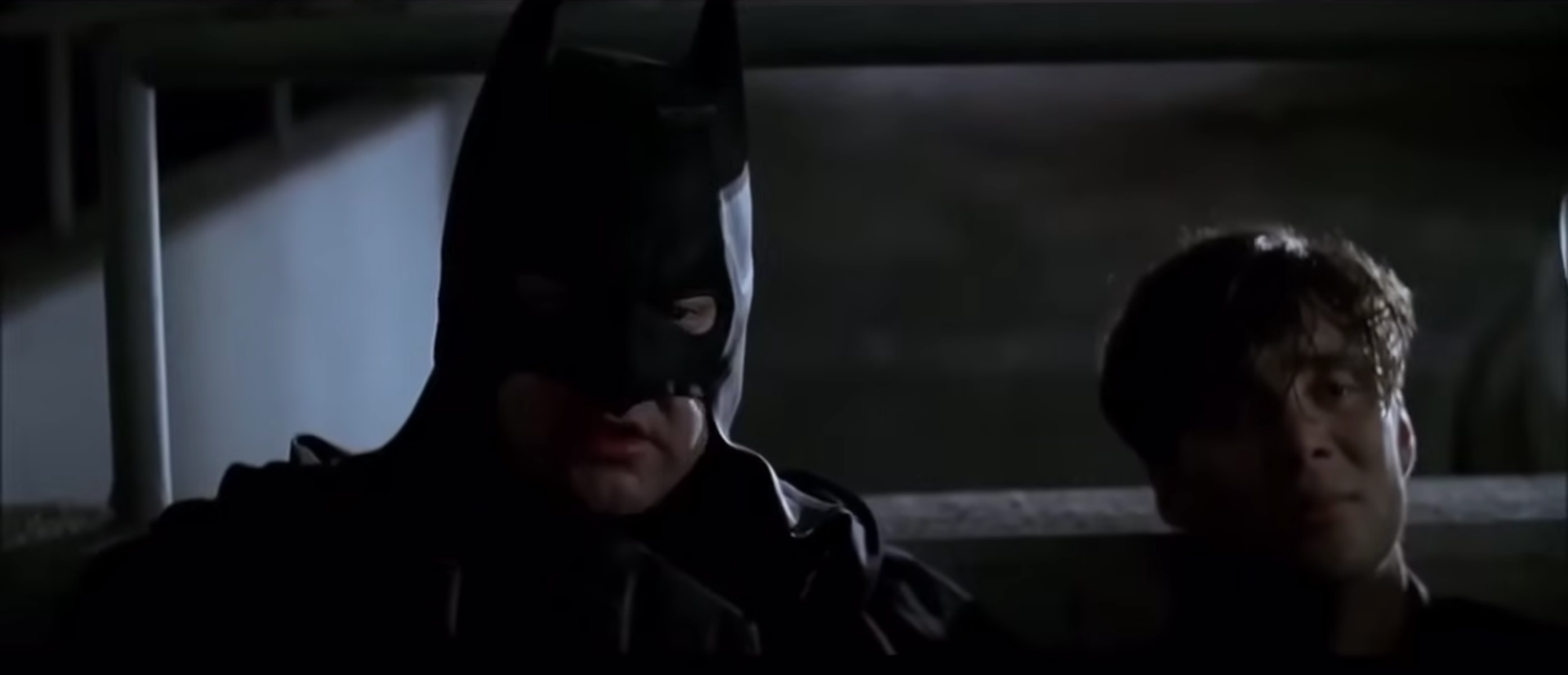
Here’s the funny thing about superhero movies, something that we haven’t really touched on yet. There are enough of them that you can identify them as a genre, and a meaningful one at that. But ask someone with a Sight and Sound ballot, say, if they can come up with superhero movies that they’d consider putting on their ballot. I’m sure if you asked that critic, programmer, what have you to come up with westerns or gangster movies or musicals, they could do it. Look no further than the 2022 list: Singin’ in the Rain tenth, The Godfather twelfth, The Searchers fifteenth. I don’t care what you think the best superhero movie is: that movie is nowhere on the Sight and Sound list. The Dark Knight got named on six critics’ ballots out of more than 1,600 total. The Searchers, which it was closest to on the list, got ninety-one. There’s no genre which you could call top-heavy, but we know what the top of these other three genres look like. To get real normie on you about westerns, it’s The Searchers and Rio Bravo and High Noon and The Wild Bunch and Johnny Guitar and McCabe & Mrs. Miller and Butch Cassidy and the Sundance Kid and The Man Who Shot Liberty Valance and The Treasure of the Sierra Madre and Unforgiven and The Ox-Bow Incident and The Gunfighter and Dead Man.
I don’t grant that The Dark Knight is the equal of any of those movies, which, I understand, is personal judgment. I also understand that the general consensus is that The Dark Knight is one of the best movies of the century thus far, and the best superhero movie ever made. Even if you grant those premises, even if you grant that it can go toe-to-toe with any one of the normie westerns I’ve listed above, who are the friends of The Dark Knight who are going to back it up? When The Dark Knight is looking eye-to-eye with The Searchers, am I supposed to believe that Black Panther will do the same with Rio Bravo, that The Avengers will do so with High Noon, that Into the Spider-Verse will do so with The Wild Bunch? What I am proposing here is not that the American superhero genre cannot produce a movie which belongs in the top 100 of the Sight and Sound list. It’s that the genre has only existed for so long, and so it’s not entirely fair for us to judge this newer genre against the three older ones. There’s simply more time for these other genres to have put out great movies, and it could be that we have not reached the point where superhero movies will fall into place behind, or even in front of, The Dark Knight. This is an admittedly sanguine view, and given the business angle of making superhero movies, the kinds of people who make them, etc., I can’t quite get there myself. All the same there has to be reason to hope. When Jerry Siegel and Joe Shuster created Superman, they sure as hell didn’t imagine the Mutant Massacre unfolding across multiple books. Famously, the Lumiere brothers didn’t think that cinema itself would take root. But here we are.
It’s a fool’s errand to go around trying to pinpoint “the first” movie of a genre, but as the resident fool here, I’m willing to try. If we say that the first western is The Great Train Robbery of 1903 – that the first gangster film is The Musketeers of Pig Alley in 1912 – that the first musical is The Broadway Melody of 1929 – then we might say that the first superhero movie is Superman, in 1978. (Is it the Batman movie based on the TV show, in 1966? Is it Superman and the Mole Men, which debuted to no fanfare in 1951? What matters for the first film argument, to me, is that the first film ought to be emblematic of the genre. Many of the things I love about Batman prove that it is not emblematic of the superhero genre.) It has been forty-six years since Superman, which means that it’s worthwhile to consider not just how far the superhero film came in forty-six years, but how far all of those genres came in forty-six years.
By 1949, the western had not yet reached its apogee, but it had come close. Tom Mix and Harry Carey were already dead, and so were the types of movies they had made. The surviving heavy hitters were established. John Ford had started doing that neat thing he did where he would redefine the western at least once a decade: see The Iron Horse, Stagecoach, and My Darling Clementine. John Wayne, the face of the American western, had already been its fiery Apollo (The Big Trail, Stagecoach) and its dour Jupiter (She Wore a Yellow Ribbon, Red River). The model existed for straitlaced westerns like those starring Errol Flynn, Virginia City or Dodge City. Yet the challenges to those movies were not far away, or even contemporaneous. Destry Rides Again, in 1939, makes hay out of the idea of a sheriff who doesn’t want to carry a gun, which wreaks havoc with the machismo of the genre and its violence at the same time. The Harvey Girls wonders if the western can be a musical – the answer is yes. Duel in the Sun wonders if the western can be Gone with the Wind – not quite yet. Blood on the Moon wonders if the western can be noir – the answer is oh hell yes. And I Shot Jesse James hints not only at a new generation of directors who will redirect the genre, but at the flood of westerns to come which will think that it’s not as simple as Cimarron or The Oklahoma Kid. It’s worth repeating: forty-six years of the western had not yet given us High Noon or The Searchers, The Wild Bunch or McCabe & Mrs. Miller, Heaven’s Gate or Meek’s Cutoff.
By 1958, the gangster movie had already weathered the Hays Code and had been engaged in the struggle of breaking the Code over its knee. Both the Code and the gangster movie had been somewhat distracted, as noir stories about PIs and two-bit crooks had filled in the space previously occupied by the gangster film. But when the gangsters started to reassert themselves in the 1950s, they did so explosively. In some cases, they did it in vibrant color, as in Fuller’s 1953 House of Bamboo. Perhaps the mob was calling from inside the house, as organized labor plays a sinister cabal in On the Waterfront, and all the while performed with Method actors. The Narrow Margin, from 1951, proved that there were still gangster plots left to be explored and awed by. And shoot, The Big Heat is just plain explosive, killing people and disfiguring them in ways previously unexplored by the major studios. There’s a perfection in the early ’30s gangster movies where you just know they’re too hot to handle without oven mitts and a nearby Bible. I don’t think gangster movies ever accomplished that again, but you don’t have to be Martin Scorsese (or someone who watched A Personal Journey…) to see the pivot points still to come: Bonnie and Clyde, the Godfather movies, and Scorsese’s often-imitated and never even close to equaled pictures.
Of the three original American genres, only musicals reached their apex within the first forty-six years. For musicals, that’s 1975, and to my mind, that apex is Nashville, which is a diegetic musical but a musical nonetheless. To most people, I think that’s Singin’ in the Rain, or maybe The Wizard of Oz, but either way they provide more room to spare than Nashville. I think it’s fair to say that the musical changed faster than the western or the gangster movie. From 1929 into the 1940s, they are overwhelmingly about people putting on a show and sticking most of the song-and-dance routines into the final third. That’s our holy Warners trinity of 1933: 42nd Street, Footlight Parade, Gold Diggers of 1933, as well as anything else that has “Broadway Melody” or “Big Broadcast” in front of it. You have more of those going into the 1950s (Summer Stock, The Band Wagon), but throughout the ’40s and ’50s you start to see more movies followed the plotty path that the MacDonald-Eddy partnership pioneered in the 1930s. There’s space for The Pirate and Easter Parade and On the Town, which are not exactly like one another. The 1950s are wonderful, too, capable of huge efforts as well as work so small that it can still be in black-and-white. On the titanic side, An American in Paris. On the humbler side, The Affairs of Dobie Gillis. In the 1960s, the musical is a prestige genre and then gets blamed for killing the old Hollywood. Within these forty-six years, you have just enough time for Cabaret and Nashville. In the same decade, we have The Muppet Movie and All That Jazz, and it’s goodbye my life goodbye for the genre after that.
So we have the three original genres with forty-six years of entries apiece. The western is clearly building towards its period of greatest fecundity. The gangster movie has been distracted and is beginning to collect itself, though its loudest fireworks are still a little ways off. And the musical, which pushed the cinematic possibilities of individual scenes further than any other genre ever has in this country, has crested. All of the power and beauty of a great wave has risen after a little less than a half-century, and while it is at its height it must necessarily begin to fall.
After forty-six years of superhero movies, can we say that the genre resembles any of these tracks? Is it a little less than a decade away from The Searchers? Is it still a decade and a half away from The Godfather? Did its equivalent of Singin’ in the Rain pass us by more than two decades ago?
The Multiverse Stumbling Block
The optimistic, and maybe the most reasonable view, is that we are still muddling our way towards a superhero Godfather. If that’s true, then we have to look for a distraction, a sidequest, an alternate direction. For the gangster film, as I’ve suggested before, that’s noir. The pale and disorienting underbelly of America, the crime stories that engaged audiences, were gangster movies in the 1930s. But organized crime, whether it’s because of Will Hays or J. Edgar Hoover or Adolf Hitler, stopped being at the forefront of moviegoers’ minds in the 1940s. In the majority of noirs, crime isn’t the metastasizing organism it threatens to become in gangster films. In noir, crime is much more often about the struggle of an individual conscience, and that story does not often play well with organized crime. It took many years for the genre to reassert itself, to see crime not as the result of situation but of breeding.
Take Andre de Toth’s Crime Wave, which on its face straddles the line between the noir and the gangster movie. Ted de Corsia and Charles Bronson play hardened criminals giving softened criminal Gene Nelson a hard time. There’s some implication that these guys are more than just tough customers; they’re real gangster types. But crime is not something bred in the bone in Crime Wave, no matter how difficult it is for the Nelson character to extricate himself from the machinations of criminals and cops alike. The dramatic thrust of the story is that Nelson wants to go straight, has been living his life well inside the bounds of the law. His past is chasing him, but the threat to him and his wife is situational. If the criminals had not busted out and annexed his home as a base, then he would be able to go on living a clean life. Crime Wave is a noir, not a gangster film. The Godfather is a gangster film. It is obviously about organized crime. And it is also, in its second half, about the way that crime squeezes itself into the marrow of the criminal. Michael Corleone’s damnation is not about circumstance. There’s a sickness in him that would bring him back to the family even if Vito hadn’t been shot. It’s about something deeper in him, something that was always there, something that chooses to rise up. Circumstance does not make you the kind of person who christens your child while your underlings execute a series of simultaneous hits against all of your rivals. The criminal does not do that, for no situation he is in could engender such a complex, terrible response. The gangster can, and the gangster will. For decades the gangster movie waited for the criminal to cede the spotlight.
If there’s a corollary here for the superhero movie, a shiny new possibility that has to be explored even if it pulls away from the core credos of the genre, it’s the multiverse. For the gangster film, the cross-pollination with noir is a happy accident. The two genres are richer for having encountered one another. For the superhero genre, the multiverse was an undiscovered country, and it’s fair to wonder if the genre is going to return from that bourn. If you take the plans for the Multiverse Saga at their word (and if I know anything, the businessmen who come up with this garbage and refer to it with shining eyes as “the Multiverse Saga” make Thanos look evitable), we’re not due to escape it until 2027. Darren Franich of EW describes this about as stylishly as I’ve ever seen anyone do it:
Pre-Infinity War, Thor’s hammer got emasculated to pieces and Black Panther suggested T’Challa was kinda clueless. Phase 4 demanded more reverence, and more more. Thus came the multiverse, and the multiverse sucks. Promising infinite possibilities, it delivered replication.
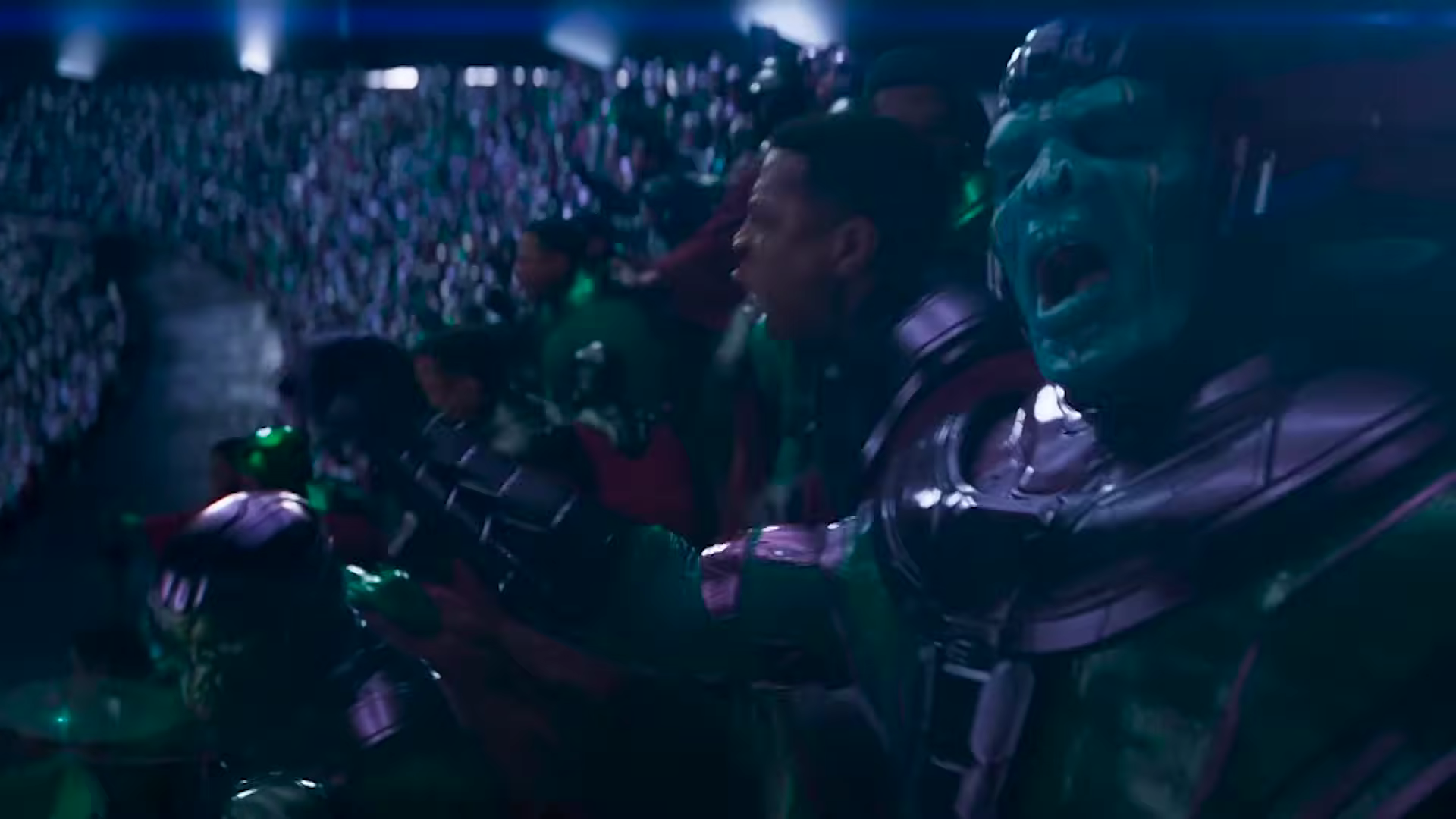
Replication is the right word. Replicating Loki and Kang all the way down is a narrative anvil. Whoever’s plan it was to plop the Quantumania post-credits scene of a gazillion Kangs laughing maniacally crapped the bed. That person, or group, mistook scale for stakes. What’s interesting isn’t that there might be more Kangs out there, that there’s going to have to be some convoluted plan to rid the multiverse of not just one Kang but many in order to bring a short-lived peace to our balkanized chronology. (The four Kangs of 20th Century Marvel Comics – Kang, Immortus, Rama-Tut, and Scarlet Centurion – are plenty!) What you are supposed to plan for is, at the very least, some glimmer of what made Thanos or Killmonger or Hela compelling. Acting that can chew even CGI scenery or, in surprising moments, give us something recognizably human in motion-capture. Just enough kidnapped truisms from social justice to make you wonder if the villain has a point. A catchphrase or a costume that ensnares us. Shoot, sometimes a fun sidekick will give you a little extra rizz, like Karl Urban’s Skurge does in Thor: Ragnarok. But the multiverse has made replication the watchword, made the cheerful allusions to Mobius strips as if any of us actually want to watch a Mobius strip for the 293 minutes it takes to hack through the first season of Loki.
The sins of the multiverse era were executed before the multiverse started. In Doctor Strange, the climax of the film depends on the Doctor, in possession of the Time Stone, brings Dormammu back to the same moment over and over again until Dormammu relents. The entirety of Avengers: Endgame depends on the surviving Avengers doing time travel in order to undo the events of Infinity War. Decisions were made in the 2010s which undercut one of the keystones of, gosh, I am so sorry I’m about to use this word, storytelling. Nothing that is done can be undone. In our American genres, this is the basis not just of movie-to-movie storytelling, but the basis of their greatness. You can’t unburn the Edwards homestead in The Searchers any more than you can undo the genocide of Native Americans. You can’t resurrect Tony Camonte in Scarface any more than you can undo the passage of the Volstead Act that gives a gangster the chance to make big money. Only the musical, with its blockbuster musical numbers that defy space and linearity, can act as if a past event never happened. Even still: Dorothy Brock’s ankle cannot unbreak, and that means Peggy Sawyer can go out a youngster and come back a star. The idea of a western, a gangster movie, a musical where you just go back in time and undo stuff is impossible.
That’s obvious. It was obvious for thousands of years of narrative that when you kill Hector or Achilles, he’s dead. When Eurydice dies, Orpheus can get awfully close to bringing her back, but has to fail; Persephone cannot simply be unabducted now that Demeter has seen what will happen to her daughter. The Norse gods and their enemies not only have Ragnarok in front of them, but we know that Fenrir will kill Odin, and that Thor and Jormungand will kill each other. There is wonderful magic in Camelot, but there’s no magic that can give Arthur a second chance so he might preempt Mordred’s coup. Only in superhero stories, across mediums, do we expect that a consequence will be temporary. Infinity War works on this principle. The timeline is restored so that we may have Spider-Tom and Nick Fury and Black Panther (and Thanos!) in our lives again. The multiverse may not be invoked, per se, but the tinkering with the timeline that moves Endgame is a cousin to it. Where there is a single, immutable timeline, which is the case for not literally everything else but basically everything else, it matters that Thanos snaps away half of all living organisms. That means Groot is as dead as Hector. Where the timeline is no longer sacrosanct, where the timeline is no longer unique, then Groot is never as dead as Hector. There’s always another Groot. (Shoot, Hector’s not even as dead as Hector.) The question of what happens in any of these movies is academic, not personal. Ant-Man and the ants defeated Kang here, but in that other timeline? Who knows. Who cares.
Maybe we ought to credit the superhero movie for amplifying the influences of La jetee and Back to the Future, of taking the sheer weight of possibility as far as any movie genre ever has. Maybe this is something that the superhero genre was more likely than not to engage with because the source material is famously convoluted, and only growing more so by the issue. Or maybe the superhero genre has stepped onto a temporal rake; no matter how many Spider-Men you can summon, none of them can put the multiverse business model back into the box now that it’s been opened.
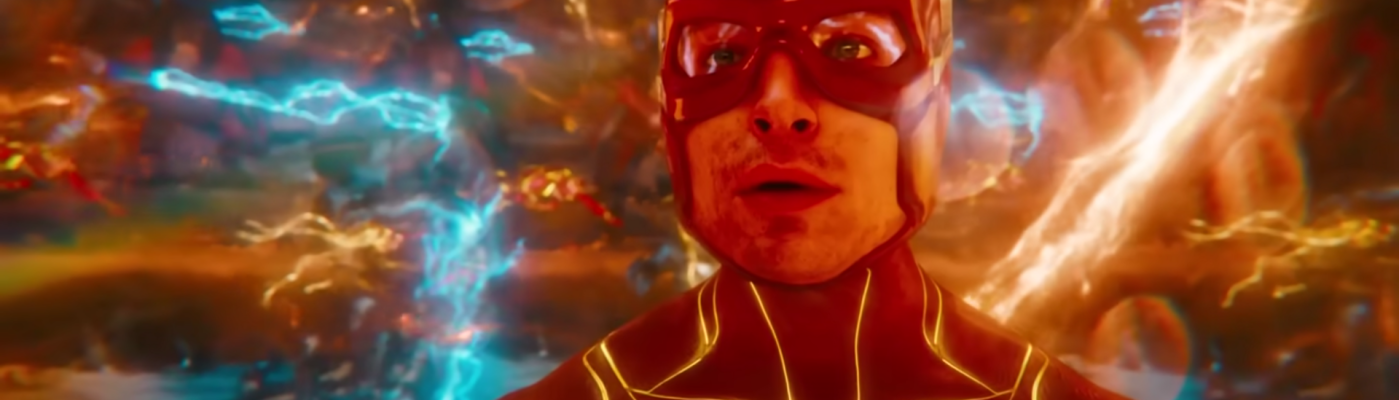
This is the premise of The Flash. It’s also the premise of Justice League: The Flashpoint Paradox, the animated film which precedes it by ten years and which works from the same foundations. Barry Allen wants to save his mother’s life. She was murdered when he was a child. He wants to prevent her murder. In saving his mother’s life, Barry sets off a chain of events which have catastrophic consequences. In The Flash, Barry meets up with a slightly younger version of himself, one who has grown up with both parents, and the two of them have zany adventures together culminating with a return to the battle against Zod previously represented in Man of Steel. In The Flashpoint Paradox, Barry comes into a world where the Amazons and Atlanteans are waging a war on the surface with no regard for the lives of normal humans. In either case, humanity is on the brink of total destruction, and the only way to avoid this future is to go back to square one: Nora Allen must die her horrible death.
In The Flash, this is handled in a somber scene where Barry makes conversation with his mother and removes the all-important can of tomatoes from her shopping cart. In The Flashpoint Paradox, Barry has to restrain another version of himself, and we see the house where, inside, the person he longs for most is dying. In these Flash properties, the multiverse is something that has to be reined in for the sake of a better timeline. Barry tells Barry in The Flash that there are some things which simply have to happen (in the case of the timeline they’re currently cavorting in, that means the deaths of Supergirl and Michael Keaton’s Batman), and that no matter how they try to redo recent events, they’ll come out the same way. There’s a cynicism in the DCEU version of the multiverse, amplified by the masochistic production history of The Flash and whatever was going on with Ezra Miller. I have no idea how long the DC folks were sitting on Michael Keaton’s return as Batman, and maybe they came up with the idea for that at the same time the MCU was scheming up Tobey Maguire and Andrew Garfield. Real shades of Newton and Leibniz coming up with calculus independently. But any play for nostalgia, and certainly one as pointed as returning Keaton, is cynical. There’s a cynicism in the replication itself, the way that the movie seems exhausted once it gives over time for the knowing Barry to explain to the naive Barry that his efforts are fruitless. Bringing in images of Christopher Reeve and Nicolas Cage as Superman, in a movie that’s not even about Superman, is as disconcerting and tasteless as proxy baptism. The Flash comes at the multiverse sweaty and bored. The Flashpoint Paradox is much more interested in the possibility of what might happen in a world where Nora Allen lives, certain that the future in question will be drenched in blood.
Even when it’s abundantly popular, as we’ve seen in Spider-Man: No Way Home and Spider-Man: Across the Spider-Verse, the multiverse is still about scale rather than stakes. I’ve written about the former. I’m still a little angry about how bad that movie is, but I’m a little hopeless thinking about the fan (and critical!) reaction to it, this relentless insistence that it was such a good time, this acceptance that little piggies in cinemas, some of them with sinecures at major periodicals, will gobble up any slop you put in the trough. Shots of three Spider-Men who have all been Spider-Men on screens make the multiverse a dismal place indeed. By putting them all together, people think that they’re getting a brand new dish, something they’ve never had before, something which opens up their palates in exciting directions. What they’re actually getting is a burger with three different types of lettuce on it, and the experience is new insofar as no one has ever put three types of lettuce on a burger before. The takeaway shot from Across the Spider-Verse for me is one where Miles Morales is running up and away from a horde of other Spider-Men, most of whom are fundamentally identical to one another except for the occasional high-concept one. There are so many Spider-Men, and there they all go en masse. Presumably every single one of them has their own story, their own lore. The mind reels at the vastness of possibility. But…isn’t that true every time a horde is unleashed on a hero? Aren’t the Chitauri who get gunned, arrowed, punched, hammered, etc. by the Avengers in The Avengers each individuals who, presumably, have their own backstory? They actually show the making of the parademons who invade earth on Darkseid’s command in Justice League: War, and that’s a heck of a lot more arresting than a bunch of Spider-Men all converging on one of their own. We’re back to Franich’s point: the multiverse is replication. The only way to show the scale of it is to make a bunch of of them, and the only way to differentiate them from Chitauri warriors or parademons is to sneak in Easter eggs so that the art of cinema is reduced to paltry Where’s Waldo point ‘n chuckles. This is what Phil Lord made people sacrifice for, so there’d be a werewolf Spider-Man who can prove that the multiverse is dense?
It’s received wisdom now that by creating such a titanic ending in Avengers: Endgame, Marvel accidentally tripped itself up for future endeavors. This was such a final statement about so many characters built up over so much time that it was hard for audiences to go back to the beginning again. I generally agree with this line of logic, though I’d also like to emphasize the massive shakeup of covid. If we’re not already looking at covid’s effect on the MCU like we look at the 2007-08 WGA strike on sitcoms (for the purpose of not getting canceled, just going to put it out there covid is more horrifying and the WGA strike was justified), then we’re doing it wrong. But the bloat of the MCU in these most recent phases was foretold, and done joyously, in Phase Three. The people making the strategy for these movies was to make them more like serialized television. You really needed to see the previous episodes before you saw the latest episode. Longtime viewers had the feeling of having come in on the ground floor, like they discovered the series themselves; for newer viewers, the binge model was a much-taken option. Endgame was a series finale, not a blockbuster film. It was a natural step for the MCU to take to rely more heavily on television. The people making the MCU had already done it. Whether or not the superhero genre can recover from the pollution of a separate medium is still to be determined. At its best, the television medium looks like Mad Men: thirteen episodes a season, forty-eight minutes each. At its best, the television medium looks like Seinfeld: twenty-three episodes a season, twenty-three minutes each. Structure elicits greatness. Television, when it is pitilessly structured, has the potential for greatness. Film is a more adaptable medium and achieves greatness more frequently, but it also has structural requirements. Movies end. They are meant to end. Put them together and the shortcomings of both are implosive. The structure which governs television fell away, while the requirements of serialization remained. The structure which allows films to end imploded, while each one was forced to prop up another. Now that television and film are content, interchangeable with one another, what we have remaining is bloat, homework, chores, “this will lead to such a cool place in the end, don’t worry.” Television cannot become like film. Film should not degrade itself to become like television. The fourth genre is currently weighed down by Multiverse and television, but that’s because Infinity, supposedly, worked out so well.
Tomorrowverse > Multiverse
Here’s what’s bedeviling. The multiverse doesn’t have to be a road to nowhere, a Mobius striptease without climax. Marvel movies view the multiverse the same way many of us view an IKEA. There’s so, so much stuff, and you can step off the path to look at any of it, but there’s only one right way through the store. You are meant to return to that path no matter how many Poangs you want to sit in, and if you’re ever going to get out of the IKEA, you have to follow the path all the way down to the registers. (Where this metaphor falls apart? There is no Phase Four or Phase Five Marvel entry more satisfying, cost-effective, or nutritious than lunch at IKEA.) Marvel insists on the multiverse’s canonicity, its stifling and ironic insistence on continuity. When you don’t insist that every little thing must add up to some BIG thing which will be the most ambitious crossover event since Infinity War, then there’s a chance for the multiverse to have some stakes.
This is where DC animated movies step in. They function as the superhero genre’s ecosystem engineer, developing the tenets and familiarities of the genre. (Confusingly, you can’t just have all DC animated movies mean the same thing. There’s the DC Animated Movie Universe, or DCAMU, and that only includes certain movies from 2013 on. There are other animated DC movies, which I will do my best to refer to as “animated DC movies” and not “DCAMU movies.” Sometimes I think I should have juiced my GPA and done the business major instead.) They are the films which we should look to in order to understand how the superhero genre works. Before we reach out for any MCU entry, or any DCEU entry, we ought to look to animated DC movies and the DCAMU, for they are the only ones making standalone films. There is some continuity from here to there, but when that continuity happens, it happens in part-one-part-two sequels, or in recognizable trilogies. To pull three successive entries from the DCAMU as an example: it is not necessary to watch Justice League: Dark in order to understand Teen Titans: The Judas Contract, and it is not necessary to watch The Judas Contract in order to understand Suicide Squad: Hell to Pay. Batman does many things across these movies, and no individual action he takes in one movie should be understood to be essential to what he does in future movies. These movies are connected to each other because they’re animated and they’re made by DC, not because they make up a canonical base that we treat like the New Testament.
In 2010, Justice League: Crisis on Two Earths was released. Co-directed by Sam Liu and Lauren Montgomery, Crisis on Two Earths loosely adapts a Grant Morrison storyline from the turn of the century in which a heroic Lex Luthor from a different Earth makes his way to the Earth where the normal Justice League keeps the peace. On Luthor’s Earth, the counterparts of the Justice League members (Ultraman, Owlman, Superwoman, etc.) have formed the Crime Syndicate, with Ultraman, sounding suspiciously Italian-American, at its helm. This is a fascinating movie even without the trivia of Jersey Shore Superman and James Woods voicing Owlman. For one thing, the Justice League agrees quickly, and almost unanimously, that their territory extends to other earths. Only Batman voices a dissenting opinion here, and even that’s based more on the idea that the Earth that ought to have priority is theirs. For another, the Justice League are not greeted as liberators, and are instructed to stand down by the sitting president of the United States. At this point, they ignore the president because, in their eyes, he is in the wrong. The hubris of this group is stunning, and Crisis on Two Earths is not quite brainy enough to punish them for it, or even recognize that the people of this unfortunate Earth are caught between tremendously powerful splinter cells differentiated only by their moral fiber.
What Crisis on Two Earths does understand, far better than any other superhero multiverse movie, is that you can’t look the multiverse straight on any more than you can look at the sun straight on. Ultraman thinks that Owlman has put together an enormous bomb because it will act as a deterrent against American nukes that are currently keeping the Crime Syndicate from an out-and-out coup. Owlman has put the bomb together because he wants to find the prime Earth and use the bomb to eradicate everything in existence. It’s the only action he can think of that has any meaning. As Owlman tells Batman late in the movie, Every time you choose one action out of two, you’ve created a new world. Everything I do is at least neutralized by the me who does the opposite. Nothing I do matters. The only thing that can matter is the destruction of everything that ever was or ever will be. Batman, as he has a way of doing, gets control of the bomb and transports the bomb, with Owlman, to an uninhabited Earth. Owlman looks around, sighs, says that it doesn’t matter, and that Earth promptly explodes. This is the multiverse! Nothing matters! It’s not possible for anything to matter! No one has any choices! Batman feels differently, and hey, when you look at from the perspective of a personal responsibility to protect uncountable lives, it makes sense. Crisis on Two Earths gets at the heart of the multiverse, and although Owlman doesn’t get his way, it really feels like he explodes the concept itself.
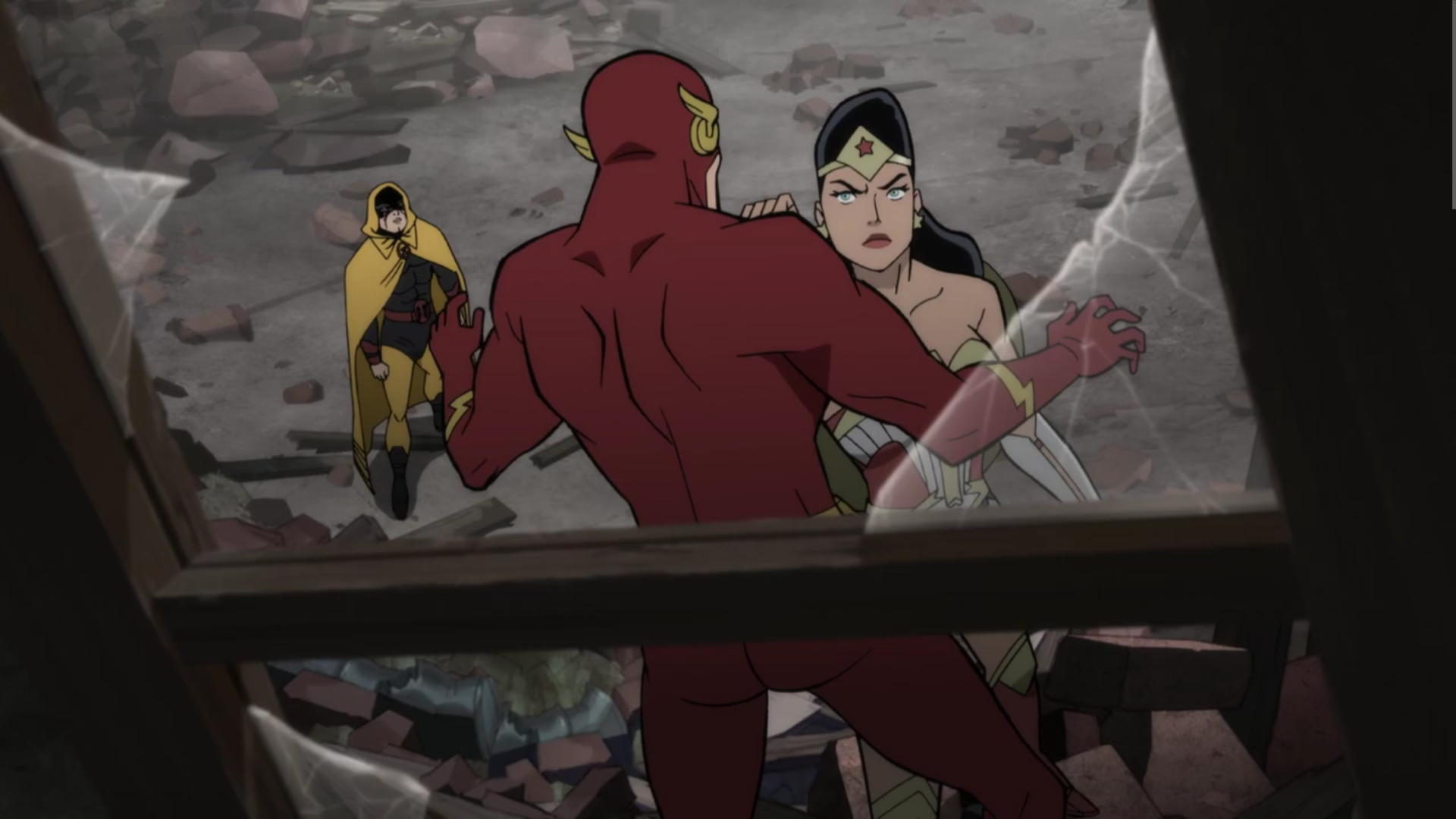
Because everyone has shareholders and every dog slavers at the sound of a bell, the DCAMU has phases like the MCU does. One of those phases is called the Tomorrowverse – ten movies over four years that generally explore alternate possibilities, histories, etc. The Tomorrowverse is capped off with a Crisis on Infinite Earths trilogy, though it also gives us a Superman origin story, a Legion of Super-Heroes film, and a Warworld collab. It also includes Justice Society: World War II, a 2021 movie directed by Jeff Wamester. Wamester directed seven of these movies, including the three films which take on the Crisis on Infinite Earths storyline. This is the first of the Tomorrowverse movies that he made. Flash II, as he seems prone to do, accidentally travels through time and space while trying to save Superman from a kryptonite bullet. What he believes to be the World War II of his own planet turns out to be the World War II of a different earth, one where Charles Halstead is working for the Nazis and has mind controlled Aquaman into saying things like “Heil Hitler!” (I laughed really loud at that. I realize Aquaman has this little brother thing that we’re all trying to undo, and turning Atlantis into a Nazi puppet state does not help.) Various oceanic critters come out of the sea and attack a coastal city as Black Canary, Hawkman, Hourman (justice for original JSA members), Flash I, and Flash II defend it. At the end of the film, Barry Allen is returned to his original time and space. He has helped stave off defeat at the hand of the Atlanteans and the Nazis in the timeline he just visited, and he can now return, inspired, to ask Superman if he wants to team up for some kind of justice league. Justice Society is in the multiverse just as much as Across the Spider-Verse. It posits the existence of separate timelines, separate earths, with similar events and characters across them. But in the DCAMU, just because it happens on one earth doesn’t mean that we’re bound to it going forward. The DCAMU does not visit the JSA-Earth again.
When I logged that movie on Letterboxd, I gave it two stars. Things happen seemingly at random in this movie, with very little holding the first half together. I don’t know that we gain anything by watching Superman and Flash fight Brainiac. There’s a weird interlude with Charles Halstead and Dr. Fate that doesn’t add anything to the picture. The second half definitely holds together, though that’s by way of a crustacean blitzkrieg. It’s not a good movie. Just because it accesses the multiverse in a standalone way did not raise the quality of the film. And to be perfectly honest: the Tomorrowverse movies as a whole are a mediocre lot. It takes more than a slightly different concept to be good; look no further than the drivel of Taika Waititi.
Justice Society, and the rest of the Tomorrowverse, no matter how middling, can still prove an important point. There is space in the multiverse to explore. There’s room to engage with a plot that has nothing to do with anything else the studio is making, to have it begin and end, and to make choices that further the film itself without having to worry about bumping elbows with some other film down the line. I wanted a better movie. I adore the Justice Society characters and their Golden Age origins. I’m such a sucker for World War II stories that I’m afraid that I have illegitimate progeny I don’t know about. Yet there’s a success here, even if that’s more of a moral victory than an artistic one. Such a standalone film can be made.
The questions we started the multiverse conversation with are “Is the multiverse the next step towards a superhero The Searchers?” or “Is the multiverse keeping us from a superhero The Godfather?” I think it’s plain that the answer to the first is “Hahaha.” The answer to the second? “It sure isn’t bringing on the superhero Godfather any faster.” If I were more pessimistically inclined, I might even say that the multiverse has damaged the superhero movie so severely that we’re past the point where the genre might even be able to recover. This is the musical route: there’s nowhere left to go, and The Dark Knight (but really The Incredibles) is as good as the genre will ever get.
In future posts, we’ll imagine both possibilities. First, the musical route. If the superhero genre is in decline, even dying out as we know it, what have been its high points, and what can we learn about the genre from them? Who are the auteurs of the genre? Second, the gangster film route. If there is a superhero Godfather in the wings, where will it diverge from the founding texts of the form?
 Seeing Things Secondhand
[…] This is the second part of a three-part series. The first part, where I talk about the superhero genre’s place among other quintessentially American film genres, is here. […]
[…] part of this series, where I talk about the historical context for superhero movies as a genre, is here. The second part, where I talk the superhero movies I think are the best, as well as the superhero […]