Dir. Fred Zinnemann. Starring Shirley Jones, Gordan MacRae, Charlotte Greenwood
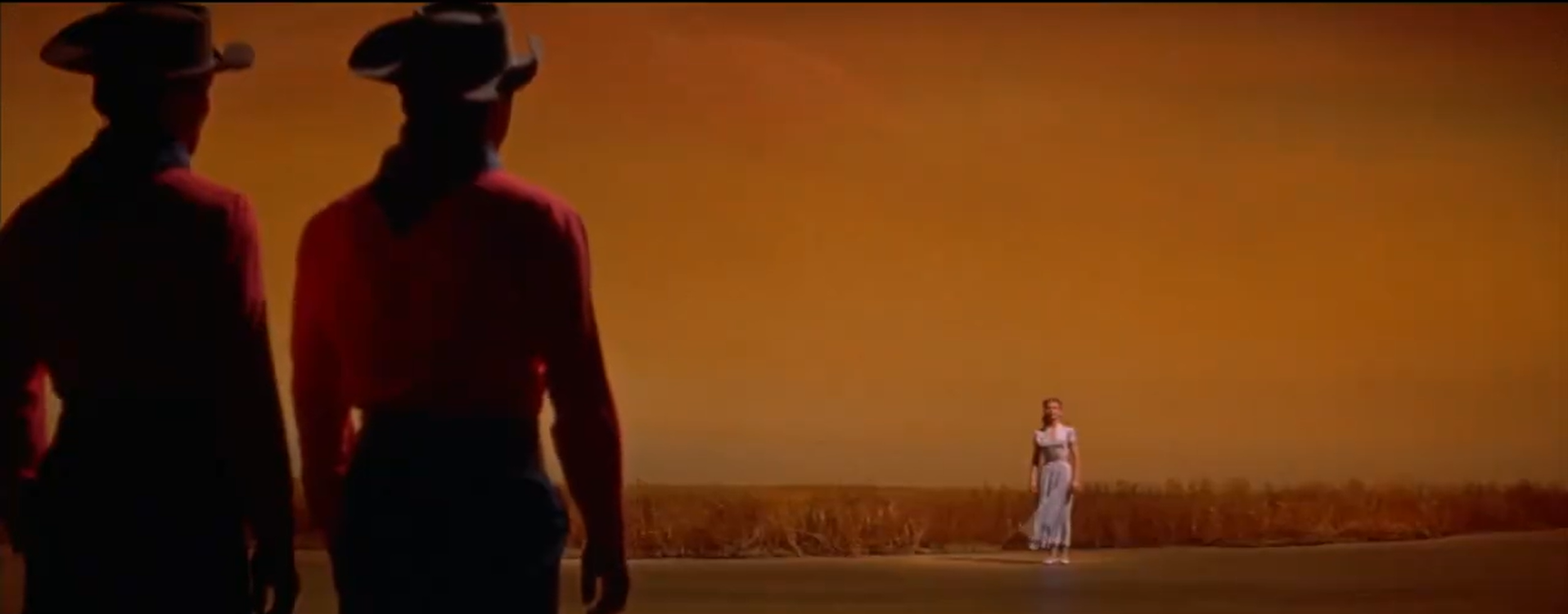
The year is 1955, the year of Kismet and Rebel without a Cause. The black-and-white musical is dead. The model of 42nd Street is crumbling around the feet of The Band Wagon. The three M’s (that’s “Method,” “Meisner,” and “Miller”) are coming to symbolize the best in film performance. Look no further than the Best Supporting Actor race for 1954, where Meisner student Edmond O’Brien triumphed over three actors from On the Waterfront: the originator of Willy Loman, Lee J. Cobb – Elia Kazan’s everyman, Karl Malden – impeccable Method actor Rod Steiger. Oklahoma! is Kismet, with its humor, its sumptuous cinematography, its loud numbers shot from a distance. Oklahoma! is Rebel without a Cause, in which a new generation is birthed with extraordinary pains. Oklahoma! is, unfortunately, not really Oklahoma! at all. Even if the text is only bowdlerized in a few places, Oklahoma! ’55 oppresses the spirit of the thing. This most vital of American plays, one which should translate easily to cinema, is paltry in the hands of Fred Zinnemann and this troupe provided by RKO.
Oklahoma! is sex. The dream ballet in Oklahoma! is about a woman’s awakening to sexual maturity, as forceful and stunning as Brian De Palma’s depiction of Carrie’s first period. (Bringing in James Mitchell and Bambi Linn to perform instead of Gordon MacRae and Shirley Jones makes sense in a practical sense, since someone has to dance, but no amount of touching hands before switching places can make up for the terrible falseness in this fragile sequence.) Laurey (Jones) dreams of two forms of foreplay just as she’s been given to understand there are two ways of being courted. The first form is polite, form-fitting, a dance where both partners follow their roles, where Laurey is literally lifted up. The second form is vulgar, corporate. Others come into the picture, women who are paid to put on suggestive clothes and dance robotic dances, women who are accessible to men like Jud (hey, there’s Rod Steiger, how’d you get in here, buddy?) because they have prices. Laurey will have sex. Oklahoma! is the story of how Laurey chooses her sexual adventure. What remains to her, more or less, is the path she takes towards that particular pleasure. Will it be with one man, or will it be with one man and the women he hopes she’ll take after?
The comic relief in the film is about women having sex. Ali Hakim (Eddie Albert), who gets most of the funny business, doesn’t get “It’s a Scandal, It’s a Outrage” to work from, but we very much keep “I Cain’t Say No.” Laurey and Ado Annie (Gloria Grahame) are set against each other, a prim teenager playing mind games with her beloved juxtaposed with a friend who knows how good it feels to “lose” wrestling matches. By the end, Laurey is married, and Annie, who has been engaged to some guy or another for most of the film, is well on her way. Oklahoma! leads both of them to safe sex, a happy ending. We can believe that Laurey will always choose Curly, as she’s chosen him before he ever rides his horse through the high corn. It’s harder to believe that Annie is a one-man woman in a world where women are very much limited to just the one guy. Annie is a fish out of water; she’s the only character in Oklahoma! you could make a sitcom spinoff from.
Oklahoma! is class warfare. Curly (MacRae) sells off his possessions one by one in order to win Laurey’s lunch basket from Jud. The film chooses to make the interpretation of Aunt Eller (Greenwood) its primary interpretation: she beseeches Curly to keep bidding on the basket because it symbolizes Laurey. But this is a marvelous fight when text triumphs over subtext. This is a battle between the upwardly mobile Curly and the untouchable Jud. There’s a song preceding this about the labor of farmers and cowmen, the first profession Curly’s future and the second his present. There is no song about hired hands, nothing which glorifies their sacrifices, nothing which condescends to poke fun at their foibles. Even the one that comes closest to it, “Lonely Room,” has been excised from the film for time. Jud has limited capital, no possession he can divest himself of that would be worth anything to the assorted crowd. Even if he had, how could they support the hired hand against Curly, who is one of their own? It’s risible to think he can go beyond the money he has squirreled away. Curly can sell his saddle, his horse, his gun, and still be seen riding a horse with a saddle later on in the movie, as if there were no real consequences in giving up his three most important possessions. Even self-induced penury cannot knock Curly out of his social class.
One of the curious choices that Oklahoma! makes is the showdown between Curly and Jud. Jud, taking inspiration from a jilted farmhand, decides to take advantage of the newlyweds’ presence atop a haystack via shivaree; he torches it. Curly falls on top of Jud, who has his knife out, and Jud falls on the knife. This happens instead of Jud falling on the knife because of his own drunkenness, as in the original stage play, or, as we’ve seen in later revivals, an actual fight where “fell on his own knife” is more of a useful justification to ensure Curly isn’t jailed for ridding the community of an undesirable. The camera, which isn’t shy about making us a part of the action, flitting shadowy extras in front of it so that we are more nearly involved with the events, gives us a true point of view shot. We see Jud below with flames licking the foreground, his small knife waiting. We’ve been meant to identify with Curly the whole way through already, but now that identification is a forced one, and Jud is in opposition. The viewer, regardless of his or her own class or affiliation, now stands unified with a prairie bourgeois. It’s pushy, further burying the folk devil: the help who wants to claim the middle-class girl for himself.
The 1955 film is the simplest possible Oklahoma!, the one that can be adapted into umpteenth community plays and high school musicals, something to provide variety against Our Town (sorry) and Seussical (not sorry). In this outing, Oklahoma! is a repository of pretty songs with mostly static performances, MacRae and Jones melodious but boring on their soundstages. Curly’s challenge to Jud is a high school quarterback telling off some bleacher creep against ogling the cheerleaders, not a bully who comes into another man’s bedroom and tells him to kill himself. The accents are quaint for the sake of it. Jud’s pornographic habits aren’t a signifier of his second-class citizenship, but they do stand in as proof of his degeneracy. Oklahoma! is so bold when it is given the chance, a rich cream dripping over with intellectual and physical power. Time and again, this film waters the text down, thinning the substance of it to something below skim milk.
There is one body in this film where you can see an alternate Oklahoma!, and he walks around in a dirty undershirt most of the time. It’s Rod Steiger, alone among a crew of showtunes regulars, people who will go on to make other Rodgers and Hammerstein adaptations or back up Doris Day. There is a little slice of the Method hanging about this crew, and Steiger gives us the chance to imagine what this movie would look like if it were more like Rebel without a Cause. It’s tantalizing. Steiger’s hostility is some of the best you’ll find in actors, and the resentful cold shoulders he offers in Oklahoma! would be used to greater effect later in the decade in purer westerns like Jubal and Run of the Arrow. Even Steiger can’t adequately humanize Jud in this film. (Zinnemann offers Jud all the sympathy he offers Fatso Judson in From Here to Eternity, although Rod Steiger isn’t offered the chance to murder Frank Sinatra and thus he retains a little more of our good will.) Robbed of his ilk, he simply sticks out like a sore thumb. But Steiger, surrounded with other people you’d have to dub and whose dancing you’d need to curtail, might find some of the raw stuff in the text. Opposite Paul Newman or an aging Monty Clift, maybe “Pore Jud Is Daid” resonates with genuine malice and hopelessness. Perhaps Julie Harris could have stepped in as Laurie, less doll-like but more naturally anxious. The seed of a more difficult Oklahoma! is here with Steiger’s presence, but it is a seed which falls on rocky ground.
It’s harder to see the Method Oklahoma! than the potential for a Kismet-styled Oklahoma!, a film which takes the spectacle of music and dancing and reflects it back in production and costume design. Jud’s smokehouse could be danker and darker just as the box social setting could be prettier. It wouldn’t make a ton of sense, but neither does Kismet. Yet I think I would rather have an ill-fitting lux version of the play, one where singers belt and dancers tumble, than this lame compromise where CinemaScope frames light drama and our response to the film is a happy sigh.
 Seeing Things Secondhand