
After the American Film Institute did their initial Top 100 in 1998 (countered twice on this blog, and I’m only linking to one because only one of those projects is non-embarrassing) and their Top 50 movie stars (countered on this blog), they started to move towards genre lists. In 2000, 2001, and 2002 they listed their top 100 “Laughs,” “Thrills,” and “Passions,” respectively. I hate laughter and excitement, so I decided I’d take a whack at the list of Passions. (This project actually started when I was thinking about writing about the greatest romance films, period, going back to the silents, all nations may apply, any kind of romance. I’m a little bit ashamed of how many hours I spent working on that before I had a thought like, “This is certifiable and you need to govern yourself.”)
AFI’s list is here. As far as I can tell, they did the usual four hundred nominations which were ultimately whittled down to this list, and as far as I can tell they cut off their nominees with the year 2000. The right way to view lists like these, once you’ve accounted for who’s making it and what they’re after, is really not about deciding whether #86 is better than #87, but in fractions. (This is also a great way to prevent oneself from seeking out the home address of whoever put The American President in front of, consecutively, The Quiet Man, The Awful Truth, and Coming Home.) What’s in their top and bottom halves? What are the top and bottom ten percent? That’s a much more useful way of approaching this list, which even for the AFI seems calibrated more to sell home video than it is to tell the story of the heights of American film.
I usually save the badly made charts from Google Sheets for the end, but I here I think this is a more useful place to begin.
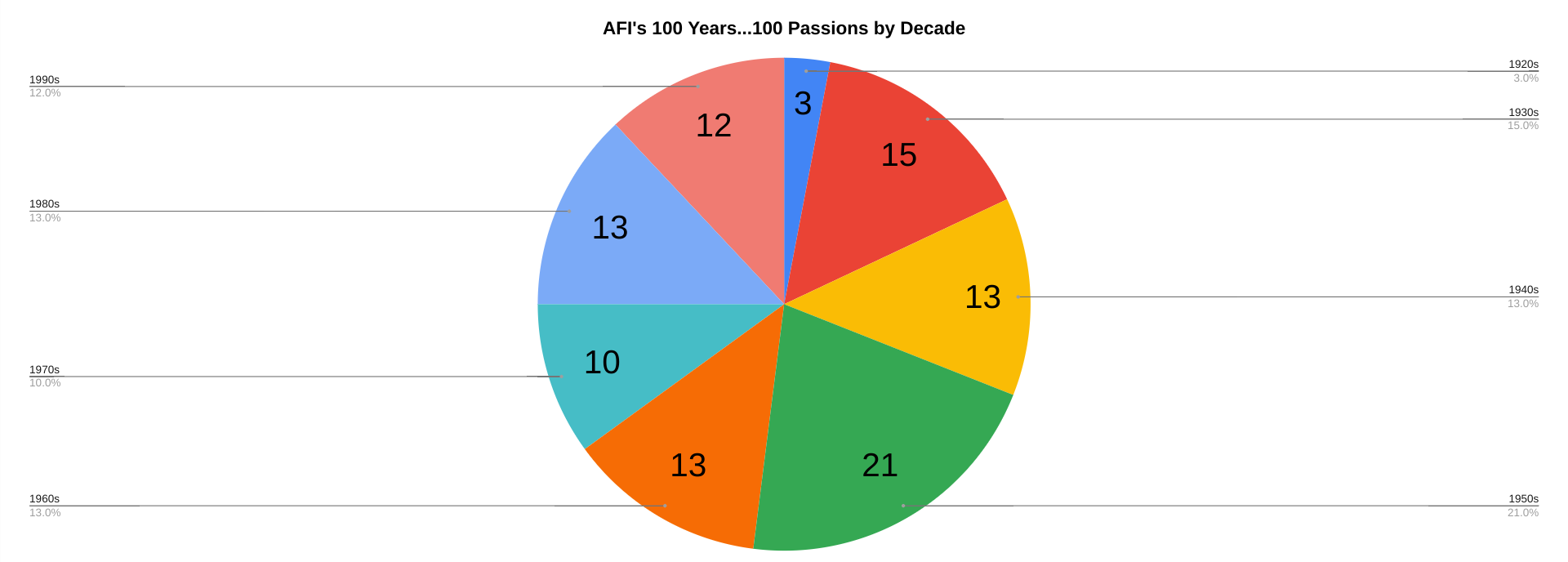
The 1930s, with five honored films from 1939, and the 1950s, with every year from the decade represented except 1950, make up more than a third of this list. And the majority of those films certainly make a lot of sense. The lowest two from the 1950s are Pillow Talk (#99) and Lady and the Tramp (#95). The lowest two from the 1930s are The Hunchback of Notre Dame (#98) and Morocco (#83). These are unironically worthy choices. Where I tend to disagree with the AFI list is mostly about the taste that Boomers have in their romances. I cannot get on board with The Way We Were sixth, Love Story ninth, Out of Africa thirteenth, Ghost nineteenth, On Golden Pond twenty-second. This is a list worth consideration less because it’s so good at identifying romance and more because you can learn about what the AFI is trying to highlight. And yet for all of its mishaps (and its insistence on including British movies like Two for the Road, Doctor Zhivago, and The African Queen), there are some real prizes listed here. Roxanne is unexpected at #72, but it’s an inspired choice. Likewise Witness at #82, Reds at #55, and the inclusion of a couple Hitchcocks that ought to be recognized as romances even before they are mysteries or thrillers: Vertigo and Notorious.
Yet curmudgeon that I am, that didn’t stop me from being especially petty as I put this list together. Despite those pleasant surprises, I felt, like Jonathan Rosenbaum did with the ’98 list, that I could argue for one hundred completely separate films from the ones AFI chose and make something at least as compelling. Sure, they stole a bunch of good ones from me, but they also left a marvelous trove of passionate pictures. Like Rosenbaum, who is an adult, I am presenting my alternative films without rankings. Unlike Rosenbaum, who is an adult, I’ll ultimately post a ranking so people will get mad at me on the Internet and hopefully drive traffic my way.
Here are my self-imposed rules for this project.
- No movie I cite on this list originally appeared one the 2002 “100 Years…100 Passions” list.
- In the interest of fairness, I’ve held myself to films with a 2001 release date or earlier. There will be a culminating post with the great romance films from 2002 on, but because I’m trying to make a point (petty), we’re sticking with basically the same dates the AFI used.
- In the spirit of AFI’s list, which felt that inclusion on their list needed to demonstrate “actions and/or intentions [that] provide the heart of the film’s narrative,” I’ve tried to choose romances that are integral to the film. If I could amputate the romance from the picture and find that the plot nor the characters are seriously affected, I’ve left it off my list. To choose an example near to my heart, Janis Ian and Kevin Gnapoor from Mean Girls are a very entertaining pair, but the movie would change not a whit if their relationship had been left out of the final cut.
- Likewise in the spirit of the AFI list, I haven’t gone out of my way to choose passions which are overwhelmingly stuffed with bad vibes. Bad vibes are part of any compelling romance, which AFI understood when they put a romance based on adultery and abandonment first, a romance with marital rape second, and a romance that ends in the murder of one the lovers third. Yet the goal here is primarily about uplift and pleasure. It’s about being able to enjoy the passion, romance, adulation, infatuation, sex, whatever of the characters involved in that romance. For example, I’m fascinated by the Mia Farrow-John Cassavetes pair in Rosemary’s Baby, but it goes a little overboard for mainstream audiences when the latter invites the Devil to rape his wife so his career will get off the ground. It’s about good or bad romance, not good or bad relationships.
- We’re not doing ironic clickbait stuff. It has to be between two sentient individuals. “Clint Eastwood and his gun in Dirty Harry” do not count as a romantic relationship. The two sentient individuals rule also carries over to love polygons. I absolutely considered romances with as many as five people swapping among themselves, but as the AFI did, I’ve asked myself if there are two people at the center of that passion we can focus on. If you want to call me narrow-minded about this, I’ll take it. However, before you do that, please start with the sexual myopia of American society and vent your spleen in that general direction first.
- I’m also staying away from films which might include some kind of erotic or sexual or romantic subtext but which the film itself is not working towards. Is there homosexual subtext between Bill and Ted? Sure, why not. Or, better still, is there homosexual subtext in Top Gun? (Haha, is there, haha, anyway.) Would I include those characters and films here? No, because the films are not presenting those characters with undeniable erotic connections to one another. We have ample evidence to consider the sexual undertones between characters like those, but that’s not what AFI is after, and thus neither is my rebuttal.
- My focus in making my list was less about putting together the best movies I could and more about putting together passions that interested me. In the way that you tend to get the best fantasy football players from actually good football teams, I think I’ve collected a pretty good set of films here. But there are movies here which are not, quote-unquote, “good,” and that’s more than fine.
Indulge me, and allow that every love story is allowed one free cliché. There’s only so many ways to fall in love, to fall out love, to meet someone, to lose someone. We’ll be talking about five movies at a time, each of which represents one of those clichés wonderfully. Links follow below.
 Seeing Things Secondhand