July 1st
- Pompeii (2014, dir. Paul W.S. Anderson)
- Soylent Green (1973, dir. Richard Fleischer)
The place I want to start with Pompeii is its budget, because it’s a blockbuster/spectacle movie and, cynically, I have a hard time starting anywhere else with those. The numbers vary, but let’s call it $90 million in 2014 dollars. My guess is that you are watching pretty close to $90 million on screen, and if it’s a thin ninety mil, then it may not even be the movie’s fault as much as society’s. In 2014, the last gasp of the 3D movie fad was rattling around your cineplex, and Pompeii was shot to be interesting in 3D. My guess is that the movie would have looked much less mediocre if it were shot normally, and more importantly that the special effects would have suffered less from brown CGI. It’s not better than other Pompeii movies; I was marginally more impressed by plot-heavy The Last Days of Pompeii from 1935, though like most of the pictures with that title it’s drawing from the Bulwer-Lytton novel. And it’s not better than Gladiator, even though the best of the arena combat scenes in Pompeii are certainly comparable to those in Gladiator. For me, this is the real question: would Pompeii, if you jacked up its budget by nearly $50 million, be as good as Gladiator? Adjusting for inflation, that’s roughly how much more Gladiator cost, which is why you get prime Russell Crowe in front of grand old performers like Richard Harris and Oliver Reed and Derek Jacobi instead of…Kit Harington and washed Kiefer Sutherland. My answer is that Pompeii, which centers on “the Celt” rather than “the Spaniard,” would probably the better movie with an extra $50 million!
The movie I kept thinking of while I was watching Soylent Green was Blade Runner. The world is functionally over in both films. The latter takes place in 2019 and the former in 2022, and they both feature world-weary investigations playing similar beats. Yet they don’t look even remotely the same, and where Blade Runner is set in a phantasmagorical perpetual witching hour, Soylent Green looks like the greatest threat to the human race is an incredible amount of pollen in the air. This is a long way of saying that the two movies really shouldn’t remind me of one another, since they’re only superficially similar, but the reason I couldn’t get over the comparison is because Deckard doesn’t have anyone to talk to. Thorn has Roth. This is the greatest single flaw in Soylent Green, a movie which feels hopelessly old-fashioned even when you compare it to compeers literally set in the past, like American Graffiti or The Sting. Thorn will always be able to bounce his ideas off Roth, who will be able to say something charming about how there used to be actual food. (It’s not lost on me that Edward G. Robinson and Joseph Cotten, who broke out in 1931 and 1941, respectively, have major roles here. It’s a far more clever way to apply the past to the film than just saying THERE USED TO BE ACTUAL LETTUCE over and over again.) As long as Thorn has Roth, there can be no isolation, no dark night of the soul; roommates get in the way of existential crisis. Soylent Green takes place in a New York hellscape that’s even less appealing than whatever nightmare Los Angeles turns into in Blade Runner, but the images of Soylent Green lack urgency. What Fleischer has created in the crowded staircases filled with postmodern Lotus-eaters is much more the post-revolutionary setting of Doctor Zhivago than the stained broken glass of Serpico.
July 2nd
It figures I’d have to do one of these again in my first go-round with a proper movie diary in months.
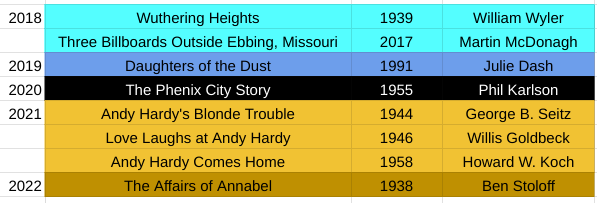
On the whole, this is a pleasant surprise. We have a couple true American classics in Daughters of the Dust, which, until further notice, is the greatest film ever made by a Black woman, regardless of national origin, full stop. Wuthering Heights is not a good adaptation of the novel, but that doesn’t trouble Laurence Olivier any as he represents the spirit of the moors (as opposed to representing the spirit of a Moor, which he did in Othello, very weirdly, almost thirty years later). There are some nice oddities in here as well, like The Affairs of Annabel is a very funny comedy about Jack Oakie playing Lucille Ball’s agent, a man who would be a terrific main character of the day on Twitter and quite likely to get Ball’s Annabel killed. It’s an impressive movie, and Ball makes it that way; it would be almost unbearably frustrating without the absolute comic precision of her performance as the much put-upon actress. The Phenix City Story is not funny at all, but it tiptoes around documentary until it goes full throttle into political noirish drama. Then we have the three Andy Hardy movies, the last three in the series; you can find all the ink you can swallow on my journey with Andy here. Finally, last and emphatically least, Three Billboards. I want to draw your attention to the top critics on Rotten Tomatoes, a group that seems intend on showing their asses with their adoration of the film. Look at how much the acting grabs them and the intensity of this wordiest screenplay thrills them, and how little their brains work to think about how resoundingly dumb this movie is, how placeless and hypothetical and turgid. You know who didn’t get carried away in this hilarious groupthink? Kam Collins and Nick Pinkerton.
July 3rd
- The Great Hip Hop Hoax (2013, dir. Jeanie Finlay)
- High Society (1956, dir. Charles Walters)
- The Mists of Avalon (2001, dir. Uli Edel)
It’s a terrific title for a movie, even though it would be a better title for a Ringer article, but The Great Hip Hop Hoax bothers me. A title isn’t everything, but it can tell us something about the direction a movie wants to take, and in this instance, it’s clear that what the movie is most interested in are the faked identities. I’ll grant that in a very literal sense, what Gavin Bain and Billy Boyd did (pretending to be Americans in order to get a record deal) is a hoax. It’s a deception for financial gain. But in its spirit, that just doesn’t seem quite right. Young Boyd seems to have enjoyed behaving ludicrously in his early twenties with free money, and Bain liked it too, but it wasn’t really about the free money for them. This isn’t something like the Cardiff Giant, where the only purpose is to scam people out of their money. Silibil N’ Brains was, at least in large part, about wanting to be rappers, feeling like they were good enough to be professional, and knowing that as long as they were from Dundee, there would be no avenue to that goal. Were they inauthentic? Sure, insofar as they were representing themselves as being from the Inland Empire. Was the music inauthentic? Not at all. That’s where the idea of “hoax” falls short, and that’s where the music itself falls short. They weren’t trying to coast off of a single novelty song; they wanted to make multiple albums. If the music was not authentically “Scottish,” what does that mean? Is the only authentic Scottish music the type with bagpipes or harps? Are Belle and Sebastian or The Jesus and Mary Chain inauthentically Scottish? The film is too worked up about the lie and barely interested in what is actually the most important piece of itself, that authenticity is a terribly gray area, and that impugning it often says a lot more about the accuser than the accused.
You know what the funniest thing about High Society is? It’s that The Philadelphia Story stars a New Englander as a Philadelphian, and then they made High Society and made a Philadelphian play a New Englander. This is, for the record, not funny in a “haha” way. Nothing about High Society is funny in a “haha” way, which is rough because the film excises the goofball in order to placate the aging crooner. (You know the one about the movie theater owner who cut the songs from The Sound of Music in order to streamline it? High Society is like that, except it adds the songs and the idiot in this case is MGM.) Bing Crosby was fifty-three when they made this, well past the prime of his career, more than a decade and a half removed from “White Christmas.” His most memorable song in this film is almost certainly the one where he talk-sings his way through what jazz is, and that’s because he just doesn’t sound like Bing anymore. The other casting choices are vexing, but this one is just so transparently bad it makes me angry. Think about what Cary Grant brings to The Philadelphia Story, which is the scheming, petty romantic who is funny every time we see him. Compare that to Crosby, who is set up as Mr. Right the entire time. Why? Anyway, Frank Sinatra was forty-one, which is more palatable, but like Crosby the best of his singing is so clearly behind him. And then there’s Grace Kelly, twenty-seven years old and looking it, which just makes the two guys chasing her look and sound even more ancient. No one except Louis Armstrong sounds good in this, which only proves that they should have just made a movie about Louis Armstrong crashing a wedding in Newport. (I’m mad that this isn’t a real movie.) High Society is a cynical flick, a movie cashing in on nostalgia for the previous decade in its plot and performers alike, and like so much nostalgia, to give us something new and memorable would ruin what we came for. On the other hand, if you’re showing up to watch a movie that thinks the giant houses filled with last decade’s pop stars and this decade’s long-limbed beauty queen are the real draw, then you might even deserve High Society.
There will never be another film based on The Mists of Avalon because of Marion Zimmer Bradley’s heinous past, which is too bad, because the story is as interesting as ever and because this adaptation isn’t so good that it ought to be the last word. As one of those three-hour television movies, it’s actually a good length to adapt the story into, and on the whole that adaptation is even pretty successful. The film understands where it needs to be most heavily weighted; it understands that everything before Morgaine and Arthur reconnect in what we’ll euphemistically call untoward fashion is just a buildup to that single great sin. The Mists of Avalon goes a lot harder on the incest than most interpretations of the Matter of Britain, especially the stuff predating, say, the Renaissance, but it works. The religious conflict between Christianity and Druidism in the film is subducted, and while that means that Guinevere’s religious petulance has less power here, it also means that the film can more amply convey the evil of that religious power struggle. Vivien would do anything in order to set the Goddess above the God on the principle that if you’re not ahead, you’re behind. The reason we know she’d do anything is because she masterminds the incestuous sex between Morgaine and Arthur, and does it because she believes that their son Mordred will be the true culmination of devotion to the Goddess in Britain. (This is something I do like about this movie; Arthur is, like Moses or Elijah, meant to be superseded in power and scope by Joshua or Elisha. It’s a different take.) Alas that Vivien could not be advised by Reverend Hale: “cleave to no faith when faith brings blood.”
July 4th
- The Bride Wore Red (1937, dir. Dorothy Arzner)
- That’s Entertainment! (1974, dir. Jack Haley, Jr.)
- True Grit (1969, dir. Henry Hathaway)
- That’s Entertainment, Part 2 (1976, dir. Gene Kelly)
Even when she was making studio films with career girls and fine romances and big dreamers, Dorothy Arzner was far better at cutting through the fat of those fantasies than most any other Hollywood director of the time. They end with things fixed up in a jiffy (usually), but there’s a threat that hangs over the women of her films, this understanding that even in the happy endings they’re still only on the edge of a razor. Merrily We Go to Hell, a movie about going to AA (alcoholism and adultery), ends with two unhappily married people with deep hurts reconnecting over a baby. Of course that situation never degrades. Craig’s Wife is a slightly terrifying parable about how a woman who marries for security (as so many women have been taught to do!) might still find herself alone and insecure if she’s insufficiently affectionate. Dance, Girl, Dance has a happy ending as the girl from the burlesque gets swept up by an impresario who intends to make her a ballerina, but the film is much more about how easy it is to get swept into the gutter. The Bride Wore Red is different from the rest of this non-exhaustive list because I find it a genuinely romantic movie where none of the others are. Like Maureen O’Hara in Dance, Girl, Dance, Joan Crawford ends up with a man who we believe will love her for herself. Unlike Judy, who is about to achieve a great personal dream, Anni is about to move into the remote postman’s cabin and be surrounded by Franchot Tone’s brigade of cousins, presumably while she supplies them with another battalion of cousins. Crawford and Arzner are a dream pairing, both of them neat fits for stories about social class and women’s issues of the ’30s, running a Warner Brothers office deep undercover at MGM. Anni, elevated for a couple weeks to the ranks of the Alpine jet set (the toboggan set? is there a term for this?), turns the haughtiness she wore as protection against discovery into a belief that just wearing better clothes and eating better food makes her a better person than the postman or his constellation of relations. Humility comes for Anni as it came for Harriet Craig, although it goes better for her in the end. She’ll be stripped of all her fine clothes, humiliated in front of a whole hotel, but then taken in on the caresses of romantic sweet nothings airy enough to take her to the mountaintop…where the telegrams pour in.
I really, really enjoyed That’s Entertainment!, but the image that’s going to stick with me longest from this movie has nothing to do with any of the marvelous clips they bring out. Look at Peter Lawford trying to look like George Harrison’s weird Kentish great-uncle.
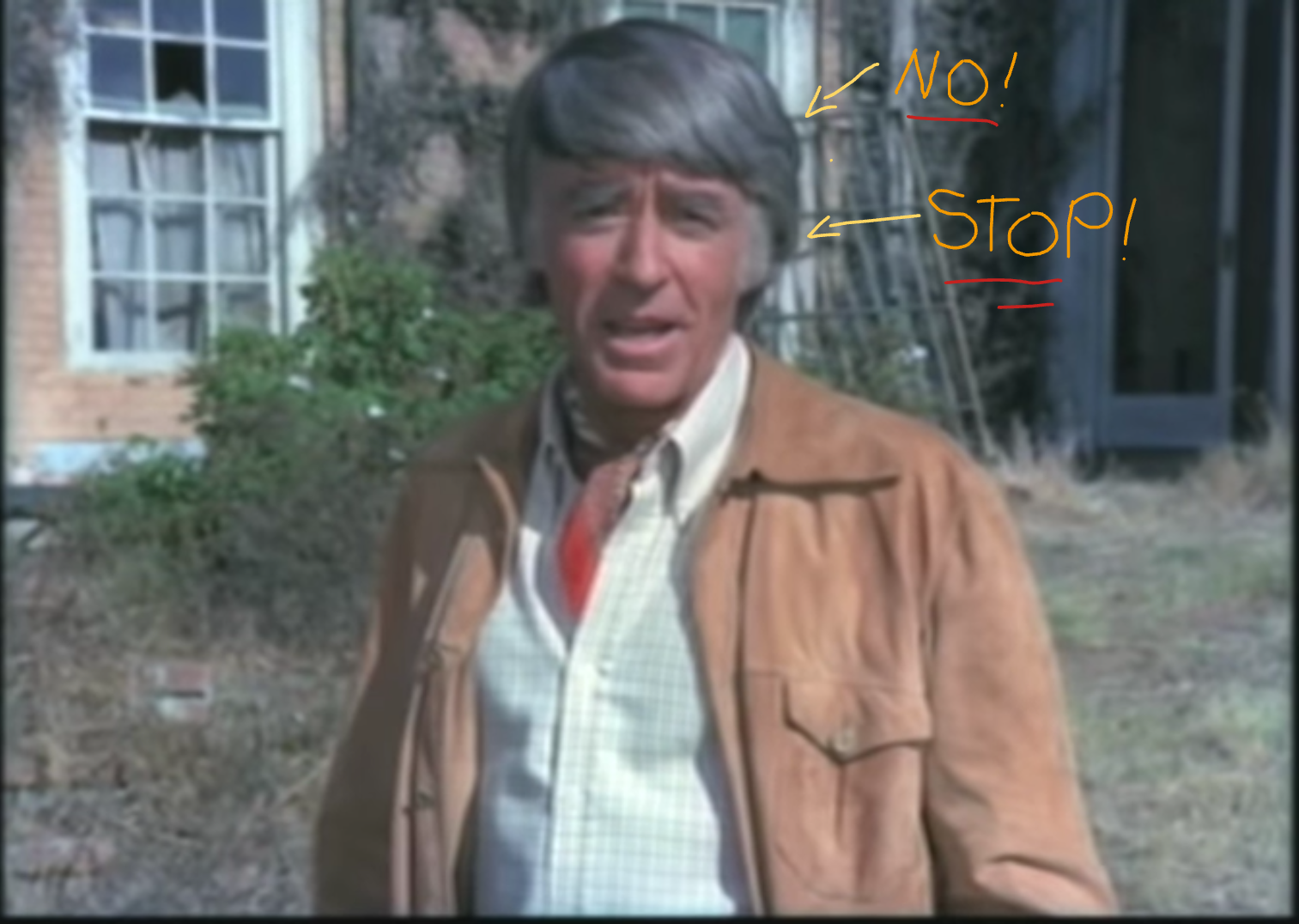
Chilling stuff. That’s Entertainment! is still a lot of fun despite Peter Lawford living “How do you do, fellow kids” like it’s a religion. It’s a loosely structured picture, using “Singin’ in the Rain” in its many forms as a prologue and the ballet from An American in Paris as its epilogue. Major chapters about Gene Kelly and Judy Garland suffuse the back half of the film, while the first half flits around between Eleanor Powell, the MacDonald-Eddy pair, Ann Miller, omnipresent Mickey Rooney, late Fred Astaire. Maybe the most charming part of the movie is the brief section where Jimmy Stewart hosts clips of major stars who did not sing or dance being roped into singing and dancing: Stewart himself, Clark Gable, Jean Harlow, Cary Grant. It’s the most human footage of the documentary, even more so than seeing the screen legends of yesteryear with wrinkles and spare tires. Just as the tycoons and politicos of bygone eras retreat to write their memoirs once they’ve been cast from the spotlight, MGM retreats to its favorite stars and scenes to do the same. Like most memoirs, it attempts to justify itself (look at how much everyone likes Lena Horne! who else would have lifted up Esther Williams! see the legacy of Judy Garland in Liza Minnelli!) while mostly opening itself up to criticisms for future generations to level at it. No one wants to touch Busby Berkeley, Arthur Freed, Louis B. Mayer. There’s a part where Mickey Rooney is like, I dunno where we got the energy for all this, which is risible and especially sad when you consider why they couldn’t bring Judy Garland back to talk about her movies. The blackface is really everywhere here; they cut the blackface into the movie! The old people, the memoir feeling, all of it contributes to funereal tap dancing of That’s Entertainment! In the 1970s, the most memorable, culturally important movie they released the entire decade was probably Shaft, followed by some zany/dry sci-fi movies. It’s a great comedown for a studio that can tell it’s dying, and which has brought out dying men and women to tell you how wonderful it was know MGM before it had to be stuck in a home because it couldn’t take care of itself any longer.
Another day in the life, another day to sit down at my laptop and wonder why everyone else but me struggles to understand John Wayne. The short answer, a lot shorter than the answers I usually come up with, is that the people who want to claim him do so on the basis of his political views more than his films, and that the people who don’t want to claim him haven’t seen his movies based on their own sophistication, misguided as that belief may be. True Grit is the movie Wayne won his Oscar for, a lifetime achievement award if the Oscars have ever given one in competition, and even this one isn’t really essential to understanding Wayne as a performer. It’s an adequate movie with an adequate Wayne, but his performance as Rooster Cogburn is practically anonymous. With Henry Hathaway behind the camera, and with the most interesting performances of the film coming from the generation after Wayne’s generation (Dennis Hopper and Robert Duvall), Wayne has nothing more interesting to work from than stock: stock lines and stock readings and stock riding and stock shooting. Even the eyepatch doesn’t liven him up; he’s just a guy in his sixties. He’s less ruthless and passionate than he was throughout the ’50s. He’s less human than he was in the ’40s. If this is one of the key Wayne performances for people who aren’t sifting through his filmography, then I suppose it would be easy to see him as a bland right-wing figure. It’s too bad; despite True Grit, I don’t think he was bland at all.
That’s Entertainment, Part II is a lot more focused than That’s Entertainment! was, which I find hurts the film. Another thing that hurts the film is bringing back yet another clip from High Society, which felt like a personal insult. The focus is not a bad focus, per se. The first half of this is an ode to the Great American Songbook. Part II is much more focused on telling you that this one is Irving Berlin, this one is Cole Porter, this one Rodgers and Hart. I liked that a lot; it ties MGM into the legacy of American music in a way that forces us to venerate their commitment to these major figures (and the money they made off them) and see them as an outlet for their continued popularity. It’s also much more focused on Gene Kelly and Fred Astaire doing new lyrics for “That’s Entertainment,” as well as a more selective focus on bigger stars like, well, Kelly and Astaire plus Frank Sinatra. When it diverges from those three, it’s making forays into other MGM figures, like a clip with Greta Garbo, a longer sojourn with Hepburn and Tracy, even a brief pair of asides to Laurel and Hardy and Abbott and Costello. I wish they were much less focused on trying to shoehorn big names into the film, especially when there’s so much more they could be doing to highlight smaller names. Bob Fosse is in a routine, as is Gwen Verdon, as is Ethel Waters, as is Kathryn Grayson. The purpose of Part II to function as a clip show when it was harder to come across rep screenings and there was no serious home video market is more apparent than it was within the malaise of ’74. Kelly and Astaire do dance together, in Astaire’s final onscreen dance routines, and that is still a treasure no matter how much the rest of the movie fails to live up to that brightness.
July 5th
- Dr. Kildare Goes Home (1940, dir. Harold S. Bucquet)
- Public Housing (1997, dir. Frederick Wiseman)
Maybe this is what happens when the second movie in your series is “Dr. Kildare decides that this prime suspect in a murder is innocent, decides to risk everything on it, and also gets this close to banging barely legal Lana Turner.” Everything else just feels a little more normal after that. Or if you keep raising the stakes, Jimmy Kildare is going to have be a spy on the ground while Molotov and Ribbentrop divided Poland while trying not to fall for Carmen Miranda. What a relief for Kildare to graduate from the intern program, get a job on staff, and then immediately bail on the hospital to go back home to Connecticut. His father is overworked because a factory closed down in the next town, the doctors from the next town moved out, and now Stephen feels a great duty to supply medical care to more people than he can handle. There are three real differences between the Andy Hardy movies and the Dr. Kildare movies, at least as far as I can see in the latter franchise. First, Jimmy Kildare definitely has his underwear on the right way; Andy Hardy must go out with it backwards at least once a week. Second, Jimmy has his sights set very firmly on Mary Lamont, while Andy is even more eager to flirt with the new girl in Carvel than he is to try to sneak kisses from Polly Benedict, Queen of My Heart. Finally, and this is most serious, both Jimmy and Andy have to have parent-to-parent talks every time out. Andy, who is a boy for fifteen movies (and never does grow to a man’s height, more’s the pity), has a talk with his father. Jimmy, who is a grown man, has a talk with his mother. He doesn’t need to learn how to be a man any longer, but he does need someone he can trust with his feelings, who understands him implicitly. The two of them communicate in a very verbose way for the benefit of the camera, but if they were more like real people they wouldn’t actually need to talk. Most of their conversations go something like this:
Jimmy: Mom, I want to do something that’s going to make people look at me weird.
Mrs. Kildare: You should do it.
Jimmy: Thanks, Mom. This chat really opened my eyes.
It makes sense within the scope of these films that even if Jimmy doesn’t connect specially with his father, he’s willing to drop everything out of responsibility to his family; his mother would be the one who’d suffer most if his saintly pater were to drop dead of exhaustion. All’s well that ends well. All it takes is a little case of meningitis and literally socialized medicine to get Stephen some help and send Jimmy back to New York so he can do the work his real father, Dr. Gillespie, has in store for him.
The “I have five movies to watch on Kanopy every month and at least two of them are going to be Frederick Wiseman docs” roulette has spun around again, and this time it’s landed on Public Housing. I have admittedly limited knowledge of Wiseman’s oeuvre (this makes six, woohoo), but the film that it reminded me of most was In Jackson Heights. In the latter, Wiseman makes much of the diversity of the neighborhood even if most of it is still in English and Spanish. In the former, he is focused almost entirely on Black people. Community organizing is just as important in Public Housing as it is in In Jackson Heights. The film begins with a scene where one of resident-officials at Ida B. Wells is letting some faceless person have it over the phone. There’s “a baby with a baby,” as she puts it, who is sitting in front of her and needs housing while some apartments at the complex are open. The police officers (Wiseman must have footage of white officers but sticks to Black and Hispanic officers in his vignettes) are infuriatingly paternalistic, even for cops. One particularly benevolent individual tells a woman working to overcome her drug addiction that he’s going to stop her every time he sees her and ask how she’s doing getting off alcohol too. That’s a bad dream, and we can only hope he doesn’t mean it, that he’s just showing off for the camera. Then there’s a social worker talking to a man who has had excruciating drug addictions and is now trying to go straight; the guy from government is not part of public housing, but because he is actually helpful, he’s included. It’s the opposite of what we see in Welfare. This is not a bevy of white people telling Black and Hispanic people in fluorescently lit sardine cans that they can’t help them, come back in a few days. This is a quite scene, a one-on-one between two Black men. The social worker is casual, non-judgmental. He provides an immediate statement at the end of the interview saying what the man is eligible and not eligible for, what he does intend to recommend him for. There’s a future. Where there is no funding, or, in other words, where the ruling classes are apathetic about these people in public housing, at the very least the best of them are trying to look out for one another.
 Seeing Things Secondhand
The way you describe That’s Entertainment!, as a final tribute from MGM to itself, reminded me of when I watched the first part of that 100 Years of Warner Bros. special on Max. The one that celebrates the company’s legacy in cinena history, which came out like one day before literal movie villain David Zaslav announced the decimation of TCM. My brother remarked that they made this miniseries because the company won’t last beyond those first 100 years.
Your brother has an extremely good point.