
The first part of this series, where I talk about the historical context for superhero movies as a genre, is here. The second part, where I talk the superhero movies I think are the best, as well as the superhero movies other people think are the best, is here.
The Auteurs of the Superhero Genre
We’re headed back to Martin Scorsese. In A Personal Journey with Martin Scorsese Through American Movies, Scorsese sees the successes of American movies through the lens of the auteur, and more than that, the lens of a director who must adjust to external pressures in order to make a personal film. The director must “smuggle” his or her ideas into a movie in order to make them palatable as entertainment. Here’s where he underlines Ida Lupino, Joseph H. Lewis, and Jacques Tourneur. Or, the director may be an “iconoclast,” someone who damns the torpedoes and does everything possible to make the picture in his or her own way. With John Cassavetes, that might mean no budget. With Josef von Sternberg, that might mean a very short shelf life. With Stanley Kubrick, that might mean running away to London and throttling his creative output into only a relative few movies. Scorsese understands the power of a producer, certainly, citing David O. Selznick and Val Lewton among others who could rule a set with an iron hand. But for all the influence of Lewton, Scorsese is still more interested in Jacques Tourneur. For as much as Selznick dominated Duel in the Sun, the story for Scorsese is in the greatness of King Vidor.
I have my own misgivings about auteur theory, which is fashionable for people to say now, just as ascribing to it was once fashionable for people like me. But this is nevertheless a useful lens. Where Andrew Sarris saw Hollywood filmmaking through the 1960s as a place where the auteur might smuggle or break icons under the noses of the entertainment apparatus, we ought to do the same for the even more rigorous confines of superhero movies. David O. Selznick was answerable primarily to himself. Kevin Feige is answerable to the Mouse, and to the Mouse’s stockholders, and for as profitable as his movies have been, Feige is no Selznick. Neither are Bruce Timm nor Sam Register. Yet the superhero movies have leeway. Something is still left to the director in execution, though, as Lucrecia Martel can attest, some of the action sequences can only be done in the house style.
What follows is a catalog of directors of the superhero genre, something like what Andrew Sarris did for American cinema in its sound era up through the 1960s. Where I’m going to differ from Sarris is that I’m not going to be able to tell you that there’s a Alfred Hitchcock in here, nor an Ernst Lubitsch, nor any of his “pantheon directors.” If there were such people to study, then by gum we would know it by now. There are exceptional figures thus far, and there are some who are as important to the superhero genre as John Ford was important to the western, or Vincente Minnelli was important to the musical. Again, to be abundantly clear, their importance does not imply greatness as craftspeople. I’ve seen things you people wouldn’t believe.
The auteurs of the superhero genre come in one of four different flavors: Stampers, Brutes, Iconographers, and Jesters.
The Stamper may have some moments of personality in their films, but that personal vision is subducted beneath some larger goal which the film is in service of. This might be a corporate goal, in which the film is part of the brand first. This might be a focus on a house style, especially in animation. The Stamper may be closely associated with a particular superhero, taking control of a number of projects on the same character. The Stamper may also be content with taking cues from a preexisting text of the same name, adapting a limited series or a graphic novel with special care, sometimes even transposing pages or sequences from the comics into the film. The Stamper rarely asks why a superhero exists, even within the context of an origin story. The most important of the Stampers is Sam Liu.
The Brute is primarily concerned with the superhero as a violent figure. The justification for superheroes might be questioned, but the violence with which the superhero discharges his or her duty is unmistakable. Where other superhero auteurs will try to create metonymic individuals who are saved by the heroes, standing in for the many others we are meant to assume they have saved, the Brute is comfortable with the idea that there will be casualties. The Brute pushes the limits of what might be acceptable for other types of directors in terms of the types, representations, or gazes of violence, e.g. violence against children, superheroes killing their foes, blood and guts. In some ways, the Brute works with realism, insofar as that’s possible, more than others. The most important of the Brutes is Jay Oliva.
The Iconographer typically incorporates elements of a personal style into their film, although it is not unusual to see some of the same concessions to a house style that a Stamper might make. (The Iconographer often has a name brand quality that the Stamper might not.) The Iconographer takes the presence of a superhero to be an obvious good. Where a Stamper simply accepts the presence of a superhero, an Iconographer will make a point of arguing why the superhero is justified, necessary, or laudable. The Iconographer will emphasize “real-world” themes and ideas, referring back to contemporary political ideologies. These directors are more likely than others, with the possible exception of Stampers, to pit the superhero against a supervillain who simply could not be stopped by bureaucracy, constabulary, or armed forces. The most important of the Iconographers is Zack Snyder.
The Jester wants to remind you that the superhero originated because s/he is an entertaining figure. Where humor is often part of the superhero genre, the Jester goes out of their way in order to make jokes the center of the first two-thirds of the film. The Jester prefers self-referential humor and irony. The Jester may occasionally question the need for a superhero, or show concern for the methods by which a superhero attains a state of peace and order, but the Jester is in the service of a monarch. The Jester may have enough authority to poke fun at the genre, or at the individual superheroes in a film, but chooses to accept the presence of superheroes with almost as much approval as the Stamper. The Jester must choose different stakes than other superhero auteurs do, because in effacing the superhero in the first two-thirds of the film, the stakes seem less important. Often the real solution is in maintaining and mending “found family.” The most important of the Jesters is James Gunn.
I lied about there only being four kinds. There’s a fifth kind which we’ll breeze through at the end: people who have only directed one superhero movie so far. You can tell which ones they are because they’ve only directed one superhero movie so far.
I’ve ordered the directors within each group in terms of meaningfulness to the superhero genre at large.
Stampers
Sam Liu
Superman/Batman: Public Enemies (2009), Planet Hulk (2010), Justice League: Crisis on Two Earths (2010, co-directed), All-Star Superman (2011), Thor: Tales of Asgard (2011, co-directed), Batman: Year One (2011, co-directed), Justice League: Gods and Monsters (2015), Justice League vs. Teen Titans (2016), Batman: The Killing Joke (2016), Batman and Harley Quinn (2017), Batman: Gotham by Gaslight (2018), The Death of Superman (2018), Reign of the Supermen (2019), Justice League vs. the Fatal Five (2019), Wonder Woman: Bloodlines (2019), Superman: Red Son (2020), Batman: Soul of the Dragon (2021), Batman: The Doom That Came to Gotham (2023)
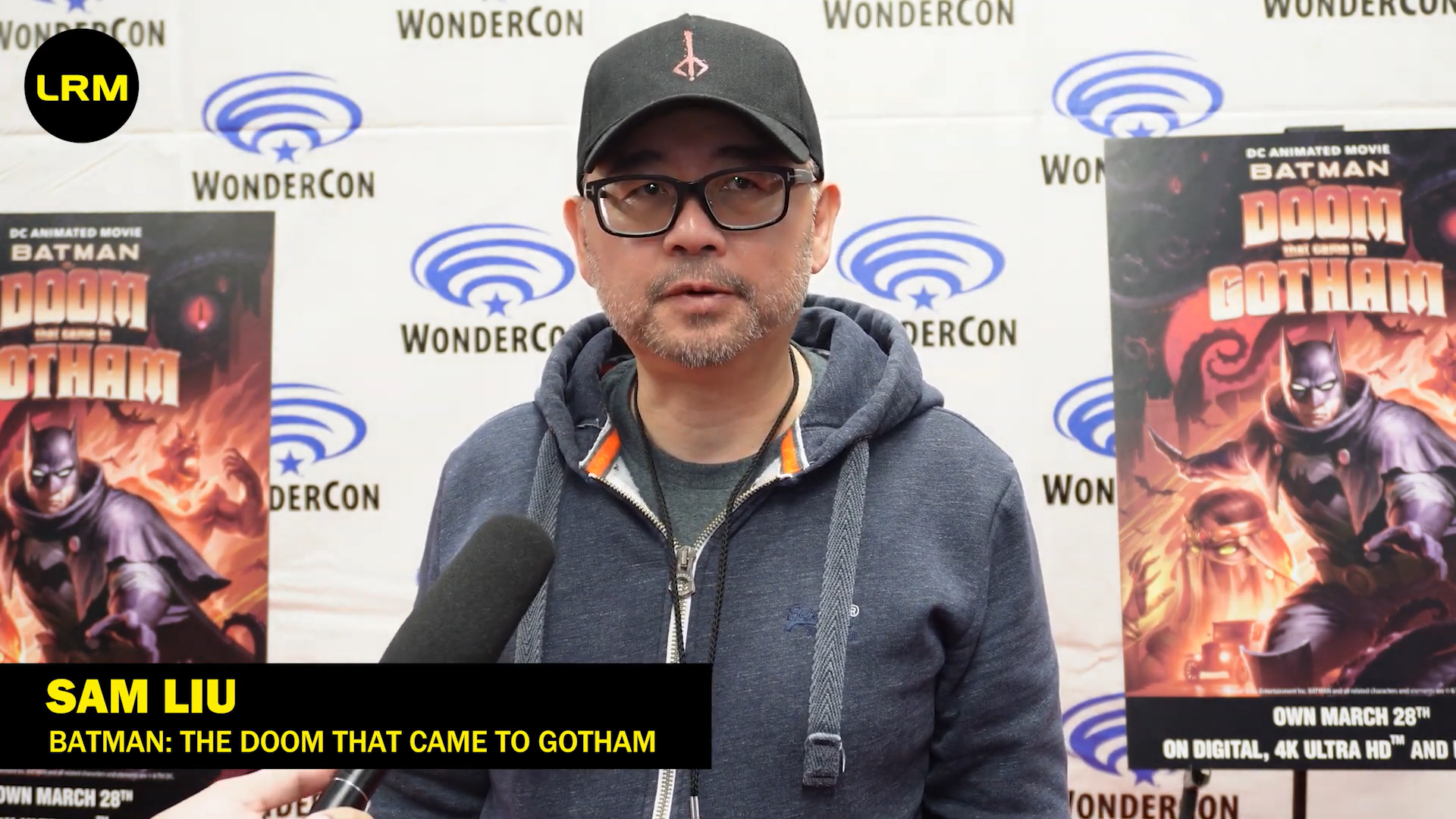
Sam Liu has directed or co-directed eighteen superhero features, which is more than any other director in the sample that I’m working from. His work is primarily in one-shots, many of them based on limited runs and graphic novels (All-Star Superman, The Killing Joke, Red Son, etc.), though Reign of the Supermen builds directly on Death of Superman, and his foray with the Teen Titans starts a continuity which would be revisited in Teen Titans: The Judas Contract. Much of Liu’s work is speculative in nature. Aside from All-Star Superman, which would pretty firmly close off Superman if it were to be taken within a timeline, other films are plainly in a different space than the regular timelines we see in the DCAMU. Gotham by Gaslight, which takes place in a Victorian Gotham, and The Doom That Came to Gotham, in which Etrigan teams up with a pre-World War II Bruce Wayne to defeat Ra’s al Ghul, who is trying to bring a Lovecraftian creature into the world. My personal favorite of the bunch is Soul of the Dragon, which riffs on the ’70s kung fu movie. Only a small handful of Liu’s films are of the origin story variety. Batman: Year One, a co-directed movie, stands out in that way, and so does Wonder Woman: Bloodlines, which witnesses Diana’s expulsion from Themyscira and her accession to the role of Wonder Woman in man’s world.
Liu’s three best solo films are Justice League: Gods and Monsters, Justice League vs. Teen Titans, and Batman and Harley Quinn. (Justice League: Crisis on Two Earths has been covered in some detail previously, and was also co-directed by Lauren Montgomery.) These three are, in terms of content, very different from one another.
Gods and Monsters takes place in one of those alternate realities, one in which Superman (fathered by Zod rather than Jor-El), Batman, and Wonder Woman are Hernan Guerra, Kirk Langstrom, and Bekka. The three of them coexist uneasily with the world’s governments. Their powers clearly place them above the law, and world leaders, such as Amanda Waller, can do little more than nag them to submit to federal inquiries. This is one of those grim DCAMU stories with a high body count, though what makes this one stand out is not the stench of its violence but its targets. A number of characters with recognizable names go down in this one, either in a Red Wedding-style flashback sequence starring Bekka or, more often, in sequences where many scientists are killed by assassin robots.
Justice League vs. Teen Titans is a pretty straightforward DCAMU outing, lightened a little more than usual by the presence of the Teen Titans. There’s a long sequence where Damian Wayne beats Gar in a Dance Dance Revolution competition, which I like pretty well. After all, why shouldn’t a nimble trained assassin be able to pick up the rudiments of DDR, thus proving that he can learn to fit in with the other kids? The film focuses on the Titans more than the Justice League, working on its outcasts (Damian and Raven), and in the end, the only one who can defeat the demon Trigon is his daughter.
Batman and Harley Quinn is singular among the animated DC films, a zany adventure of kook and kink. The star is not Batman (who smells a fart and says it smells like “discipline”) or Nightwing (who is tied to a bed before, we are given to understand, he has the best sex of his life). It’s Harley Quinn, freed from the supporting role we so often see her in next to the Joker, and freed as well from her position in the Suicide Squad. Harley is interpreted not as manic but as liberated, and what she does in partnership with Batman and Nightwing is not done to destroy crime but to help a friend. Poison Ivy has teamed up with the Floronic Man to make a point about climate change, but in the end, she can still be swayed by Harley making a sad face at her. It’s not Spider-Man 2, but it’s a heck of a lot closer to Spider-Man 2 than anything else I’ve seen in a DC movie.
Liu’s facility with these different types of stories—I haven’t even talked about his work with Superman, probably the character I’d associate with Liu first—shows that Stampers are not depersonalized directors. Their preferences and concerns will shine through over time, and for Liu, those preferences and concerns are clearer. What makes Liu the prime Stamper is his unquestioning view of the superhero. The position of the superhero is almost always justified in Liu, and concerns about the primacy of the superhero turn to carping. This is what’s being stamped in. Justice League vs. Teen Titans looks at the world and suggests that what it needs is a developmental league for superheroes. Damian is perhaps the most unpopular character in these animated DC movies, and he’s definitely drawn up in such a way that it’s hard to like him. He’s snotty, arrogant in the extreme, and because no one (Batman, Starfire…Alfred…) allows him to kill people once he’s been liberated from the League of Assassins, we don’t even get any proof that he deserves the arrogance we have to face. He takes poorly to being sent to the Teen Titans after a selfish blooper gets him kicked off Justice League duty, understanding it correctly as a demotion. The jokes about boarding school that characters make through multiple Damian movies show up here as well, and the Titans are the closest thing to boarding school that Batman can find for his son.
(Personally, I like Damian, and I like Stuart Allan’s vocal interpretation of the character. After encountering him for the first time in Son of Batman, I had the warm recollection of watching Kitchen Nightmares. In that case, Batman is Gordon Ramsay, and Damian is the petulant restaurateur who refuses to take advice from a Michelin-starred superhero. It’s a comic relationship, amplified by how little Damian looks next to Bruce, but then again, few are the viewers who come to Batman movies seeking humor.)
Justice League vs. Teen Titans sees the need for superheroes in a few ways. The foremost reason for superheroes is that only they have a chance of defeating the enormous threats that face helpless citizens. Raven is the only one who can defeat Trigon, for example. Damian, armed with the kryptonite that Batman keeps handy, is the only one who can defeat a possessed Superman. (See also, from Liu’s oeuvre: only a transfigured Batman can defeat a Lovecraftian monster, only Superman can defeat Doomsday, only Wonder Woman can defeat Medusa…such examples exist all across the types of superhero auteurs.) Superheroes also can defeat a different set of villain, one who does not summon cosmic power but who would strain the resources of a local police force or SWAT teams. In the beginning of the film, the Justice League fights the Legion of Doom; Weather Wizard and Toymaster, battled by the Flash and Cyborg, respectively, represent this kind of adversary.
Perhaps most importantly, at least in Liu’s work, superheroes exist because of their consciences. Conscience is what moves the superhero to take action, and guided by that conscience, a superhero can never go too far wrong. Jaime (Blue Beetle) and Gar (Beast Boy) have abilities which they did not choose for themselves. Yet they are training as minor league superheroes because their consciences dictate that they ought to do heroic deeds for the benefit of others. Most superheroes come to this conclusion so naturally that it barely seems up for debate. In Justice League vs. Teen Titans, only Damian and Raven seem to think hard about their position as heroes, and those two are only forced to think about it because they are still children struggling with their obviously traumatic upbringings. It’s what allows them to act as the credible focuses of the film. Jaime and Gar and Kori have made peace with their situations, made peace with them before the beginning of the film and remain at peace after its conclusion. Damian has to change because he realizes that the goals that he’s set for himself are inflected with the wickedness of Ra’s al Ghul, and thus those goals are not befitting of a heroic person. Raven has to change because she realizes that safety comes in fighting for those you love, not in hiding them. (That the answer to “What brings safety?” is “Literal fighting” is one of the simplest points in the superhero catechism.) All of these are pretty straightforward raisons d’être for superheroes, and Liu gives us those reasons straightforwardly in Justice League vs. Teen Titans.
In other Liu films, the question of the superhero’s conscience is approached more unusually. In Justice League vs. the Fatal Five, the protagonist is a popular DC character who goes mostly unnoticed in other DC movies. That’s Jessica Cruz, one of the Green Lanterns, and in The Fatal Five, she is extremely unwilling to use the powers she is imbued with. The superhero who does not want to take up his or her place in the line of duty is a fairly common story. In First Class, Charles and Erik walk up to Logan, intent on adding him to their lineup of X-Men. They introduce themselves. Logan replies, “Go fuck yourself.” The story is handled with more gravitas elsewhere. Rogue’s attempt to run from her powers in X-Men stands out, given that she might reasonably view them as an uncontrollable curse. Green Lantern: Beware My Power even does something similar, in which John Stewart, ravaged with PTSD, runs away from the ring for the majority of the movie.
In The Fatal Five, Jessica seeks to run away from her powers because it’s not clear to her that what’s bestowed on her is, in fact, meaningful. She was unable to prevent the murder of some friends, and was nearly murdered herself. Given that fear is the enemy of all Green Lanterns, the fears that she carries about herself, and the ambivalence that engenders in relation to her powers, Jessica is temporarily weakened. Yet this is not a Dark Knight Rises situation where she is intent on regaining her position as a superhero. Jessica is out on the idea entirely, and it requires not just the presence of supervillains to animate her again, but the success of those villains as they brutally defeat other Green Lanterns. It is not simply that Jessica is reluctant, which is strange compared to so many other films in which the superhero leaps in immediately. It’s that the history of the 31st Century, where a mentally ill Star Boy comes from and which he references often, depends on Jessica Cruz outshining Superman and Wonder Woman and all of the other heroes of the Justice League in order to defeat the Fatal Five. Because of Star Boy, we know for certain that all of Jessica’s refusals will be outweighed by a single decision to do the brave thing and defeat these 31st Century villains. Even when it seems that a superhero must struggle with her conscience in order to attain her status again, history itself conspires against that interpretation. She was always going to act in her capacity as a Green Lantern. In that way, it’s as if her conscience never wavered at all.
The other example that leaps to mind is All-Star Superman, an adaptation of a twelve-issue Grant Morrison run of the same name. In it, Superman, exposed too closely to the yellow sun, has gone beyond the previous peak of his powers and in so doing is wearing out. He will die. How Superman chooses to spend the last weeks of his life puts his values into stark relief. It turns out that Superman spends most of that time with the two people nearest to him. First, he goes to Lois Lane, coming up with a serum that makes her as powerful and gifted as Superman for twenty-four hours. This interlude is marred by a competition with some time travelers, but on the whole, it’s sweet. A dying Superman intends to spend his last days with the one he loves. Then, even when some vexatious troublemakers barge in on the Man of Steel, the rest of the movie really circles the relationship between Superman and Lex Luthor.
The superhero, after all, is defined not by his relationships with mortals, not by the relationships that s/he can have with other people which are like the relationships we can have with other people. The superhero is defined by the relationships s/he has with people we cannot fathom, and so it is that Clark Kent gets an exclusive interview with Lex while he waits to be sent to the chair. The way that the two circle one another is at the heart of this movie. Luthor, loquacious to the point of rambling as he talks about himself, his plan to eliminate Superman. Superman, coolly saving Luthor’s life by pretending to be klutzy ol’ Clark, foiling Luthor’s attempts to manufacture enough serum to make a SuperLex. Other distractions pop into All-Star Superman; it’s no surprise that this story was adapted, in a literal sense, from twelve different things. What’s interesting about All-Star Superman is that the decision to highlight Luthor as the mirror of Superman, to find the conscientious hero above all else, pervades the choices in adaptation.
There’s a well-remembered piece of the Morrison book where Superman prevents a young girl from death by suicide. That doesn’t make it into All-Star Superman, and while Liu has talked about that cut as a victim of runtime, it’s worth considering what does make it into the film. Atlas, Samson, the Sphinx, the shrunken city of Kandor, the intrusion of Bar-El and Lilo, the massively powerful Solaris, and multiple points of entry for Lex Luthor. All of those require Superman. They require the conscience of a person who has colossal abilities. But you, gentle reader, might be able to prevent suicide. Normal people do it every day, and not one of them has the proportional strength of a person born on a planet under a red sun. The superhero, in Liu, leaves the prosaic to us. In so doing, s/he tends to leave tenderness to us as well. Conscience dictates the doing of great deeds, not small.
Sam Raimi
Darkman (1990), Spider-Man (2002), Spider-Man 2 (2004), Spider-Man 3 (2007), Doctor Strange in the Multiverse of Madness (2022)
In Raimi’s films, superheroes do exist because those gifted people are placed in situations where they are too needful of their power to let go of the gift. Superhero work is personal for Raimi in a way that it’s rarely personal for directors working on Marvel or DC IP. (Nothing could be less personal than the stuff that the various Doctor Stranges, or is it just one, who really cares, are doing in Doctor Strange in the Multiverse of Madness. Thus a real turd of a motion picture.) Peter Parker doesn’t strictly need to be Spider-Man until he locks himself into the role when Uncle Ben is murdered, but once he begins to be Spider-Man, it isn’t something he can ever put down again. He tries to put it down in both sequels, looks for ways to give it up so he can make ends meet or so he can express the anger he feels, but one simply does not give up being Spider-Man. People close to Peter are constantly threatened, and thus Spider-Man must always answer the call.
The heart of Raimi’s superhero ethos is in Darkman, who barely fits the description of a superhero at all. When Peyton Westlake looks in the mirror when the lights are low, he sees Jack Griffin, the Invisible Man. Westlake was in the wrong place at the wrong time, one of those scientists on the edge of a breakthrough who gets left for dead, whose body isn’t even identified as his own when he’s found clinging to life, and who resurfaces as a man with a terrible, yet solvable, problem. He has been burned into oblivion and he has no chance of returning to his former life, with girlfriend and steady job in tow. But his research and his programs are still intact enough that he has a chance to do something magnificent. No one is closer to inventing a synthetic skin than Westlake. All he has to do is work out the final kinks in its design (too much direct sunlight makes it fall apart), and he might be able to live again.
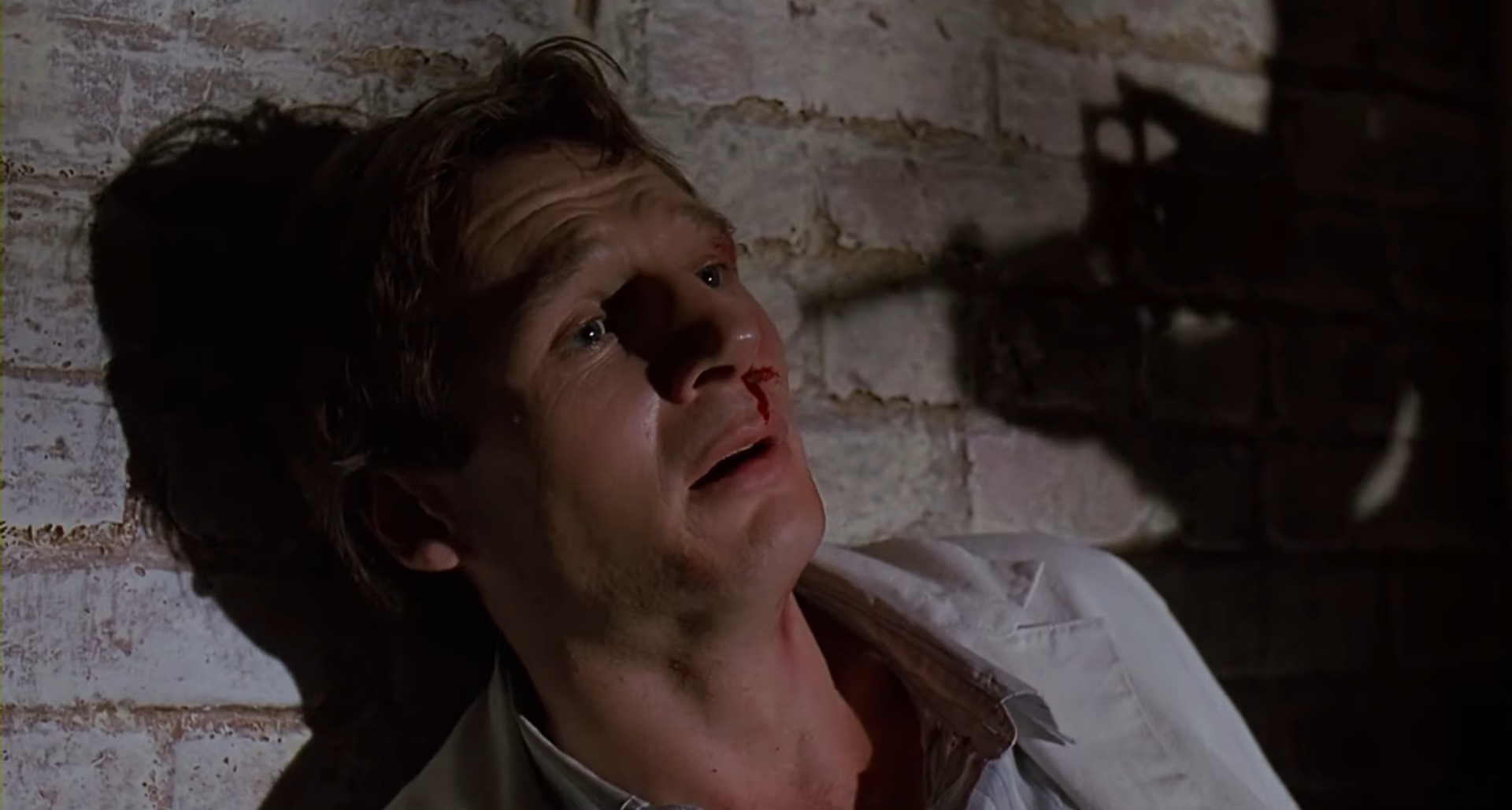
Westlake’s crime-fighting efforts lack the universality of your average superhero. There is no focus on crime or injustice outside of the injustice that has been done to him, which puts Westlake in conversation with Frank Castle and not that many other people. Death is not too high a price to pay for malefactors, although only very special individuals at very dramatic intervals of the movie receive dispatches at Westlake’s own hands. There is no expectation that after Westlake has gone through Durant and Strack he will move on to stymie the other white-collar criminals. Westlake is a man with just one job, and just one purpose, and it is really tough to put those kind of single-issue voters into the superhero electorate. The more violence he deals out, the more he begins to enjoy what he’s doing. The rhythms from The Invisible Man are tapped into, as the foul humor of a dangerous man yields to the mania of a murderous one. Our sympathies remain with Westlake throughout the movie, not least when he’s trying to reconnect with his girlfriend wearing his old face through as much sunlight as the synthetic skin can stand. However, this is the pity we grant to a vigilante, not the respect given a sigil, and so the line between superhero and Universal movie monster grows ever thinner throughout the movie. To avenge himself and his future, he must lean ever more into his superpower of creating these exact masks.
Raimi’s Darkman may not ask that many questions about what Westlake’s legal purview ought to be, or if there ought to be other people like him in the world. What interests Raimi is whether Peyton Westlake can coexist at the same time as Darkman (a name which is not spoken until the closing moments of the film). To borrow from Paramount’s library instead of Universal’s, Westlake has reversed the polarity of the problem of Dr. Jekyll and Mr. Hyde. Is Jekyll or Hyde the true owner of the body? Is Westlake or Darkman the true owner of his? The one with death at his fingertips in Darkman is the one who looks like Jekyll, the handsome scientist; the one scrambling for a solution to his problems is the deformed Hyde. Where does the man end and the costume begin? It is one of the most frequent questions of superhero movies, whether it is the legal questions raised in Civil War or the little nod that Bruce, sitting with Selina, gives to Alfred in The Dark Knight Rises. To Raimi’s credit, no one has ever been quite as interested in the mask/man point of separation as he is in Darkman, for nowhere else can we find a superhero whose plans are so intensely personal. Darkman is not a job, a secret identity, or a symbol. It is the final destination of Peyton Westlake, who even before he was Darkman was possessed of the same basic motivations and tools. Once joined, can the two ever really be separated? Looking at the final shot of the movie (where Bruce Campbell, as always, pops up), the answer appears to be a pretty firm “no.”
In his Spider-Man entries, Raimi sees the the superhero and the man inside the mask as functionally inseparable. One can, and does, go on about the sequence where Peter Parker pops up in front of Doc Ock and convinces him to go down a better man than the tentacles have made him. But it’s also in Spider-Man, where the famous upside-down kiss happens. Mary Jane rolls the mask up so that Peter’s lips are visible but so Peter’s face is invisible to her. It is both Peter and Spider-Man who are on the receiving end of her affections, one of them equivalent to the other, and the kiss is therefore doubly sexy.
Jon Watts
Spider-Man: Homecoming (2017), Spider-Man: Far From Home (2019), Spider-Man: No Way Home (2021)
If Liu represents some of the amiable possibilities of the Stamper, in which ideological consistency expresses itself through many variations of story, Watts represents the pernicious in this directorial framework. No superhero director has more fundamentally misunderstood the character s/he works with than Watts.
The most effective treatments of Spider-Man on film engage with a genuinely complicated individual. First, Peter Parker is young. (Miles Morales is even more emphatically a child, though Watts has never worked with Miles, and so we’ll stick to Peter here.) As Spider-Man, he is the most gifted and powerful young person going, but he is still stuck with the child’s limitations. Even when the character ages, he never seems to age too far. Aunt May is always a maternal figure who he has daily responsibilities to. His love life is the twisty and turbulent love life of a young person, not the mature or settled life of a married man. The villains he fights are older, more seasoned. Sam Raimi had a way of finding villains who were not merely older but aspirational figures to Peter specifically: Norman Osborn, Otto Octavius. The betrayals of those men, those people who Peter could see himself becoming, sting much more than the actual havoc they wreak as supervillains. Marc Webb, who made two flat bad Spider-Man movies, knew enough to return to that mold by starting with a limp yet recognizable Curt Connors.
Second, Peter Parker is an outsider. Because he was raised by an uncle and aunt, he does not fit into the normal family structure that his peers fit into. Because he is brilliant and nerdy, he does not fit into the classic structure of American high schools. (Recent iterations of Peter Parker have a terrible time with a Peter who is highly intelligent now that it’s not socially unacceptable to be preternaturally bright.) Because he does not come from money, he does not fit into the lives of some of his wealthier friends. He must always be an outsider. A Peter Parker who is accepted fits into a group, and a Peter Parker who fits into a group can lean on others for help. As a superhero, that means that Spider-Man is constantly on the razor’s edge. There’s a reason that the Sinister Six and its many iterations throughout the years are so popular in the comics. Peter Parker is not just alone, but outnumbered to boot.
Jon Watts, firmly working within the continuity of a Spider-Man successfully licensed away from Sony and into the warm and crushing embrace of the MCU, is forced to put Spider-Man into a group. By the time Homecoming comes out, we’ve already seen Spider-Man amidst the Avengers, albeit a splintered team in the events of Civil War. The Spider-Man of Homecoming and Far from Home and No Way Home is not strictly Watts’ fault. The Stamper, after all, is definitionally ensconced within a power structure where s/he is not the arbiter of his or her own work. Certainly Tom Holland deserves a lot of blame for the dingy beige interpretation of the character. Watts gets a fair bit of the first part right. Peter Parker is young. Homecoming and Far from Home are both linked to school trips, and No Way Home, hilariously, gets kicked off because Peter has managed to get both his friends knocked out of consideration for MIT. Where Watts fails, and fails unequivocally, is in the more important piece. Spider-Man is never really alone.
In Homecoming and Far from Home, Spider-Man has to manage the villain by himself at the end. Homecoming makes a special point of this, with a scene where Spider-Man, rooting himself on, has to emerge from a pile of rubble that has entrapped him. But to emphasize the final confrontation here is to miss the point. In Homecoming, Peter Parker is still very much under the sway of Tony Stark, who acts as a mentor/pocket god for the teen. At one point, Iron Man has to save Spider-Man’s life, and tells him to put away the costume for a little while. In Far from Home, after Tony sang his last song (“Snappy Days Are Here Again”), Peter is still an Avengers asset, reporting to Nick Fury and SHIELD. This is not a teenager at the edges, someone who is separate from his peers, always a little bit alienated from the world. This is a teenager secure in his popularity and who, in his spare time, is moving as a knight for one of the world’s key chess players. Spider-Man is not alone, caged by the limits of his ingenuity and means. Spider-Man is getting a super-suit from Tony Stark; Spider-Man is getting facetime with J. Edgar Hoover for superheroes. In Watts, it’s difficult to even know what makes Spider-Man meaningful short of his location. Maybe Iron Man or Thor or Falcon or Ant-Man could deal with the problems of the Vulture and Mysterio. They just don’t happen to be in the right place. When Peter was bitten by the radioactive spider, that was an accident. In these first two movies, Watts fails to conceive of a Spider-Man who has grown beyond that initial accident to become an agent in himself.
No Way Home speaks for itself in terms of its failure of considering Spider-Man. Nothing says “I can only look to myself for help” like “I can only look to myself from alternate universes for help,” unless it’s “I can only go to the Sorcerer Supreme for help so my friends can enroll at MIT.” The film set the course for the new MCU. During the first decade of the MCU, we were meant to wonder and stagger in the presence of the crossover. In the second decade, we were too jaded to do that in the presence of the multiverse. Instead, we were given that favorite emotion of fascists: nostalgia. It’s an effective emotion. After Spider-Man 3 and The Amazing Spider-Man 2, you would think that everyone was ready to toss the Maguire and Garfield interpretations off the bridge. It turned out, it seems, that all it takes to make someone miss you is to go away.
Watts’ films are failures, but he’s just what the MCU ordered. He is a consistent presence with a bankable superhero, all the while fitting that bankable superhero into the bankable franchise into the larger bankable franchise. At his or her worst, the Stamper is little more than a company hack, a non-entity making non-movies, a sloshing bucket under the sounds of “Sooie, pig!” Thus Watts.
Jeff Wamester
Justice Society: World War II (2021), Green Lantern: Beware My Power (2022), Legion of Super-Heroes (2023), Justice League: Warworld (2023), Justice League: Crisis on Infinite Earths – Part One (2024), Justice League: Crisis on Infinite Earths – Part Two (2024), Justice League: Crisis on Infinite Earths – Part Three (2024)
With apologies to Matt Peters and Chris Palmer, Jeff Wamester is the defining director of animated superhero movies in the past five years. Wamester’s films feature characters inked into a background, popping up like the segments in pop-up books. It’s a punchy animation style, more welcome in a retro film like Justice Society than it is in work as crowded with people as the Crisis on Infinite Earths trilogy. His movies are purposefully connected to one another, previously an occasional element of DC animated storytelling but now an essential piece of what one is forced to call a puzzle. This results in a shakier command of the material, a carefulness in inserting the details which might matter in future films, a laboriousness. Wamester’s movies have heavy footsteps and deep imprints, and at their worst, just feeling the film raise a foot evokes a wad of gum on its sole. Even the dialogue seems to come slower in his films. Crisis 1 is a serious offender here, with so much space between line readings that you can think about them multiple times before someone else speaks, but other Wamesters aren’t immune to that same problem. Legion of Super-Heroes seems to take an eternity to unfold in exactly the direction you’d expect, while Warworld takes an eternity to unfold into the twenty minutes of plot exposition necessary for Crisis 3.
Watching the three Crisis movies on top of each other translates to 286 minutes, a full forty minutes longer than the Snyder cut of Justice League. It’s an experience much more numbing than engaging, but it’s in those three movies especially where the Stamper expresses himself. Wamester has been given the motherlode to mine, a three-film adaptation of a legendary twelve-issue series that rewrote DC superhero comics and blew a gaping hole in Marvel’s Secret Wars for meaning. What happened in Crisis on Infinite Earths genuinely mattered. The Wamester films don’t earn anything like that. I don’t blame them for that, necessarily. They get just shy of five hours, much of it spent on the the Flash, Psycho-Pirate, Supergirl, and the Monitor, to attempt to bring enough meaning to bear to compare to five decades of DC superhero comics. It’s a losing battle, though Wamester has chosen the ground to fight on. He must adapt, and adapt at length, and in trying to tell a story, too often the Crisis movies lapse into synopsis.
In the first two movies, there’s a lot of time spent on relationships between two unequal but yoked partners. In the first film, it’s Barry Allen and Iris West, whose relationship, wedding day, marriage are all essential in showing us what the Flash must do to give his peers a chance at saving all reality. In the second we see Wamester’s best work. The Monitor lives a torpefied life in his spaceship, witnessing the deaths of civilizations and solar systems and beings perhaps beyond number. He saves Kara Zor-El, later Supergirl, and in doing so the frostbitten hand touches a blue flame. Kara, who believes herself the lone survivor of an entire planet, is catatonic in the face of that disaster, so profoundly physical that it has become existential. What the two of them have is like the relationship of the tutor and the pupil, Chiron and Heracles, something much more intimate than teacher and student. The two of them are bound to one another. As she recovers her sanity and function, he becomes sensitive and engaged. Before Kara, the Monitor may have seen the end of all reality as just another cataclysm to make notes on. After Kara, the Monitor summons extraordinary power to bring as many metahumans and great minds together as possible in order to save life itself. It may be that only these two, interacting in this precise way, could lay the groundwork of rescuing all life from all emptiness.
I’m making Crisis 2 sound like a more interesting movie than it is. It sags with plot in a lot of the runtime (it’s the end of all reality and I’m learning the full autobiography of Psycho-Pirate, do you guys want me to balance a chemical equation while we’re here?), and the execution of the Monitor-Kara relationship is more theoretically interesting than it is anything else. What’s happening is as much faithfulness to the material as Wamester can muster up, and in that faithfulness, encompassing as it wants to be, there are limits. More than even the Crisis movies, Warworld finds those limits and runs headlong into them anyway. A Bat Lash and Jonah Hex story, a Skartoris story, a run-in with White Martians in a story told in black-and-white. It doesn’t add up to as much as a real anthology would, but there’s a lot here, a lot that hadn’t previously cracked the DCAMU lineup, and the movie cynically invites you to see that as reason enough for its existence.
Green Lantern: Beware My Power deserves a word here. For one thing, it’s probably the best of Wamester’s movies, but it’s also noteworthy because it has the opportunity to tell a personal story, and for a little while it seems that the movie might even follow that path. John Stewart, a veteran who has served in Iraq, faced some scary people in battle, done things that I’m not entirely sure he should be proud of, is still so punchy that he can’t go into a convenience store without slamming a normal Joe into the concrete. There’s a lot of fear in him. There is doubt which overrides his will. Yet the ring comes to him all the same, and at first, he tries to shirk the responsibility. This doesn’t last long. It’s important that the hero remains the hero in the world of the Stamper, and without very much development at all, John decides that he wants to keep the superweapon which has decided to bind itself to him. It’s a relatable idea. How many of us would really want to give up superpowers if they were bestowed upon us? In relatability, Beware My Power loses the personal touches of John’s story, and then sees them consumed entirely by the “Emerald Twilight” adaptation that the film speedruns in the second half. Lore triumphs over invention.
There’s a signature in Wamester’s movies more than there is in Watts’, but the essentially lawful nature of one matches the other’s. What makes Wamester less important but more rewarding than Watts is that his work doesn’t sneer contemptuously at cinema as an art form.
Mark Steven Johnson
Daredevil (2003), Ghost Rider (2007)
I ate a lot of pasta and then watched Daredevil and I thought I was going to have to stop the movie and put a cold cloth on my forehead. That sweet 2003 CGI shows us how Daredevil uses his senses to “see” what’s around him, his hearing working as radar that can create a pretty good picture of what’s in front of him. Johnson has the radar vision going, he’s got the flips going, he’s moving the camera, he’s cutting hard, he’s really leaning into a kinetic parkour superhero, someone who we might see in slow-motion only to see in real time a moment later. I think it would have been a little nauseating even if I hadn’t just eaten. Daredevil is not directed well, but if there’s a Stamper path to a new vision of superhero filmmaking, it might well have been hacked out by Mark Steven Johnson.
Johnson is the sole writer on both Daredevil and Ghost Rider, which gives him a level of authorial control on a superhero movie that seems incredible now. It’s not unheard of for a writer-director to get free rein on a superhero movie. We’ve seen it with Christopher Nolan (with brother Jonathan), Brad Bird, James Gunn. But it’s rare. That we have two examples of Johnson’s superhero interpretation where it’s just him is really something. Even James Gunn (allegedly) co-wrote the first Guardians movie. Ryan Coogler was teamed up with in-house Marvel studios writer Joe Robert Cole for both Black Panther movies. Oscar winner Taika Waititi has never had the sole writing credit on an MCU movie. And then there’s the guy whose only previous work as a writer-director was for Simon Birch.
Johnson’s screenplays are bad. The Ghost Rider screenplay has this clanking lorem ipsum quality to it, the kind of movie Wes Bentley at his most addicted to heroin has to laugh convincingly, where multiple characters start by saying, “I know this will make me sound crazy…” The Daredevil screenplay at least has a few laugh lines, although even those bits about alligators in the sewers and fungal infections owe more to Jon Favreau’s ability to say them with his chest than they do to any kind of wit. The movies aren’t any better. If Ghost Rider is water torture, where you have to suffer line by line, then Daredevil is impaled on a structure that feels totally unnecessary. Daredevil starts with a badly wounded Matt Murdock unmasked by a priest. Then we go back to the beginning, back to Matt’s childhood, and then ultimately come around on the events of the movie. Why we need to start with the scene in the church, which is then recapitulated in front of us, is hard to know. My hypothesis? I bet Johnson had the banger of a line “They say your whole life flashes before your life when you die. And it’s true, even for a blind man,” queued up and some executive in the pitch meeting insisted that it should be the first words of the movie.
Both of these movies really challenged my will to live, and although Daredevil is probably the more infamous title, Ghost Rider is the one which had me banging my head against the wall. While we’re talking about people we’ve talked about already: Spider-Man: No Way Home, Justice League: Warworld, and Ghost Rider are all equivalently bad. Get your popcorn and rustle up your icepick for the lobotomy, we’re going to the picture show.
Johnson is not a good director of action, although there’s probably something to be said for the helter-skelter version of combat that he prefers in Daredevil, one where Johnson prizes speed above all else. (A number of DC animated movies, especially those by Jay Oliva and Lauren Montgomery, are more successful in the same vein that Johnson wants to work in.) When young Matt Murdock fights off his bullies after being blinded, he does so with the swift rat-a-tat motions of his cane. When we get our first look at Daredevil as he shows off his moves, it’s nifty thrusts and hi-keeba in front of a dark background. During a fight between Bullseye and Daredevil, Bullseye fires multiple rounds at Daredevil as Daredevil does a series of back handsprings to avoid them. Then it’s all slowed down, the bullets rocketing torpidly at Daredevil’s increasingly ludicrous Silly-Putty body. Speed, either high or low, is essential for Johnson in Daredevil just as it would become essential for the Russos in The Winter Soldier. He may not know what to do, precisely (and I am no fan of the fight choreography in The Winter Soldier, either), but he has an ethos. It’s barely present in Ghost Rider, a movie where things happen slowly. There’s a single sequence where Johnny Blaze is first transformed into Ghost Rider and his motorcycle obliterates a street and sends cars flying into local businesses and lights billboards on fire. That happens fast. But little else does in that film, I’m assuming, because the special effects budget was stretched thin just creating Ghost Rider’s body and igniting his chopper.
Neither Daredevil nor Ghost Rider are especially violent by the standards of the superhero movie. One of the unusual choices that Daredevil makes is that it sets us up for a final battle between Daredevil and the Kingpin, but the fight is short and ends quickly after Daredevil appears to tear a number of ligaments in the Kingpin’s knees. The violence in Ghost Rider is generally left to his chain, which squeezes his opponents into submission. The penance stare, which Ghost Rider uses to defeat Blackheart, is barely violent by the standards of superhero movies. Johnson uses some of the same hazy visual language to show the effect of the penance stare that he used in Daredevil to show off the radar vision. He’s more interested in what the superhero sees then he is in what the superhero punches. Furthermore, his heroes tend to be all or nothing in terms of the violence they deal out. Both Daredevil and Ghost Rider are responsible for kills over the course of their films. If it weren’t for a mid-credits scene in which a hospitalized Bullseye in a full body cast impales a buzzing fly with a needle, you could chalk up two deaths to Daredevil’s vigilantism. Ghost Rider’s killings are of the supernatural kind, eliminating demons. Who would miss a demon or three?
Although Daredevil will come to quibble with his eliminationist approach by the end of the film (“I’m not the bad guy”), neither Daredevil nor Ghost Rider will question that the superheroes in question ought to exist. Ghost Rider ends with Johnny Blaze deciding to keep the curse placed on him by Mephisto even when the devil offers to remove it from the man. Johnny’s rationale is that he wants to fight the devil with the power imbued to him by the devil, a choice which shows Johnson’s intent. No matter how strange or costly the decision might be, the superhero must continue to act even at great expense to himself or others. Even though Johnson’s decisions as a director border on inscrutable, his basic belief in the superhero keeps him firmly within this category.
Peyton Reed
Ant-Man (2015), Ant-Man and the Wasp (2018), Ant-Man and the Wasp: Quantumania (2023)
Something a number of the upcoming Stampers have in common is that their superhero turns come after having made their bones in a subgenre that does not easily mesh with superhero movies. The horror-superhero connection, which we’ll see in James Wan, makes a certain amount of sense. Both genres tend to deal with the supernatural in some way. The romantic comedy-superhero connection requires more steps. In Marc Webb’s case, he might have to walk until his feet are worn down to nubs in order to connect the two. In Peyton Reed’s, even though the Ant-Man movies are as sexless as your average MCU movie, it’s easier to see the screwier side of the superhero movie as translated through the guy that made something as horny as Down with Love.
The Ant-Man movies are probably the most likeable flicks in the MCU. There’s some inherent humor in watching things become the wrong size, the kind of silly, topsy-turvy jokes that we might have expected in ’70s live-action Disney movies. In Ant-Man and the Wasp, the topsy-turviness is brought out of the floorplans and into the streets, which adds to the comedy and makes it the best of the movies in the trilogy. Reed also has a softer touch with his romantic pairings. Hank finds out that Janet has been alive all these years after believing that she’d died, and that he’d had some personal responsibility for her banishment to the Quantum Realm. Reed navigates moments of actual pathos as well as anyone in the MCU, which is to say that he has the command of a guy whose previous film credits were mid-2000s romantic comedies. As any connoisseur of romantic comedies knows, though, casting means the world to credibility. It’s why there’s barely any spark between Paul Rudd and Evangeline Lilly, whose distinct lack of chemistry looms throughout Ant-Man and the Wasp. But it’s also why that Hank-Janet reunion, performed by Michael Douglas and Michelle Pfeiffer, has a spark of reality to it in a world where Pez can be made enormous and then weaponized.
Like Ant-Man and the Wasp, which is still a top-five MCU movie, Quantumania has been savaged by lay audiences and brought to book by critics. Quantumania looks rough, although I think a little too much has been made of M.O.D.O.K. (Not to sound like Todd Phillips here, but the character has always looked ridiculous. It’s sort of like looking at Batman and wondering why he doesn’t have some splashes of neon in his costume…to obsess over what’s obvious misses the equally obvious point.) Nor do I think Scott’s attempts to parent Cassie in the Quantum Realm amount to much, especially compared to how much time Quantumania spends as a cinematic, rather than televised, origin story for Kang. The Stamper cannot hold out against the demands of the brand for too long, and that’s true for Reed in the Ant-Man movies. Two battles with fairly low, almost self-contained stakes yield to something which makes Ant-Man the vanguard of the multiverse wars.
Curt Geda
Superman: The Last Son of Krypton (1996, co-directed), Batman Beyond: Return of the Joker (2000), Batman: Mystery of the Batwoman (2003), Ultimate Avengers: The Movie (2006, co-directed), Superman: Brainiac Attacks (2006), Vixen: The Movie (2017, co-directed)
Geda is a little like Mark Steven Johnson in that I didn’t think it was possible for a director, least of all a Stamper, to make movies in the shape that he did. There used to be a time when you could have a superhero television show that was really separate from the movies that were coming out around it. Nowadays, that superhero TV show can either be aggressively distinct from your superhero movies, or you can try to make the two of them absolutely inseparable. Brainiac Attacks was made two years before The Dark Knight and Iron Man, but at its heart it has more in common with Batman 1966 than it does with either of those two movies. Expressly cartoony, as all of Geda’s work is borrowed from the proverbial Saturday morning cartoons, Brainiac Attacks is made for children. If the Lex Luthor of Brainiac Attacks has anything to say about it, the movie is really for weird children. Powers Boothe voices Luthor like he’s George Hamilton three martinis in, and he’s drawn to be equivalently tan. At this point in my life I’ve seen supervillains in many, many different ways, and I can confidently say that there is no villain in a superhero movie quite like Lex Luthor here. This is not to say that the movie is good. Quite the opposite. Brainiac Attacks is almost unbearably repetitive, like Blue’s Clues but with more punches and explosions. That replication issue is present in Mystery of the Batwoman as well, where, shocker, it turns out to be three separate Batwomen as opposed to a single woman in a single costume on a single glider.
The most interesting decision made in a Geda movie is in the characterization of Bruce Banner in Ultimate Avengers. Like the original Avengers story from the comics, the unification of the Avengers comes primarily from having to contain the Hulk from doing terrible damage. The movie feints in the direction of a Chitauri invasion, which is not all that interesting. The groundwork it laid in characterizing Bruce Banner at the beginning turns out to be what’s essential, and it’s this characterization of an individual which stands out not just in Geda’s work, but in all representations of Banner/the Hulk in movies. For this film, in which Geda is part of a three-man team with Steve E. Gordon and Bob Richardson, Banner is on drugs in order to keep him even. There’s a little bit of Next to Normal in Banner. Medication is keeping him from becoming the Hulk, but it’s also stripping his mind, keeping him from the breakthrough with the super soldier serum that he’s been assigned to recreate. He is a shell of a man, dyspeptic and drawn, and as much as he knows he cannot return to the Hulk again, he is withering away having to be, for lack of a better word, himself. All hell breaks loose when Banner finally gives way, and although the movie ends with the Avengers assembled and ready for further action, that despair that Banner must feel has to be remembered. For Geda and company, the Hulk is an ironic figure, his genius linked with his monster, forced to live within bounds which make others safe and make him miserable. He’s not just on the treadmill, like Spider-Man or Batman. Theoretically, those guys could step off at any time and accept lives as a brilliant research scientist with a hot girlfriend, or a billionaire with a lot of hot girlfriends. Banner can never step off the treadmill, but he’s never allowed to run, either. We’re about as likely to get a character like that in a major superhero movie as we are to return to the Saturday morning cartoon as a primary vessel for superhero consumption.

The Stamper without a strong heroic figure to highlight is in an odd spot indeed. Style becomes more important. I love the cyberpunk look of Neo-Gotham in this movie, its discotheques, the contradiction between the old Batcave and the old candy factory against the rest of a city with hovering cars and laser handguns. There’s a good case to be made that no Batman movie does a better job with color than Geda’s Batman Beyond, which finds strength in cels which might only have two or three colors total. You can feel Geda striving to convince us that Terry McGinnis is Batman in this movie on top of delighting us with the look of Neo-Gotham. The movie can’t do it, and while I never watched the show as a kid, I kind of doubt that the television show could have convinced us of Terry’s Batman-ness. They may wear similar costumes and have similar gear and fight similar villains, but those are all superficial. They’re just not the same guy. How am I supposed to believe that a guy named “Terry” could be Batman, anyway?
This is one of the fundamental issues of a superhero who is popular enough to bridge generations. From a business perspective, Batman is non-negotiable. The fans want the creator to give them Batman. The bosses will arrange to have the creator shot if s/he doesn’t give them Batman. And for all I know, the creators may want Batman as much as the fans or the bosses. But Batman Beyond wants to have its cake and eat it, too. It wants to use the many shorthands of Batman as we know him, but it doesn’t want to be stuck doing the same thing as its predecessor, Batman: The Animated Series. Thus we get a void at the center of the film. This may be Batman, in some sense of himself. But it’s not Batman as we know him. Bruce Wayne makes sense, in no small part because we know how Kevin Conroy sounds in the role. Terry McGinnis doesn’t make sense. There are multiple mentions of Nightwing, which is a little frustrating because Terry has much more in common with Dick Grayson than he does with Bruce Wayne. Terry is not one of the Robins despite filling the same role as they did. The final confrontation in Batman Beyond is between Batman and the Joker, which, same as it ever was. But they’re not the same people. It’s not Bruce and the Joker. It’s Terry and this weird mutated remnant of the Joker that’s using Tim Drake’s body. There’s no history between these people, which the Joker comments on a few times, and every time he does, the fight sags a little bit more. These are strangers to one another.
Chris Palmer
Superman: Man of Tomorrow (2020), Batman: The Long Halloween – Part One (2021), Batman: The Long Halloween – Part Two (2021)
Palmer has an easier style to ingest than Wamester’s, although the two of them are working from similar models. The Long Halloween, split into two parts and running a little shy of three hours, is a thorough retelling of the graphic novel of the same name, and there’s some tedium in the storytelling not unlike what we see in Wamester. Given how much Palmer’s work seems caged in by the demands of the DCAMU (of which Man of Tomorrow kicks off a phase) and the Long Halloween adaptation, I have a hard time putting him anywhere else. It’s possible that if Palmer adds more films to his superhero CV that he might end up in a different category. Even in Man of Tomorrow, the night has a brooding quality to it, a nuclear plant’s warm glow spreading into the atmosphere against the blacked out silhouettes of the city nearby. That quality is amplified, obviously, in The Long Halloween movies, which deserve a place among other superhero movies with a dark palette.
I’m curious about Palmer more than I am about any of the other directors in this group. The Tomorrowverse phase of the DCAMU is split entirely between Palmer and Wamester. Palmer handles the majority of the standalone stories, while Wamester is the one who is forced to handle the ties between movies. Unsurprisingly, with a more standard plot structure on his side, Palmer by and large has the better movies. How much that has to do with Palmer as a director I’m not sure, and I wonder if the visual flair he wanders into in The Long Halloween has more to do with a recognizable adaptation or more to do with his own sensibilities.
James Wan
Aquaman (2018), Aquaman and the Lost Kingdom (2023)
I’ve already hinted at the way that horror and superheroes have a natural place to cross over, and Wan’s work in the past has given him two ways to get there. First, as the director of Saw, it’s easy to imagine a superhero movie which pushes into the real of psychological horror. Batman has gotten close to torture porn before; couldn’t Wan push him over the edge? Second, as the director of The Conjuring, the supernatural, the express proof of something which we cannot totally comprehend but must reckon with all the same, Wan has plenty of relevant experience.
Naturally, neither of his Aquaman movies really let him lean into those horror manifestations. There’s a jump scare in Aquaman, and in both movies there’s some creature design that looks like it could have come from horror, but for the most part they both work as comedies with Jason Momoa playing a slacker god. In Aquaman, Arthur clashes with mission-oriented Mera; in The Lost Kingdom, Arthur clashes with chivalric Orm. In animated movies, they’ve made a point in the past decade of pointing out that Aquaman is possessed of almost godlike powers. In live-action movies, they’ve let Momoa’s muscles do a lot of the talking while working in the other direction. Rather than trying to put us in awe of Arthur, we are meant to chortle at his oafishness. (In MCU terms, we might call this “having your Thor and eating it too.” Alternately, the special effects in these movies are both just awful, and maybe they decided it was better to act like everyone was in on the joke of the special effects together? I dunno. They really do look bad.) The humor in those movies is unsatisfying no matter how competent Wan-regular Patrick Wilson is. Yet Aquaman is, for all of these flaws, among the very best of the DCEU movies. They gave a blockbuster movie to a guy who has made plenty of blockbuster movies, and it feels like a blockbuster movie. If it’s pretentious, it’s pretentious in service of its humor and its attempt to put the comic back in “comic book,” from Arthur’s insistence that he could have just peed on an object requiring water to work, to the ridiculous Day-Glo hair they gave Amber Heard.
Given that the DCEU is dead, I doubt if we’ll see Wan back in the fold, let alone for an Aquaman movie. To me, this makes him among the most tempting and reasonable free agents for Marvel or DC, especially if anyone, someone, were to combine two hugely popular genres. One of the presumptions of horror is that given some situation, certain people will be absolutely helpless. It’s true in the superhero genre as well. Surely someone could give James Wan the leeway to recreate The Conjuring (endangered group reaches out to knowledgeable figures who cannot wield as much power as what endangers the group) but with superheroes. Under those circumstances, there’s no director named in this post who I’d rather see helming another superhero movie than Wan.
Joe Johnston
The Rocketeer (1991), Captain America: The First Avenger (2011)
Johnston has made two of the more enjoyable superhero movies of the past forty years, and he’s done so in a way that’s so simple that it’s practically genius. All you have to do is set the action of your film during the years around World War II and the audience just cries out for a hero. He does not have to challenge the gods for might, because all he’s doing is fighting Nazis. Cliff Secord is not Thor or Superman or the Hulk. He’s not even Iron Man. Cliff has a jetpack and the Nazis don’t and that’s good enough to go on. The hero just has to be a handsome white fellow with a good jaw, no recognizable accent, and look good in whatever costume you stick him in. Neither one of The Rocketeer or The First Avenger is an especially good movie, but they are what so many superhero movies are not: watchable. What makes them watchable is what makes them average, as far as that goes, as not even the old Hollywood movies people think they know about ever thought that a white guy with a square jaw was absolute cinema. Johnston’s work has a refreshing disinterest in lore and, even if the special effects in both movies are a little hairy for a guy who cut his teeth on Star Wars, they appear to the eye without infringing too much on our sense of reality.
Ethan Spaulding
Batman: Assault on Arkham (2014, co-directed), Son of Batman (2014), Justice League: Throne of Atlantis (2015)
Spaulding pushes the edge with violence a little bit more than most of the other people in this group. The League of Assassins, primarily armed with swords, are gunned down by adversaries firing from the air. There’s some electrocution in Throne of Atlantis which puts Billy Batson in some grave danger and which sees Cyborg put down for the count in an upsetting way. But Spaulding, despite working closely with top Brute Jay Oliva, doesn’t quite make it there himself. If anything, there’s a humor in Son of Batman that makes it more than palatable, while the lack of humor in Throne of Atlantis makes it close to unwatchable. Maybe Aquaman’s sideburns are the joke? The guy has muttonchops like I haven’t seen since I watched Woodstock.
Damian Wayne is not quite at his most annoying in Son of Batman, but the audience for this movie is made up of people who, if Batman said to jump, would get on a pogo stick with Batman bumper stickers and attempt to take flight. Any kind of resistance to the sacred law of Batman is received with disbelief, and Son of Batman takes that concept to extremes that, arguably, no hero ever goes to. All the same, just because Damian takes a while to get used to the whole “no killing people” thing doesn’t mean that he doesn’t ultimately accede to the “no killing people” thing. At one point he has Deathstroke under his sword and refuses to strike the final blow because Batman has taught him not to. Batman gets an in-house challenger like we’ve never seen him have in a Bat-movie, but for as much squealing as precedes it, it ensures that Deathstroke will be a menace for all time.
Marc Webb
The Amazing Spider-Man (2012), The Amazing Spider-Man 2 (2014)
I know I’ve used sharp words to describe the work of some directors, and I think that’s okay. That’s what the money is for. I struggle to know what to say about Marc Webb’s superhero outings because I think I would cross the line between “sharp” and “mean-spirited.” I like the Peter Parker-Gwen Stacy connection. I don’t think it has the juice that Peter and MJ have because Peter and Gwen, absent Gwen’s neck breaking, could only ever have a copacetic relationship. Gwen could never say “Go get ’em, tiger,” to Peter, but hey, nobody’s perfect. It’s an interesting choice to set Peter up with Gwen rather than MJ, and I like that. Not every Spider-Man adaptation has to have the same characters. Andrew Garfield and Emma Stone are both very good-looking, they were both good actors in 2014 even if neither had made a true star turn, it seems like it’d be hard to mess it up. Leave it to Marc Webb, but these movies, centered on the relationship between Peter and Gwen, are messed up.
You can see them on screen, you can see the smiles, the kisses, the cuddling, and you know it’s supposed to be alluring, but what’s alluring about it has absolutely nothing to do with Peter and Gwen and absolutely everything with having two models in front of the camera. Marc Webb simply has no idea how to make those people feel like people to us. There was a lot of press about how Garfield and Stone were together at the time, and that’s when people start to say “Oh, they’re really into each other in real life, it’s a window!” but mean “Oh, I’m not getting anything from this, maybe I will if I fool myself into thinking it’s real?” Good luck out there to Tom and Zendaya!
Brutes
Jay Oliva
The Invincible Iron Man (2007, co-directed), Doctor Strange (2007, co-directed), Next Avengers: Heroes of Tomorrow (2008), Green Lantern: Emerald Knights (2011, co-directed) Batman: The Dark Knight Returns – Part One (2012), Batman: The Dark Knight Returns – Part Two (2013), Justice League: The Flashpoint Paradox (2013), Justice League: War (2014), Batman: Assault on Arkham (2014), Batman vs. Robin (2015), Batman: Bad Blood (2016), Justice League Dark (2017)

In Black Adam, there’s an exchange that’s meant to be funny, and I suppose could have gotten there if Dwayne Johnson weren’t the one pounding the dialogue into our ears like a nail gun pounds a 2×4. “I do not want you teaching him violence,” a woman tells Teth-Adam, trying to protect her son from the Kahndaq superman. Teth-Adam replies, “Who do you want to teach him violence, then?” Jay Oliva made all of his movies in the sample before Black Adam was made, but that line encapsulates his work. These are movies about people who have been taught violence, and that violence is absolutely necessary both to the endeavor of the superhero and the endeavor of the director. Indeed, a world where superheroes do not work primarily in the genre of violence is unthinkable.
I had an epiphany watching The Dark Knight Returns – Part One, while Batman is in that mudpit operating table with the leader of the Mutants. Some people watch superhero movies because they like watching one person beat the shit out of another person. Maybe it’s even most people watch superhero movies because they like the spectacle of one person beating the shit out of another person, or one person beating the shit out of many people, or whatever variation is at hand. That has to be the appeal of that scene, recreated from the Frank Miller comic, right? If you do not enjoy the spectacle of two large, broad-chested, powerful, fluent with left and right hooks alike, leg-sweeping, nose-busting, slow-bleeding people, then what could possibly be the appeal of that scene? Oliva understands that we’re here for that pummeling more than we are anything else. It’s not action that moves us. It’s violence, violence that Oliva delivers by pummeling us frame by frame with it, violence that needs neither rhythm nor grace to enrapture us. That sequence in The Dark Knight Returns – Part One is the first one I would show someone who wanted to understand what the superhero movie is about. On one side: justice. On the other side: chaos. How do we resolve the two? Put chaos on the operating table and let justice take it apart. Oliva simplifies the entire genre into a few sounds, a few motions, a single purpose. Form follows function. Oliva places the camera where it best emphasizes the violence. If bones crack, highlight the shape of them breaking. If blood trickles, capture its descent. If a face is rearranged with the force of a punch, then follow the ebbs and flows of those elastic features.
If his movies were better, I’d call Oliva a genius. In the absence of that kind of quality, I’ll settle for calling him the best and most important director in the genre. There is no superhero without the habitual use of such violence that would rupture our dreams if we just saw it one time. That is what the superhero offers to us, provides as a service. No matter what we are told by our parents or in school, we want our problems to be solved with violence. We fantasize about striking others. We chase after footage or, better yet, real-life expressions of violence in fights. We love violent sports where physical injury is part of the game, and where long-term health problems are part of life after retirement. We come up with reasons that protesters or civilians deserve life-altering and life-ending forms of violence at the hands of some superior armed force. We believe that a problem solved with violence is permanently ended, that it sends a message that a peaceful resolution does not. Oliva understands these principles, and his movies are not there for the viewer to watch so much as they are weapons for him to wield. He is locked into those fantasies, and more than that, he translates those fantasies into entertainment. This is the stock in trade of the Brute. S/He recognizes the true element of the superhero fantasy. It is not “What if I were more powerful than my peers?” or “What if I were able to help far more people than I can now?” or even “What if I were idolized by the masses?” The true element of the superhero fantasy is “What if I was supposed to make things right, as I saw them, by means forbidden to others?”
Four of twelve Oliva efforts are expressly about Batman. (Batman: Assault on Arkham and Justice League Dark both lean on Batman as a key character, but I wouldn’t say either one is really a Batman movie.) No superhero is more perfectly connected to the true superhero fantasy, and no director short of Christopher Nolan has opportunities to discover Batman like Jay Oliva.
All together now: I’M NOT WEARIN’ HOCKEY PADS.
Through his wealth and his vast resources, through his years of training, through his cunning, Bruce Wayne is living the superhero fantasy that so many viewers crave. None of us can really imagine what it would be like to be Superman or Wonder Woman, but all of us can imagine what it would be like to live as Batman. Some of us have even spent time in boxing gyms or at karate classes. Batman, as plenty of movies have reminded us, is a guy in a costume. I am sure it was Joss Whedon and not Chris Terrio who insisted on the line from Justice League where Bruce explains his superpower: “I’m rich.” He is not a metahuman like Flash, not gifted a power ring like Green Lantern. For that reason, Batman is the superhero most like an officer in combat. His pugilism, while laudable, is inferior to his strategy. When Batman succeeds, it is because his strategy succeeds, because the manner in which he lives his role has been adequate to the challenges faced by it. When Batman fails, it is rarely because of some failure with the Batmobile or whatever gadget he’s pulled off his gadget belt. It’s a failure of Batman’s strategy, a rare failure of imagination or foresight.
Other directors have approached the question of whether Batman’s ethos of vigilantism—anything short of direct killing is acceptable—is workable or desirable, and all of them basically give him the thumbs up. Sam Liu gets the job of Batman: The Killing Joke, and ends up watering it down with a cringy first act in which the teacher (Bruce Wayne) sleeps with his student (Barbara Gordon). Christopher Nolan is fine with a Batman who violates all norms of conduct with noncombatants (spying on civilians with tools that the Stasi would kill for) as long as he feels sorry about it. Brandon Vietti, as we’ll come to soon, gets this close to criticizing Batman in Batman: Under the Red Hood and then walks it back. Oliva, however, has the mother of all Bat-texts. He has both parts of The Dark Knight Returns, and there is no superhero hagiography quite like that story, no story which, to borrow from the parlance of the youth, “glazes” its protagonist with such zeal.
The Dark Knight Returns, in both parts, recognizes the common critiques of Batman. For one thing, he works outside the law, has no legal authority to fight crime, and so is an outlaw. So says Commissioner Yindel, Gordon’s replacement at Gotham PD. Batman has a symbiotic relationship with the various rogues he has fought and captured. So says psychologist Bartholomew Wolper, doctor to the Harvey Dents and the Jokers of the world. The movies don’t take either of those critiques seriously. For all of Yindel’s attempts to collar Batman and bring him to justice, she cannot control the major gang on the streets, the Mutants, nor can she bring criminals to heel at the requisite rate. On the other hand, after there’s a baby nuclear winter in Part Two, Gotham becomes the safest city in America because Batman basically takes over a remnant of the Mutants and uses them as law enforcement. Harvey Dent tries to blow up a building in Part One, and in Part Two, a previously catatonic Joker comes back to life and does some nasty mass killings. People tried to bring them back to health, but something about those characters simply rejected that kind of help. In administering plastic surgery to Dent and fixing the exposed side of his face, all the doctors did was make him believe he was disfigured on both sides. The Joker is too broken to fix. As soon as he gets the opportunity, he’ll kill anyone just to get his kicks.
You can’t fix crime with better policing. You can’t fix Harvey Dent by giving him his face back. You can’t fix the Joker by putting him through treatment. You can only fix these problems with Batman, and more specifically, with Batman’s fists. In Part Two, Batman breaks the Joker’s neck enough to paralyze him, though not enough to kill him. The movie does not linger on this particular moment of moral crisis in which Batman wants to kill the Joker but doesn’t do it; he gives in just enough to do irreversible damage to his nemesis instead. It seems like this would be an appropriate time to reflect on where the line is for Batman. Is paralysis closer to what Batman usually does, or is it closer to killing? Would the Batman of The Dark Knight Returns be justified in paralyzing multiple other individuals, especially criminals as dangerous as Harvey Dent? The movie dodges this issue entirely. The Joker, that goofy galoot, twists his neck hard enough to kill himself, knowing Batman will be blamed. You can only protect other people from the Joker by paralyzing him, the movie finds. The Joker is so twisted that paralyzing him can’t protect him from himself. Violence is the answer in both halves of The Dark Knight Returns. It ends the threat of the Mutants. It brings stability to Gotham while the rest of the world falls apart. It proves that Batman can defeat Superman with a little help from some kryptonite and Green Arrow, giving the lie to Ronald Reagan’s post-nuke propaganda. There’s something of the witch-ducking in The Dark Knight Returns. The test is that Batman will beat you. If you pick yourself up and do good, he was right to beat you. If you pick yourself up and do bad, he was right to beat you.
Oliva’s most violent movie is not a Batman movie, incredibly. No matter how violent the Dark Knight Returns movies are, and regardless of their basic belief in the justice of violence, they still cannot compare with Justice League: War. Not only is War the most violent movie in Oliva’s oeuvre, but it is more violent than any movie by Steven Spielberg, Rob Zombie, David Fincher, or John Carpenter. War has more in common with Bone Tomahawk than it does with anything Jeff Wamester ever made.
War has essentially the same barebones plot as Zack Snyder’s Justice League, but in under ninety minutes it stacks more violence than Snyder does in four hours. The Justice League comes together rapidly, with minimal character introductions. Cyborg and Shazam show up together. Flash learns who Batman is after briefly reconnecting with Green Lantern. Wonder Woman and Superman show up. Parademons sent to Earth via boom tubes flood the skies and fill the streets. The battle takes place at night. The city has no personality, and the streets are basically deserted before most of it is Beruitized. Eventually Darkseid himself comes through the portal and personally wreaks havoc. You could spend a full day trying to categorize the types of blows that the characters strike in War: by superhero, by parademon, by Darkseid, by fist, by weapon, by superpower, against friend, against foe, damage-inflicting, disabling, deadly, by amount of blood, by amount of concussive force, by amount of explosive force. The action is quick, but not so quick that you can’t savor each attack.
The superhero movie frequently pits the hero or heroes against legions of enemy combatants. The parademon, winged soldier of Apokolips, each one shanghaied and genetically modified to become one of Darkseid’s pawns, is the best example across superhero movies. They are in every movie with Darkseid, and even appear in Justice League, which Darkseid is technically not in. The parademon is armored and stronger than any man. In some cases, it breathes fire, while in others, it comes with firepower. OIiva prefers the fire-breathing parademons in War, and he unleashes swarms of them on the Justice League: Superman, Batman, Wonder Woman, Flash, Green Lantern, Cyborg, and Shazam. The heroes are kept very busy but not necessarily overwhelmed by the parademons, many as they are. The primary battle is fought in the city by the latter heroes, but there is a secondary battle on Apokolips, where Superman is brought after being captured and Batman puts himself at risk to rescue him. Superman is not all the way himself after nearly being turned into a parademon; he kills Desaad. Superman does not kill lightly, but in War, he does so, choosing not to lash out, when he does lash out, against the hordes, but against their maker.
The movie has it both ways. We hardly mourn Desaad, who is about as close to Mengele as the DC movie universe is comfortable getting us to, but Batman still has to talk Superman down from doing more killing. This raises a question that I thought had been answered: aren’t all of those parademons they’ve struck down dead already? I assumed the answer was yes, especially given some of the punishment those guys get. Wonder Woman’s sword. Shazam’s lightning. Cyborg’s guns. The question has a very different answer. Sure, the parademons are dead, but they are not really people anymore. (I don’t test people, not even movie people, for souls. Ask a priest.) What Batman objects to is Superman killing Desaad, a person with agency, rather than killing the parademons, which have no real ability to resist. Spectacular violence against the parademons is thus justifable. They are subhuman. Oliva, in an earlier co-directed effort, Doctor Strange, does something similar. There are magical creatures released by Dormammu that get hacked up pretty good by Mordo and Wong, and these are pure threat and not human. The same principle seems to hold here.
What’s interesting is not that the Justice League forms in order to defeat violent intruders on Earth, nor is it even that interesting that they kill parademons. What’s interesting is that Batman draws the line between killing parademons and killing Desaad. The movie does not necessarily object to that killing, but Batman, ever the moral arbiter of DC movies, does. What Batman proposes to do with Desaad I am not sure. It’s obvious that Desaad would go on creating parademons, enslaving innocents and making them brainwashed monsters, and it’s obvious that Batman objects to the parademons enough to explode them, or, at the very least, never object to his fellow heroes doing lethal violence to them. Nor do I think Batman and Superman really mean to get Desaad to stand down through the force of reason, or an appeal to the importance of human life. This is not the genre, generally speaking, where people sit down and talk through their differences. Usually Batman’s reasoning cracks up when the Joker is involved, but it happens here too with an entirely different person. Perhaps Bruce Wayne has been reading Jean Rostand: “Kill one man, and you are a murderer. Kill millions of men, and you are a conqueror. Kill them all, and you are a god.” It certainly makes Owlman’s nihilism from Crisis on Two Earths track a little easier.
The ultimate defeat of Darkseid in War requires blinding him, so that the tracking energy beams he shoots from his eyes are disabled. Wonder Woman stabs him in one eye, which gives them the leg up they need for Flash to speed in with a crowbar and get him in the other. At one point Shazam hits the crowbar with his lightning, using it as a lightning rod. Darkseid does not bleed or show bruises, but from his eyes, those rules are broken. The eye that Wonder Woman pops out flows heavily, his blood a dark red mudslide. The eye that the Flash gets with the crowbar erupts with red lightning. It stays there for a while, a grotesque impaling, before ultimately falling out. Darkseid is still dangerous without his eyes, and the fight goes on as the giant dishes out damage and refuses to let himself be sucked into the vortex that would return him to Apokolips. It takes all of the Justice League attacking at the same time to get him close to falling in, and then one final blow from Superman. This takes minutes without breathing once. The context makes it justifiable, at least in the realm of the superhero movie. Darkseid wants to conquer Earth, and anything is justifiable to protect Earth from the destruction that will follow. But it doesn’t make it easier to watch. Oliva finds the point where it’s hard to comprehend the physical beating that this superest of supervillains has to take. He screams and moans with pain, his hands cupped in the universal symbol of agony. His language seems to go with his eyes. Darkseid is Zedekiah, the last king of Judah, his signs of majesty destroyed in front of him before he is blinded by the Babylonian metahumans, ignominy his watchword from then on. Crossing the superhero is the path to Biblical punishment.
Brandon Vietti
Superman: Doomsday (2007), Batman: Under the Red Hood (2010), Watchmen: Chapter One (2024), Watchmen: Chapter Two (2024)
Brandon Vietti seems like he should be a Stamper, given this resume. The Watchmen movies are incredibly faithful to the shape of Watchmen as a graphic novel, although they are also unbearably ugly, just a terrible visual interpretation, he should be ashamed. But Under the Red Hood is here. For as much as Jay Oliva does for Batman stories, for as much insight as he has into the character and what makes him so attractive—for as much as Tim Burton shaped the character, and as much as Christopher Nolan reshaped him—Under the Red Hood is the most important Batman story. Vietti finds his way into the film with some of the most unsettling violence ever seen in a superhero movie, and then, against every principle we usually find in a Batman movie, has no trouble jacking up the body count.
Violence against children is one of the pronounced running themes of superhero movies. The Spider-Verse movies are the standard bearers for this issue, focusing as they do on the youth of Miles Morales and Gwen Stacy. The X-Men movies, given that their headquarters doubles as a boarding school, frequently have to consider the danger that children are placed in. There are spare sequences in multiple films in which we see children endangered not by their participation in fights against supervillains, but by their non-participation. For example, The Flash gives time to an anecdote about the Flash rescuing a child during his first hero work, set in Metropolis in the time of Man of Steel.
I think DC is, as a rule, more interested in this idea because it frequently and explicitly places children in the role of superhero. Robin is the most obvious example, in all of the different forms we see in DC movies: Dick Grayson, Jason Todd, Damian Wayne, Carrie Kelley. The Shazam kids, transformed into crime-fighting adults, fall under this category. Then there are the Teen Titans, who speak for themselves. In Sam Liu’s Teen Titans: The Judas Contract, that danger extends even further than merely putting oneself in harm’s way to fight injustice. The reason the Teen Titans are vulnerable to Deathstroke’s attacks has to do with the way he is grooming one of their number, Terra, and intends to throw her away as soon as he has her infatuated enough to destroy the Titans. What these stories overwhelmingly have in common is that the teenagers can defend themselves. The Shazam kids have access to incredible power. Among the Robins, Damian Wayne stands out because he goes looking for trouble. He has been impeccably trained by the League of Assassins, and so he is convinced that he can handle virtually any problem he can find to throw himself at. You can see him fight Ra’s al Ghul, Deathstroke, Starro, Batman, Superman, and so forth in these movies. He enjoys it. Blue Beetle’s augmentation is the adaptive power of the beetle in his back that does what’s necessary to defend him, which has to be something every parent in America wants to buy for their kid.
Sam Liu gets into the question of violence against young people more frequently than anyone else between his multiple Teen Titans movies and the paralysis/rape of an infantilized Barbara Gordon in The Killing Joke. Jay Oliva is put on Damian Wayne duty, and so is Ethan Spaulding. Matt Peters doubles Damian with Superboy in one movie. But Brandon Vietti outdoes them all. He’s the one who shows the Joker beating Jason Todd to death. At this point, Jason is helpless, too battered inside and out to give more than attitudinal shows of resistance. All he’s got left is whatever pride he can scare up through disabling pain. I don’t know how else to put this: it’s a tough watch. Superman is the one who has to deal with evil on the “kill everyone and you are a god” scale. Batman is the one on the “kill one man and you are a murderer” scale, and no scene of violence against innocents in a Batman movie, not even the much-repeated murder of Bruce’s parents, is as difficult to stomach as this. Violence is meted out by evil people all the time in these movies, but when the Joker hits a kid with a crowbar until he dies is, we are watching as personal a murder, as personal a crime, as any in superhero films. In The Dark Knight, the Joker snaps a pool cue in half and tells a couple of grown-up lowlifes that they’re having tryouts for his organization. Under the Red Hood looks at that pithy scene and snickers at its quaintness. The paradox of Batman is laid bare in the first few minutes of Under the Red Hood. If there really are people like the Joker, people who are so consistently dangerous and amoral that they’ll kill children for sport, then maybe we do need a Batman who can keep them in check. But if there are people like the Joker, and if we do need a Batman, then how on earth can we entrust the role to a guy with the hubris to put a child in the line of fire with him? It’s not even a case of “Who watches the watchmen?” It’s a case of “Should we hire someone else to keep the watch?”
The Red Hood, for much of this movie, provides that alternative. Unlike Batman, the Red Hood kills, and does so without remorse. He shoots his way to the top of criminal enterprise. At first he uses the criminals he’s inherited to knock out their competition, and then he kills the criminals. His methods are ruthless, and he relishes doing the bloody work with his own hands. The primary villain in this movie is Black Mask, who is, by the standards of these movies, not much of a villain. (I suppose there’s a pleasant symmetry in Red Hood, Black Mask, though they may have missed the opportunity to bring in a villain from Chicago, the perfidious White Sox.) He spends the majority of this movie lamenting that he is losing territory and profits to the Red Hood. Something larger is hanging over Gotham in this movie than whatever business Black Mask is losing to Red Hood. The Joker hangs over it, and the identity of the Red Hood, a combatant who can stonewall Batman and even seems capable of besting him in subtle ways. At one point, Batman notes that the Red Hood has cut one of his ropes, something which is simply not possible for the vast majority of the criminals he takes on. This one is special. It’s never said explicitly, but you can see it on film. He doesn’t move like a villain. There’s a heaviness to the way villains are animated that’s missing from the Red Hood. No villain, however agile or sprightly he may be, moves like a gymnast.

Vietti believes that violence means change, potentially long-lasting change. The Red Hood is, of course, Jason Todd. He has been brought back to life via Lazarus Pit (feels like it breaks some rules of the Lazarus Pit, but whatever, I’m no plothog), and he has been waiting for this opportunity to return to Gotham and force a reckoning. He has captured the Joker, lured Batman to the room where the three of them are going to talk it out. The sequence is a remarkable one. It deserves to be considered alongside the Peter Parker/Otto Octavius conversation at the end of Spider-Man 2 for what it does for the genre. Batman’s creed is that violence is something that must be used, but which must also have a literal limit. Not literally killing the Joker in The Dark Knight Returns – Part Two fits neatly into this discussion. Jason’s interpretation of violence is rather different. Violence has limits as a preventative measure, but it is exceptional as a final one. “Bruce, I forgive you for not saving me, but why, on God’s earth, is he still alive?” he asks. For Jason, the continued survival of the Joker is an affront not just to the people he has killed or maimed, the friends and families of those people, but justice itself.
I am, to say the least, over the idea that Batman and the Joker are similar types of crazy who are separated, in the thesis of The Killing Joke, by one bad day. It’s both thunderingly obvious and dismissive to the rest of the days, which happen to matter as well. What Jason is suggesting is that the similarity between Bruce and the Joker is that neither one of them appropriately value human life. He refers to the Joker as “death-worshipping” in the film, which is a pretty apt description of the guy. However, through the fact that the Joker is alive, despite Bruce’s temptation to off the dude, Jason wonders how much Bruce could have valued his own life. This question that haunts Jason, that has led him to this moment where he finally has his surrogate father and his murderer in the same place, is why Bruce didn’t value Jason’s life enough to avenge it. The similarity between Batman and the Joker isn’t that they’re both crazy. It’s that they’ve both devoted themselves to suppressing their humanity. It defines the two of them. And in the final analysis, Batman chooses not to choose between the Joker and the Red Hood. He stops up Red Hood’s gun with a well-placed Batarang, preventing him from firing the fatal bullet, and leaves. It’s far from a nonviolent solution, but it’s a solution which does no solving. Vietti, making a Batman movie, has to take Batman’s side. Yet there is a little hesitance in the film, almost an acknowledgement that a little more violence either way would have forced him to make a permanent decision.
Matthew Vaughn
Kick-Ass (2010), X-Men: First Class (2011)
I’ve covered Vaughn at some length above while we were discussing First Class, but he fits neatly alongside Brandon Vietti as a person who is content to put children in the line of fire. Hit-Girl, who is one of the most polarizing characters in the genre, is both purveyor and receiver of significant violence. The competing hero and villain in this film, Kick-Ass and Red Mist, are both high school students tricked out in lurid costumes and occasionally given some wild tools of the trade. The culminating battle in this film has multiple uses of a jetpack, while the kingpin of local crime is dispatched via bazooka. Overkill, as is frequently the case in Vaughn, is the name of the game, and the violence in this movie veers between buffoonish and shocking. On his first patrol, Kick-Ass gets hit by a car, which is like, not real life funny, but is definitely movie funny. Hit-Girl may be a primo killer, but she’s also like, a goofy-looking kid in a purple wig, a plaid skirt, and a pink utility belt embossed with an “HG.” No matter how many times she punches someone or shoots someone or wields her double blades, Hit-Girl still looks like she’s going out for Halloween. The scene where Frank D’Amico subjects her to torture is a pretty hairy one, but it’s simply not as disturbing as the Joker beating Jason to death with a crowbar. For lack of a better term, Hit-Girl has plot armor. The movie accepts that there can be violence against children, whether it comes from criminals or motor vehicles, but it does not accept that the violence in question can be lethal.
Only mortal violence can be used against adults, and even then that violence can be lightened through humor. There’s something funny about bazookas in the same way there’s something funny about car crashes, and when Dave hits Frank with the rocket, that’s humorous. On the other hand, there’s nothing funny about the immolation of Big Daddy. (I suppose if you’re on the “the Nic Cage Wicker Man is accidentally funny” train, then you might find your mileage varies for how funny burning someone alive can be.) It’s a scary scene, and proves that Vaughn definitely has the touch for really ugly violence just as much as he has the capacity for violence as comedy. There isn’t a great difference between moving the coin in First Class and burning Big Daddy in Kick-Ass.
In either case, Vaughn is still pretty far off from the violence of the Kingsman movies, which is to say that his superhero violence, meant to go to excess, still doesn’t reach the heights of what you might get in a Quentin Tarantino movie. Whether this has more to do with the development of his style or the limits of the superhero genre remains to be seen, I suppose. Maybe he’ll get tired of doing secret agents and go back to superheroes one of these days, and if so, we’ll have a better sense of the limits of violence in the genre. Like Mark Steven Johnson, I doubt that we’ll get more Vaughn in this particular space, even though he’s had the coveted role of writer and director. He shows a direction for the use of violence in superhero films, but although plenty of Jesters have figured out that the violence of slapstick is easily translated to the violence of nigh-invulnerable superheroes, Vaughn wants to take that hurt further. Ironically, the superhero he is probably best fitted for is Deadpool, a character who firmly belongs to other filmmakers.
Matt Peters
Justice League Dark: Apokolips War (2020, co-directed), Injustice (2021), Batman and Superman: Battle of the Super Sons (2022)
Battle of the Super Sons is pretty easily the most kid-friendly movie that Matt Peters has made in the genre. In that film, Damian pushes Jonathan Kent off a ledge and nearly kills him in an effort to get him to fly; neither Damian nor Jonathan knows if the burgeoning Superboy actually can fly. Battle of the Super Sons is a Starro movie, like James Gunn’s The Suicide Squad, and Peters’ take on the parasitic Starro is meant to be more disturbing. Where little Starros merely glom onto the faces of their victims in The Suicide Squad, the parasites of Battle of the Super Sons appear crawling out of people’s throats, spurting blood the whole way, and only then attaching themselves to the person. More than that, the Starro threat in Super Sons doesn’t stick to NPCs, as it generally does in The Suicide Squad. The focus of Starro’s conquests in Battle of the Super Sons spreads to the Justice League and even Lois Lane.
Peters has more leeway to kill, maim, obliterate, or otherwise liquefy beloved characters than just about anyone else. Injustice kills Lois Lane, the Joker, the Flash, Nightwing, Cyborg, Hawkman, Jimmy Olsen, Scarecrow…there’s a real body count here. Apokolips War begins with an ill-fated frontal assault on Apokolips by the Justice League, one that Darkseid was prepared for, and the results are calamitous. Multiple dead Titans, Zatanna ripped apart. Several Justice League members are imprisoned, tortured, remade, etc., by Apokolips. Some of the imagery is fairly unsettling stuff if you think about it, like watching the Flash run on a hamster wheel interminably, or Batman preserved as a talking head and torso. More of it doesn’t require imagination to get freaked out by. Characters like Starfire, Martian Manhunter, and Wonder Woman are chopped up and given new cybernetic features so they can work for Darkseid. At the end of the film, the Justice League decides that their Earth, ravaged by legions of parademons and crippled by Planet Reapers, is too far gone to try to save. They send Flash to reset the timeline, thus euthanizing themselves and the billions of people they expect will die pretty soon anyway.
You can look at all of this and you can be amazed by what happens when you remove the plot armor from the superheroes, or you can look at this and be unimpressed by what turns out to be functionally low-stakes storytelling. In Injustice, Superman is ultimately brought to heel when he surrenders himself to authorities for his many crimes. He’s convinced to do so by…Lois Lane, brought over from a parallel universe in order to talk this version of Superman down from his crusade. Injustice doesn’t really have a ton of aims besides the shocking deaths of many characters. Look no further than the death of Flash, which happens so rapidly that you might miss it if you took out your phone to scroll through Twitter for a minute. In Apokolips War, the events of the film end with all of these characters, and presumably their future continuity, totally erased. The world is too far gone for superheroes to save it, and if they cannot save it on their own terms, then it is better to destroy it outright. The movie has to end somehow, and a quick line of dialogue provides the basis for this ending by saying the planet will simply be unable to support the life it has on it. The superhero as the figure who delivers euthanasia is an uncommon one, but the battered, defeated superheroes at the end of Apokolips War choose to deliver that blow on their way out.
Iconographers
Zack Snyder
Watchmen (2009), Man of Steel (2013), Batman v Superman: Dawn of Justice (2016), Justice League (2017, co-directed), Zack Snyder’s Justice League AKA THE SNYDER CUT (2021)
At the beginning of Justice League, there’s a scene where Bruce Wayne heads out to Iceland to talk to people in this fishing village about Aquaman. In this movie, Bruce and Arthur have a jokey little conversation with one another, pulling quips from the quiver. In ZSJL, that scene is much longer. It tacks on a sequence where women are chanting and singing in Icelandic when Aquaman enters the water again. For Whedon, it’s a time to cut to a commercial break while everyone’s still got a little smirk on their faces. For Snyder, it’s time to venerate the gods with ritual prayer, a song of thanks. Say what you will about the tenets of a belief in superheroes as gods to be worshiped, but at least it’s an ethos.
Over and over again through this series, I’ve highlighted Watchmen as the high point of superhero stories. There are three Watchmen movies now. Two of them are by Brandon Vietti, who splits the story into Chapter I and Chapter II. Vietti is recreating Watchmen as much as he can, down to frequent asides to Tales of the Black Freighter. Given that Vietti’s best work was with Batman and the Joker in Under the Red Hood, he’s a fitting choice for Watchmen, which has, at most, one and a half people with truly superhuman capabilities. As I’ve mentioned earlier, both of them are hamstrung by some of the ugliest animation I’ve ever seen, designed as if the height of animated characters was GTA: San Andreas. It’s not fun, even if I think Vietti’s movies basically understand the Laurie-Dan relationship and adequately give voice to an alienated Jon Osterman.
Given Zack Snyder’s predilection for seeing superheroes as gods on earth, his Watchmen is a strange beast. For one thing, I kind of can’t get over how entertaining this movie is. Down to the insane number of awful needledrops and its obsession with America’s post-World War II decisions, this scratches the same guilty itch for me that Forrest Gump scratches for a lot of people who grew up on cable television. Part of what makes this so fun is the cast, which has more hits than misses. Laurie Jupiter is a minefield to play, and Malin Akerman only gets out of there with a couple limbs intact. Matthew Goode is a little too bloodless as Adrian Veidt. On the other hand, Jeffrey Dean Morgan is awesome as Edward Blake, Billy Crudup carries the Dr. Manhattan sequences smoothly, and above all, Patrick Wilson gets the nebbish but handsome disappointment of Dan Dreiberg. With most superhero movies, the physique has to come very near the top, and for good reason. Wilson makes more out of the personhood of his mask than the vast, vast number of people who have played a superhero, and that holds even when he’s having sex in a blimp while we listen to “Hallelujah.”
The other thing is that the masks of Watchmen, excepting the nigh-omnipotent Dr. Manhattan, are emphatically just people. Veidt is a superb athlete; Dreiberg is independently wealthy and can finance a customized airship. Thus the contradiction of Snyder’s Watchmen. Snyder is not really unleashed until he gets a crack at Superman a few years later, but the seeds of Snyder’s god-men are sown in a field where the earth has been salted. You could make the case that the characters in Watchmen are more like the characters in 300, individuals who attain a tremendous superiority showcased by their uniforms (here, costumes, there, the abs of a bunch of guys whose nickname at the gym is “Captain Crunch”). Rorschach, the small streetfighter, is on the same level as Leonidas, who is mainlining whatever passed for HGH in ancient Sparta. More than that, there is a haze of morality that envelops the man who wears the mask, just as the Spartans of 300 were eminently justified in combat as they donned their helmets and capes. Snyder finds a heroism in Rorschach’s doggedness, which I suppose is its own kind of virtue. He finds it in his self-reliance as a detective; he has no one else to depend on in prison until Nite Owl II goes rogue and decides to bust him out. The graphic novel and the Vietti Watchmen both do “I’m not locked in here with YOU, you’re locked in here with ME” primarily through the journal of Walter’s shrink. Snyder bypasses the shrink entirely in this moment. Jackie Earle Haley is there, slavering and ugly, declaiming to the jail in close-up. This is a Shakespearean king under duress in a middle act, and while he no longer wears his mask-crown, he still projects the royal bearing. During a coup, you wouldn’t find Rorschach cowering under a helmet the way Allende did; he’d jury-rig a flamethrower and fight for the capitol.
To find godhood of a kind in Rorschach, Snyder settles for making him a messianic figure. In the graphic novel and in Vietti, Rorschach’s journal lingers in the crank file at the right-wing rag, clearly there to be published. All the same, it is not weighty. It is defined by its place in the crank file, not by its position as a potential bomb that would explode Veidt’s plan much like his squid exploded New York City. Only Snyder sees Rorschach’s journal as the new evangel that will neuter Ozymandias’s dystopian, effective plan for world peace. The film lingers on it, puts such music under it that we are meant to understand that Rorschach, in one fell swoop, will do for the right-wing paper what Deep Throat did for the Washington Post. Snyder’s Watchmen is excited about it. For Vietti, and of course for Moore, there is literal truth in those pages to be found like wanderers from a diaspora, though that truth is as distasteful as the thought of nuclear war between the United States and the Soviet Union. For Snyder, there is glory in the ire of Walter Kovacs, and it’s a glory that is meant to shine out. The world as Rorschach would see it is coming, and Snyder’s film is a supplement to a world where those scattered facts can be turned into the last righteous blow Rorschach ever strikes. For Moore and Vietti, a fanatical partisan begs for death when the world shifts too far from his ideal. Dr. Manhattan explodes him rather the same way Edmund Ruffin blew off his head two months after Lee surrendered at Appomattox. Snyder doesn’t find him that way. For Snyder, he’s Christ.
Then again, for Snyder the superhero protagonist sort of can’t help being Christ. Man of Steel gives itself so many chances to make Clark Kent Jesus of Nazareth that you’d think it was directed by a youth pastor sitting backwards in his chair. There’s nothing like a throwaway line of dialogue about Clark being thirty-three to ensure us that the film won’t take the whole Jesus corollary too far, you know? The question that vexes me as regards Man of Steel (as well as Batman v. Superman: Dawn of Justice, which continues the Jesus thread) is a simple one. What is gained by making Superman a 21st Century Jesus?
Jesus would have made a lousy superhero, because the point of Jesus Christ, from the Christian perspective, is that he only has to save you the one time and you’re set forever. (Like, I don’t pretend to be the world’s most admirable Christian, but come on, this is sort of the deal with salvation.) Superman, in Man of Steel, does his best to defend human cities from General Zod and his Kryptonian kronies, but that’s not really the path of Jesus either. The Jesus of the Bible never takes up arms against the Roman authorities, and in fact makes a point of not doing so; surely the Jesus of history must have realized that would have been an inefficient way to die by suicide. Nor do I think the Jesus-Superman connection does much to illuminate something about either of them. When William Faulkner creates his version of Jesus Christ in Light in August, the juxtaposition is so stark as to force us to ask terrible questions about the Son. If Jesus were born mixed-race in the American South, would he, by his thirty-third year, be a murderer, a bootlegger, a wanderer without homestead or hearth? Could the American South produce Christ, or would he be profaned instantly, his divinity stricken from him along with his civil rights? On the other hand, what if Jesus could shoot heat rays from his eyes and grew up under the quiet, manly guidance of Kevin Costner?
The chronology of the New Testament is twisted around a little bit in Dawn of Justice and, more importantly, ZSJL. Superman is still Jesus, both feted and controversial, but now Saul has entered the picture. Bruce Wayne, sort of a superhero Pharisee compared to the divine Superman, decides that Superman is too dangerous to live and decides the time has come for the Son of Krypton to be neutralized. Long story short: Snyder transforms “Saul, why do you persecute me?” to “Save Martha,” and for the next couple movies, Bruce becomes the primary proselytizer for the importance of Superman, proven right when the forces of Apokolips descend upon Earth in ZSJL and only the revived Superman can do enough to stem the tide against them. Snyder’s Jesus is, once again, a weird obverse of the original. Take what you will from Superman’s insistence that he brings a sword, but his purpose in bringing the sword is to bring peace along with him; this is literally the opposite of what the Biblical Jesus has in mind in Matthew. The more powerful Superman becomes, the more we become indebted to him as a planet, the less likely we are to be able to engage with him meaningfully. The mourning of Superman, the little park erected in his honor – these are the outer manifestations of humanity’s devotion to their new god, but they are also, most importantly, distant worship. Superman is there for us to worship, but there is not meant to be any real relationship between us and the Son of Krypton. Think again on that moment early in ZSJL where Arthur Curry disappears into the water after bestowing his gift upon the Icelanders, and they sing his praises but keep their distance. In Watchmen, Snyder was forced to reckon with his gods and wonder what would happen if we expelled them, or rejected them, or stopped believing in them. In his DCEU movies, there’s no such atheism. There’s no room for it. There is only belief, for the faith of all has become sight. With Justice League, in a touch that’s much more Joss Whedon than Zack Snyder, the film starts with old cellphone footage of an interview with Superman. In Jesus Christ Superstar, Judas accosts Jesus and scolds him for not waiting a couple thousand years: “Israel in 4 B.C. had no mass communication.” Zack Snyder agrees.
There are those who do these metahumans and demigods homage, and there are those who would interdict the work of the gods as best they can. Facing Jesus in one-on-one combat, Saul becomes Paul. This is the hero’s path, and for those who are fortunate enough to rub shoulders with the gods, as Bruce Wayne does, then it’s the only moral and rational way forward. Immanuel Kant would approve. Much more interesting, though, is the way that a human just as exceptional as Bruce Wayne but without the capacity for worship would act toward Superman. That’s Lex Luthor, and in Dawn of Justice, we get the most unusual interpretation of the character that we find in any DC movie media. The Powers Boothe voice performance that we’ve gone over before stands out for goofiness, but Jesse Eisenberg takes it in another direction. What if Lex Luthor, Eisenberg asks, were homeschooled? The conflict between Superman and Batman is basically masterminded by him. He shares a number of Batman’s concerns about Superman, at least at face value, but the point of defeating or ensnaring Superman is not to uplift people at large, but to feed his own ego. He wants to be the man who can compel God. The movie doesn’t really take the idea that seriously, because if it did, you’d think that Luthor was like Jafar, searching for the genie in the lamp. What it comes down to instead, especially once Doomsday is unleashed, is that some men just want to see the world burn. Luthor is an edgelord for Snyder because there’s no room in his work for a Salieri.
Christopher Nolan
Batman Begins (2005), The Dark Knight (2008), The Dark Knight Rises (2012)

In the first break-in scene in Following, Cobb fools around with some of the goodies in the apartment before he finds what he’s really after. There’s always a box, he tells Bill, and in this box, one finds the key to people’s personalities. What’s in there has symbolic meaning, meaning based on the memories people attach to these otherwise meaningless items. When you open up the box, you’re opening up a diary, Cobb says, and more than that, people kind of want you to read their diary. In this scene, Christopher Nolan opens up his own shoebox and pours out one item, a heavy key which lands dimly and soundlessly on a carpet. What’s inside will be outside; we want our insides outside; there is an obvious place we keep our insides. The man who made Following on $6,000 in 1998, shooting London like it was devoid of people in order to maintain his small sets and limit inconsistencies, doesn’t seem like he’d fit the bill for a superhero movie as big as Batman Begins. History tells us via the box office and the Metacritic scores that it’s not Nolan’s eye that mattered or his command of a budget. (Shoot, watch Batman Begins again and you’re struck by how much mud there is in the action sequences.) What mattered is that Nolan walked into Batman Begins believing that there is a single piece, thingamajig, MacGuffin, that hides away but, if we could hear it, would tell us everything there is to know about that person.
For Nolan, that single thing ringing in Batman’s head is his relationship to fear. Understand Batman’s relationship with fear, his approach to conquering it, and his intentions wielding it, and you understand Batman in toto. This is such a literal concern in Batman Begins that there’s barely even a box to open. Using Scarecrow as a secondary villain puts fear in the limelight in ways that are obvious even for Nolan. In The Dark Knight Rises, the fear that has been screwed into his guts after losing Rachel dominates him for years of non-diegetic time, and continues to command him well into the movie. There’s more than grief acting on Batman through the first and third entries of Nolan’s trilogy. For long stretches, he is paralyzed with fear, and more than that, anxiety. His anxiety over the possibility of failure, of letting down his legacy, of losing the people he cares about, are just as crippling as anything Bane can unleash. In both movies, he overcomes those fears in order to do just enough to preserve Gotham for another day, even if the city has broken bones and blood coming out of its ears. In neither one can Nolan find a way to make that scintillating. Batman Begins is a little bit heavy on the plot. The Dark Knight Rises is riddled with plot in the same way that Bonnie and Clyde were riddled with bullets back in ’34. It’s a worthwhile thesis to make, but that deliberation to action which Bruce falls back on (whether from planning or sadness) means that the movie must lean more heavily on its villains to maintain our interest. It’s a self-defeating proposition, even in Batman Begins, where Liam Neeson’s Ra’s al-Ghul is compelling even when he’s talking about, like, eliminating Gotham because society is corrupt or whatever.
For as much as I talk down about the The Dark Knight, Nolan does try to get at something interesting here. There are a number of Batman stories, let alone superhero stories, where the hero tries to set down the mantle of responsibility that he has worn, Atlas-like, for so long. In the Batman Beyond series/film, age forces Bruce Wayne to tap out. In The Dark Knight Rises, he is aged out; it no longer is acceptable for vigilantes to walk the streets. And furthermore, he has guilts of his own, deaths where he puts the blame on himself, forbidding himself a chance at atonement. All of the Batman iterations circle around each other when we think about what might force the Dark Knight to hang up the ol’ Batarangs, and when we do we must reckon with the fatigue and depression of doing the same job night after night with no sign that it’s making the difference he seeks to make. Bruce Wayne of The Dark Knight has reached that point earlier than other Batmen have. His chosen successor is not a Robin who might act as cannon fodder, but an elected official who will remove the need for a Batman or any of his ilk for all time. Bruce Wayne can put down “Batman” and, just as importantly, “billionaire playboy Bruce Wayne.”
That plan is ruined by the Joker, of course, the middle of the Venn diagram between “completely illogical” and “painstakingly planned.” Whether or not Harvey Dent was, as Batman tells him, “the best of us,” no longer matters now that he has lost the Joker’s mind games. The final words of Jim Gordon echo through the entire genre now, reminding us that the superhero can never really let go of that great responsibility, not even when it costs him everything. Harvey Dent is no superhero, and when he loses Rachel, he loses himself. Losing Rachel breaks Batman up pretty good, but he maintains himself. He holds onto the mission and sees it through. It’s interesting, in the end, that Nolan visualizes a possibility for Bruce Wayne where he can let go of the nocturnal vigilantism and give legitimacy a chance to preserve Gotham. But the Iconographer is no iconoclast. He must, as Nolan does, preserve the Dark Knight. And, if he does allow Bruce Wayne to retire, as he does in The Dark Knight Rises, then there must be another ready to accede to that role. Robin must be revealed, and the bats must swell up in the cave as they swealed up for Bruce decades before.
Lauren Montgomery
Superman: Doomsday (2007, co-directed), Wonder Woman (2009), Green Lantern: First Flight (2009), Justice League: Crisis on Two Earths (2010, co-directed), Superman/Batman: Apocalypse (2010), Batman: Year One (2011, co-directed), Green Lantern: Emerald Knights (2011, co-directed), Justice League: Doom (2012)
Zack Snyder is the Iconographer who casts the longest shadow, which is a shame, because Lauren Montgomery, even more than Christopher Nolan, is the most consistent and intelligent Iconographer in American superhero movies. Maybe “was” is the more accurate way to put it, given that she jumped the ship to work on The Legend of Korra and hasn’t been seen again since. One of the things that works against Zack Snyder’s attempt to fabricate a Christ is that his location, Metropolis, is insistently anonymous. Snyder has the kind of modest approach to situating gods that would appeal to your old-timey rural Mennonites. To focus too much on the place where we envision God is itself a form of idolatry. By that comparison, Lauren Montgomery is a medieval Catholic. The more glorious the cathedral, the more willingly we accept the associated majesty of the mighty.
In two early solo efforts, Wonder Woman and First Flight, Montgomery builds cathedrals. For Wonder Woman, that’s Themyscira. Every Wonder Woman movie spends at least a little time there, usually in the early goings so that we get a little Diana-context. Patty Jenkins is itching to get Diana out into Man’s World, altering history for the better. Sam Liu and Zack Snyder imagine her in contemporary times. But for Montgomery, the focal point for Wonder Woman has to be Themyscira, and therein the other Amazons. Wonder Woman imagines Amazons who are doing and thinking things which have nothing to do with a young Diana who is learning how to Amazon properly. Their sword strokes are not meant to impress her; their words are not meant to leave lingering messages in her heart. They do these things to preserve Themyscira, or to redress wrongs done to them by enemies, or to voice concerns with sisters and friends. It’s usual to crash Steve Trevor on the island for some reason, because only by invading Themyscira with a man can we expect a woman to act as a polite, superpowered ambassador to the United States. Wonder Woman does this too, but the ultimate conflict in this movie is set in motion by Ares, a villain who would hardly show up for Batman or the Flash. The battle where Amazons have to fight zombies in Washington, D.C. (look, this is still not a “good” movie) is a conflict between these figures from Greek myth, aided and abetted by Hades. Wonder Woman as we know her is kind of a latecomer to the plot of this movie, but the world that she comes from, that substantiates her, is here throughout.
The same kind of thing is happening in First Flight, where we get a lot of time with Hal Jordan on Oa, surrounded by a bunch of Green Lanterns and the Guardians of the Universe, almost all of them skeptical that the ring belonging to Abin Sur would have gone to this human. The design on Oa works. The chambers of the Guardians are vast and high, leading to some inevitable Farquaad comparisons for the little blue fellas with white sideburns. It’s a sci-fi setting, something which is not overwhelmingly creative but is still adequate for the purpose of Montgomery’s cathedral. Once again, the battle joined by our hero is one that only makes sense within the context of his heroism. A massive yellow weapon which is somewhere between fantasy and science only makes sense when it’s wielded by a pink-skinned Victor Garber in deep space. (Garber, it has to be said, gives a genuinely great vocal performance for Sinestro. There are a lot of famous people doing voices in these movies, but none of them reach the depths of personality that Garber does.) Montgomery finds a similar vastness in the final conflict of Emerald Knights, where planets and auras collide with massive destructive force. But earlier in the film, Montgomery also develops the idea of what a Green Lantern is. Given that Hal Jordan is not the Green Lantern, there is much more room to contextualize what makes a Lantern a Lantern. Various Jordan interpretations see the role like a “beat cop,” but for Montgomery, directing a segment about the training of Kilowog, Green Lanterns are space Marines. The Green Lantern may be chosen, but then s/he is made as well. The Kilowog story in Emerald Knights is one of the less entertaining sections in the movie; the most fun is probably the story of a Lantern who comes to her home planet to find that her father has become a tyrant carrying out ethnic cleansing. (This one, which has some martial arts sequences, was made by our friend Jay Oliva.) Yet it’s the section which has the most to say about what a Green Lantern is deep down, and it’s followed up by another Montgomery section where a new recruit, Arisia, has the brainwave to save the day.
Montgomery’s last superhero movie is Justice League: Doom, which recognizes the iconography of the superhero not merely in their victories, or in their processes, but in their weaknesses. This sounds uninspired. Every superhero faces up to their weakness or their inadequacy at one point or another. For a planet that was destroyed a gazillion miles away, it really seems like you can just score kryptonite the way people find old arrowheads in the dirt, and Superman is constantly dealing with variously colored kryptonite samples with the power to leave him low. The twist in Doom is that part of the responsibility of the superhero, according, at least, to Batman, is to ensure that the superhero can be defeated. He’s got the plans to neutralize his friends and potential rivals; those plans are stolen from him and wind up in the hands of Vandal Savage and his battalion of Justice League nemeses. Thus some fairly diabolical traps are set to destroy the members of the Justice League, traps which are not merely physical but which attack via the psyches of the members. Superman wants to save a suicidal man; it’s Metallo! Green Lantern wants to save the victims of a cave-in; according to Star Sapphire, it’s his fault they die! Wonder Woman’s determination to defeat Cheetah works against her when she thinks everyone is Cheetah: she’ll fight until she drops dead! The superhero whose mantle implies so much meaning, so many warm feelings, cowers beneath it as a sword of Damocles in Doom. The qualities that make a superhero, that make us believe in a Superman or Wonder Woman, can be used to turn that figure into a nightmare, to make that individual’s downfall a defeat force multiplied by utter despair.
Doom, in the way of most DC stories, becomes a Batman story almost by default. There’s a reckoning on the Justice League satellite at one point where everyone gets to express how ticked off they are at Batman. It’s not like they don’t have a reason to be displeased. It’s one thing, for example, for the Flash to have to figure out how to manage being the bus in Speed. It’s another thing to find out that the reason he had to do that at all is because Batman was dreaming up ways to destroy him. Superman puts it succinctly when he tells Batman that they’d never plan how to take him down. “Then you’re damn fools,” Batman replies. It’s not quite to the level of Under the Red Hood in terms of a story that gets after the mind of Batman, but it’s pretty close.
You can see the headstands of Doom in Crisis on Two Earths as well. There are plenty of superhero movies which get after the superhero gone bad in some alternate timeline, enough that you sort of get to wondering just how many different synonyms than can come up with for guy replacing “Superman.” Only Montgomery really approaches these characters, in Crisis on Two Earths and, in some respects, Doom, through study from omission. It’s the strengths that the Justice League lacks that make them who they are in Doom. It’s the qualities that the members of the Justice League lack that makes the Syndicate who they are. Batman and Owlman are both brilliant men, gifted in science and technology, battered by their years of staring down opposition in close-up. But Batman will always be earnest, will always believe that doing the right thing is its own reward. Owlman, as we’ve covered before, believes that all actions, short of a final one, are like pissing into a void. At this point, I’ve seen a lot of these movies, seen alternate realities, disrupted timelines, geographical mix-ups, you name it. No one has a better sense of what makes a superhero, the sum of what s/he is and what s/he is not, than Montgomery.
the Russo Brothers
Captain America: The Winter Soldier (2014), Captain America: Civil War (2016), Avengers: Infinity War (2018), Avengers: Endgame (2019)
I still can’t believe two of the best episodes of Community, “Cooperative Calligraphy” and “Advanced Dungeons & Dragons,” were directed by Joe Russo. It seems impossible that a guy who could work out such neat, tidy, and memorable character stories placed on a single set would go on to make stuff like this, movies which are both impersonal and brown.
Since I’ve started writing this, the casting notices for Avengers: Doomsday have started to come out, and the plan appears to be the same as it was for the MCU for Civil War on. Just pack as many of these people into the movie as you can, hope that the bigness of the production will summon moviegoers, and then figure out how to calibrate the marketing so people will accept “character-driven” MCU movies again while you wait for the stars’ schedules and the VC money to align again.
I’d link to this scene in Little Giants if I could find a version of it that wasn’t someone’s phone recording a TV playing what looks like the VHS, but do you remember that scene where the kids are all depressed about their team not working out, and then they get a pep talk and some coaching from John Madden and a few NFL stars? It’s a funny sequence – Steve Emtman breaks a kid’s brain when he tells him that football is eighty percent mental and forty percent physical – and it starts with the kids seeing the stars standing in front of them: “Steve Emtman! Tim Brown! Bruce Smith! Emmitt Smith!”
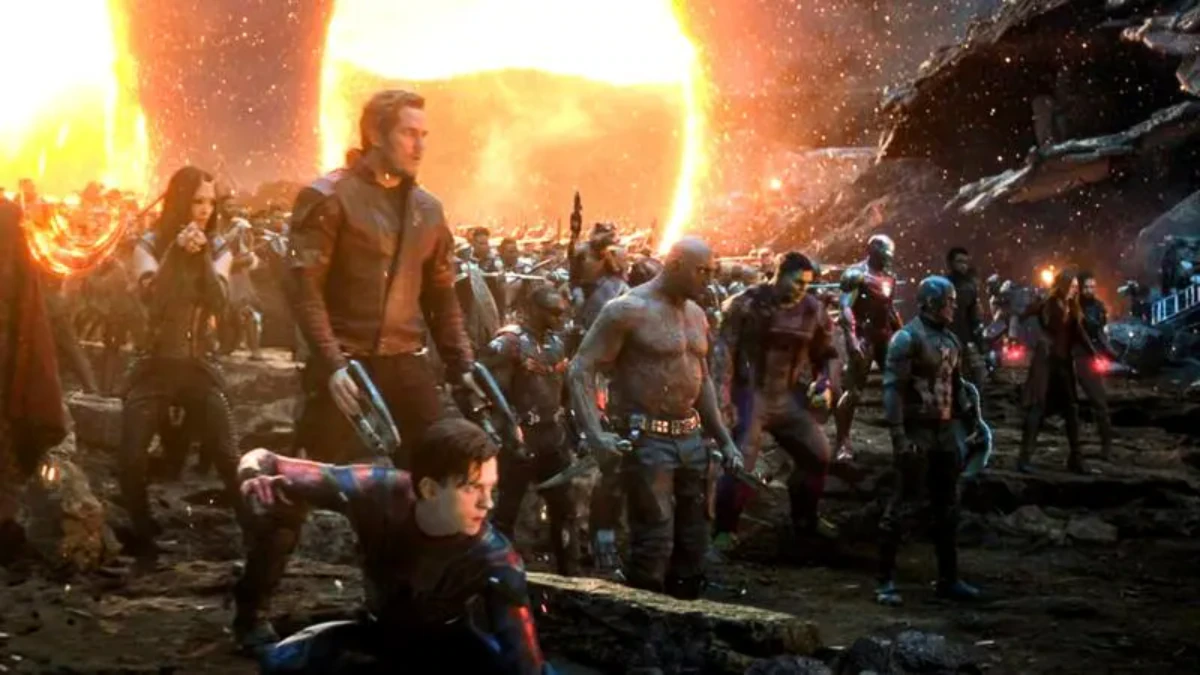
“Steve Emtman! Tim Brown! Bruce Smith! Emmitt Smith!”
There’s a childlike quality we’re meant to have when we see all of these superheroes lined up together. For people of my age, who saw Iron Man at seventeen and who didn’t reach Endgame until their late twenties, the return to childhood is baked in. For people the age of some of my former students, this is their entire childhood rising up in a few shots, returning them to the age when loving superhero stories is actually age appropriate. Perhaps for people older than me, people who had no choice but to come to the MCU as adults, this makes them dream back to animated television shows with clunky craft which cannot stand against this (crappy, but industry-standard) CGI of the late 2010s. In any case, the idea is to thrust us backwards, to put us just after the Paw Patrol moment where seeing our favorite dogs decked out in their respective uniforms gave us pleasure. Joe Russo has made some infamous quotes about how superheroes and mythology go together, which make more sense if you look at mythology as the kind of stories that you learn about as children. The purpose of mythology was never to amaze children or enrapture teenagers, but to provide moral lessons, outline a program of worship. Infinity War and Endgame only take mythmaking to a Himalayan base camp, thousands of feet and hours of onerous labor away from the Edith Hamilton storytelling at the peak.
The Russos cut their teeth on Captain America, taking over from Joe Johnston for Winter Soldier and then carrying him as, more or less, the main character of Civil War. Since Civil War is the precursor of the “Bruce Smith! Emmitt Smith!” school that the Russos blow open for Infinity War-Endgame, it’s hard to give a more incisive observation of Cap in that movie than “civil libertarian.” (After having read the “Civil War” storyline a while ago, I gotta say…the source material the MCU is loosely pulling from isn’t quite Tolstoy, is it.) It’s Winter Soldier, the one where Cap learns that being a government agent all it’s cracked up to be in the post-Hitler years, that provides the iconography for the character as the Russos see him. Perhaps appropriately for Community survivors, Captain America is basically a character on a television program about a secret agent. He stands for bringing out the truth. He stands for doing the right thing regardless of personal cost. He stands for macking on the pretty girl he knows from work. There’s no myth in Captain America, but there are tropes. He is an action hero you can put in different costumes, and you know there will be a different adventure every week, but there can be neither hugging nor learning as long as you have to keep going back to that character.
Even Zack Snyder pales a little bit compared to the Russos in terms of the bigness of the problems that the superheroes face. The DC movies Snyder made are centered on Earth. For the Russos, the problems that the Avengers face are darn near, uh, infinite in scale. Half of all life in the universe is at stake across two big movies, populated not just with Bruce Smith and Emmitt Smith but Rickey Jackson and Rod Woodson and Sterling Sharpe as well. The superhero is the only thing that can possibly stand against the might of Thanos and all his armies and his Infinity Stones and his megalomaniacal plot which exists primarily to be undone. It’s an interesting parallel to The Avengers, where you get the sense that if you were willing to accept more casualties among defenders and civilians alike, you could probably even turn back the Chitauri with a bunch of Hawkeyes and Black Widows. They could have even invited Russell Casse over to close up the hole that Iron Man has to seal. There’s no such answer to Thanos, either in Infinity War or Endgame. Not with ten thousand Hawkeyes could you do this. It is folly. The superhero is an absolute necessity in this world, and the more godlike the superhero, the more important s/he is. Thor is as close to an equalizer as the Avengers get in Infinity War. By the time of Endgame, that person is Captain Marvel. The Russos stop short of saying that we have a mineshaft gap compared to the Soviets, but not by much.
Ryan Coogler
Black Panther (2018), Black Panther: Wakanda Forever (2022)
With apologies to the television program, there are two great what-ifs in the MCU. They’re both bigger than movies. The first one is covid-related. What if covid had not landed squarely on top of Phase 4 or, more curiously, what if covid had landed bodily on top of Endgame? The other one is about Chadwick Boseman: what if he had lived? It changes the direction of Wakanda Forever, a film which foregrounds the women of Wakanda. They had previously been a little sidelined in Black Panther while remaining the clear moral center of the picture, but now, sans Boseman, there was little choice but to tab Angela Bassett, Letitia Wright, Danai Gurira, and Lupita Nyong’o for leading parts. It’s a terrible irony for Disney. The idea of the Black Panther is that s/he is a hereditary position, a part that is meant to be played from antecedent to descendant. In fact, the Black Panther had really come to mean Chadwick Boseman’s T’Challa, and I do not think that Wakanda Forever displaces it, or even wants to do so. So much of the first act of the movie is given over to mourning T’Challa, by which we really mean mourning Boseman, and everything that comes afterwards is a funky anticlimax. The threat to Wakanda in Black Panther had come from a globalizing world that inserted itself into the staunchly isolationist nation via illegal immigrant. The threat to Wakanda in Wakanda Forever is also geopolitical, but where Black Panther had gone past the limits of our belief while encasing that belief with an enchanting hypothetical, Wakanda Forever simply doesn’t make sense. Namor and the people of Talokan must fight Shuri and the people of Wakanda until they suddenly do not have to anymore. It’s like if Gamal Abdel Nasser had suddenly decided upon an invasion of Ayub Khan’s Pakistan in 1960 – who would that make sense to?
This is another way of saying that Ryan Coogler’s iconography is muddled. What T’Challa represents as Black Panther has a real case to be the most potent single superhero symbolism in American film. Black Panther represents Black power, Black identity. The difficulty of integrating into a world, regardless of whether or not integration is desirable, because the world being entered is one that hates you. In that black bodysuit with the purple highlights, the catlike mask, Boseman’s accent work and handsome face, Coogler developed the Black superhero. T’Challa had strong opinions but could learn and adapt. There was mercy in him, someone who saw the Oakland that produced Killmonger as a place that could be rebuilt as opposed to some horrible backwater, irredeemably fetid within the poisonous American ecosystem. He was a person who could appeal to traditionalists while looking towards the future. He was balanced: his probity as a ruler was equaled only by his skill as a hand-to-hand fighter. Losing T’Challa vaporizes that person. No one else is able to fill that role, and the thing about superhero movies is that they don’t tend to prioritize platoon players. If you combine Shuri, Ramonda, Nakia, Okoye, Riri Williams, and like, sprinkle M’Baku on top, you can get T’Challa. This isn’t the Moneyball A’s trying to replace Jason Giambi. The icon at the center of these movies has been stripped away from Coogler, and it’s not an accident that Wakanda Forever is the movie that feels most separate from him as a filmmaker. You can draw a straight line between Creed and Black Panther. The Black heroes at the center of each film bear some real similarity to one another, and they are among the easiest protagonists to root for in recent American movies. Wakanda Forever loses it, and whether it’s because the MCU is a Titanic with a rudder too small for its mass, or because Coogler only had one idea for managing his superhero figure, that film loses every bit of the momentum that Black Panther originally carried.
Guillermo del Toro
Blade II (2002), Hellboy (2004), Hellboy II: The Golden Army (2008)
The superhero in del Toro’s films is a magical figure, which is hardly makes him unique. What makes him stand out from other directors in this genre who work with magic is that del Toro’s version of it has absolutely nothing to do with Harry Potter. Stephen Strange seems like he should have been Harry’s Defense Against the Dark Arts teacher in Half-Blood Prince or something, carrying on with his enchanted objects and his knowledge of abstruse texts. There’s no one in the Hellboy movies who would make any sense wandering around the Hogwarts campus (or Mordor, or Narnia…), and I think if you said “Quidditch” to Blade, you’d get to see a really exquisite example of Wesley Snipes’ ability to make his lip curl.
For as much as science has been an essential part of developing superheroes, or science has been used as a kind of excuse for people like Magneto and Storm to exist, what so much of the genre really comes down to is pure magic, magic that has so much power that it warps the physique or the minds of the people attempting to wield it. That’s where del Toro is comfortable, in the world of Abe Sapien, elite vampire death squads, automated armies from Hell. It is perhaps a little ironic that Sam Raimi comes closer to recreating Universal horror in this genre than del Toro, who has made a career recreating those in the same way Quentin Tarantino has built a brand on having seen exploitation movies. At least del Toro can say that he sees a subterranean world where Raimi’s movies only ever look up.
The magic in the del Toro superhero world is built on something much older than the MCU, or whatever attempts Joss Whedon or James Gunn have made to peel off some of that shine for DC. Where magic in those terrestrial movies, aided primarily by cheap rush-job CGI, is built from bringing in as many actors into a scene as possible, the magic of del Toro is in lore. The lore is not always enchanting stuff, and I’d go as far as to say that neither of del Toro’s superhero sequels really make a meal out of the backstories which del Toro’s heart clearly cherishes. What I really admire in his work has more to do with the The Troll Market of Hellboy II. It couldn’t be any less like the random cosmic stops of The Marvels or Guardians 3, which are minor diversions where we can stuff the comic relief. Hellboy and Abe and Liz belong to a world where there ought to be some eldritch night market, something which is funny but which is so fantastic that even Hellboy can’t quite pretend he’s above it. Del Toro may never return to the superhero genre, which I hardly begrudge him, but there’s certainly no one else who brings the vivid, rancid, and lovely vibes of Phil Tippett to the genre.
M. Night Shyamalan
Unbreakable (2000), Glass (2019)
Not including Split here may feel odd, given that that film and the two above function as a trilogy, but there’s nothing superhero-ish about Split any more than there is about Joker, and so I can’t find place for it here. It’s also missing what makes the other two films work as superhero movies, and that is the question of belief. The belief in superheroes, not unlike the belief in ghosts or aliens or red-cloaked others who come out at night, must be earned through trials.
In Unbreakable, David receives that (terrifying) challenge from his son to accept that there is something special about him, to accept his exceptionality. The aptly named Elijah, who never doubts that there must be superheroes even though he himself is not one, makes it his mission to reveal these abnormal people by whatever means necessary. It is his role to prophesy some larger truth, to expose the gods who walk among us, and it is his place to do so by violence if necessary. One remembers that the prophet Elijah, in 1 Kings, wins a battle with the prophets of Baal and then, per a literal reading of the story, lynches all 450 of them. In Glass, Elijah Price is willing to send thousands of people to a nasty chemically induced death if it means that the proof of superheroes will be made known to the world. Elijah’s plan is a pyrrhic one. David, Kevin, and Elijah all perish, but the evidence of supernaturally power people is livestreamed effectively enough so that there can be, at the very least, debate about whether superheroes can exist.
The small scale, relatively speaking, of Shyamalan’s superhero movies clarifies the difference between his iconography and the iconography of his contemporaries. For Snyder or Coogler or Jenkins to find godhood in their characters, the stakes must be truly massive. Nations, at the very least, must be threatened, if not whole planets. Shyamalan treats the matter of faith in superheroes as something primarily personal rather than worshipful. How small it feels when David Dunn and Kevin Wendell Crumb square off in the front lawn of a hospital. The damage they did could be covered with the right insurance, and no special initiative will need to be involved in rebuilding what they wreak. If they had their ‘druthers, Shyamalan’s superheroes would live in secrecy and limit themselves to minor vigilantism once their consciences demanded action. There is no call to veneration from them. All they want is a cold, scientific recognition.
Patty Jenkins
Wonder Woman (2017), Wonder Woman 1984 (2020)
I have sympathy for Patty Jenkins, especially the Jenkins making WW84. If you’re Zack Snyder doing iconography, then all you have to do is pick your white guy and make him Jesus. If you’re Ryan Coogler doing iconography, then there’s a base level of Afrofuturism that you have to hit and then critics will do the rest of the work for you. If you’re Patty Jenkins and you have to do this stuff with a woman…not to sound like America Ferrara in Barbie, but I do think there’s some pressure to create the superhero who can have it all. She can be in love with Steve Trevor, but she can’t be a sap. She can be toned, but not ripped. She has to be beautiful but a little masculine in the features but also not too masculine in the features. She has to seem like she’s capable of fighting at the same level as the other guys; she’s getting judged against the hyperkinetic stuff in Winter Soldier and the slow-motion of Dawn of Justice alike. By 2017, humor is one of the key aspects of the superhero movie, and so she has to be a little funny but she had better not remind the audience of smartass female comedians.
As far as Wonder Woman goes in the range of the wider superhero universe, it’s perfectly cromulent. Out of the 200 or so movies in my sample, a quarter of them have 2.5 stars from me on Letterboxd. Wonder Woman is one of them. Placing Wonder Woman in World War I solves a number of the problems that America Ferrara and I outlined up there en route to our shared Oscar nomination. Wonder Woman is primarily a symbol of hope for people who need that kind of hope, a person who may singlehandedly possess the power to eliminate hostilities around our Belgian crater of a hometown. She can be a sympathetic, maternal figure for the children, a Joan of Arc for the adults who have nothing left to cling to. The movie makes itself borderline incomprehensible in its final act, a problem shared with the mediocre special effects and the weird twist that a Greek god in hiding is the reason World War I is happening. All the same, I don’t really look at that as being Jenkins’ fault any more than I think the battle between Namor and Shuri is Coogler’s fault, you know? The producers have stepped in, the bean counters are present and making sure that there’s a big enough climax to suit the people who have come expecting that flavor of climax. Again, even by the standards of superhero movies, this isn’t much. Gal Gadot has no discernible personality as Wonder Woman in any of her performances, which I suppose makes it harder for the misogynists to pin their hatred on a single characteristic thing that she does. Still, Jenkins has the right idea here. Wonder Woman is hope. Hope and Wonder Woman go together. It’s an appropriately feminine feeling (I don’t see any boys named “Hope” around here, do you?), but it gives her a way to do her physical combat under a banner. I’m not alone in thinking that this was fairly successful. In 2017, Wonder Woman was generally given as the most socially relevant superhero movie since The Dark Knight, and it was difficult to see how it might be surpassed. Black Panther happened, and we lost that little slice of history.
The iconography of Wonder Woman diminishes badly in the sequel, for the iconography of WW84 is not really about Wonder Woman, Diana Prince, whoever, but about the new laudable angle of the superhero movie. WW84 isn’t the child of Wonder Woman. If anything, that sequel is about the necessity of crushing your hopes, of letting go of wishes that are actively destructive to the fabric of society, of making decisions that do a benefit to society at large as opposed to making yourself happy. Diana has to give up on Steve Trevor for a second time in this movie, for example. The movie that WW84 is descended from is Midsommar. Jenkins, like Ari Aster, is not really making a movie within a specific genre. She was making a movie that signified, through its visual and thematic choices, something that we presumably cannot understand in a “simpler” example of that genre. One of the key elements of the superhero movie is that its characters must resort to violence, and with some frequency, for justice to be served. WW84 does not really believe in that idea. It does have one of the unlikeliest fights in superhero movie history to show for it at the end, but perhaps the final battle between Gal Gadot and Kristen Wiig is proof enough that it wasn’t here for the violence. It was here to say something about the greed at the center of the human heart, about how our human desire for more is a sickness that threatens to destroy all of us, about how we have to dig deep to find our noblest selves and give up the trappings of abundance, or else we will perish ignominiously. This is all well and good when Erich von Stroheim is making Greed, or Orson Welles is making Citizen Kane, but watching WW84 try to reach those same ideas is onerous in the extreme. Jenkins takes the moral urgency of Wonder Woman and tries to elevate it in WW84, and the result is a minor disaster which limits Wonder Woman’s exertions to screwing with mallrats within its first ninety minutes.
James Mangold
The Wolverine (2013), Logan (2017)
Moving on down the line here of iconic characters who have been interpreted multiple times by the same person.
Bringing back Wolverine for Deadpool & Wolverine doesn’t really affect how I view Logan. The only thing that Ready Player One has a good point about is that when the apocalypse comes, the IP will still be there with the Twinkies and the roaches. It sort of can’t be helped that there will always be enough money to get Hugh Jackman back in the suit, that there will always be some corny way to write people in and out of these stories, that there will always be people who can’t sleep at night unless they’ve heard him growl some enunciated Eastwoodism within the past week. It’s fine. And you know what, the movie at least acts like Logan is dead for good. It treats the world of the X-Men, such as we’d known it for the previous seventeen years, like it’s being sucked down a sandy, rural drain. Given the overall quality of those movies, why the heck not?
Logan is fine, getting after an idea that X-Men comics is famous for including. What if Logan, the longtime loner, obsessive, Canuck weirdo turned out to be kind of a great father figure for girls who needed that kind of interaction? There’s a lot of that with Kitty Pryde and even more with Jubilee. (In the movies, of course, we see the way he acts as Rogue’s protector in X-Men.) In Logan, that gets directed to a person, Laura, who is biologically just him. Like WW84, Logan is something of an elevated superhero movie, a little too focused on this idea of legacy in a genre where what kind of trail you’ve left is, as we’ve covered, perpetually incomplete. But it’s something Mangold has shown interest in going back to The Wolverine, which, for my money, does a better job at exploring this angle of who Logan is. The literalism of Logan’s connection to Laura, as well as her childhood, forces him into a position that isn’t explored in a terribly interesting way. If anything, knowing that there’s going to be a little girl Wolverine running around one of these days takes the edge off of the tragedy of a basically unkillable man facing up to the mortality he thought he’d never have to submit to.
Choices make characters, though, and The Wolverine has far more choices in it than Logan. In The Wolverine, Logan finds a fan. Yukio is a martial artist favoring swords and gifted with some precognitive abilities. To the best of my understanding, she is a Jedi. In any event, Yukio is a young woman whose purpose thus far is to be a killer for a Japanese crime syndicate. Logan is obviously appealing, given that the man is probably Marvel’s preeminent killer; Yukio sees him as an ultimate soldier. If this were a better movie, then I think we’d see Yukio as more than Logan’s sidekick, but the point that’s made more famously in Logan stands here. As a mentor, Logan helps to give Yukio the purpose which she did not have when she was killing for the Yashidas. Responsibilities turn to choices; she chooses to defend Logan, insisting that she is his bodyguard, and it becomes possible to see the amoral and basically disinterested Jedi as a figure capable of acting with honor within a context outside that of her birth.

What Logan is within himself is a little bit harder for Mangold to parse, and one gets the sense that we’re being wound up to that idea which is awfully disappointing for a main character: he’s as much a foil for other characters as they are for him. He is best understood as a mentor for Yukio, providing the expertise and positivism that she lacks. He is best understood as a father-brother to Laura, providing the humanity that she doesn’t have experience with. And of course, there’s Logan as the foil to himself, the wildman attempting to control his own rage and trauma, the one who dreams of himself as a likely partner to a polite and statuesque redhead. The character can still be interesting relying on foils and mentorship, but Mangold is basically running stabby Mary Poppins stories.
Logan’s origin was slowplayed in the comics, and in the movies, there’s a good chance that his origin story is the most panned origin story in this genre. Mangold doesn’t have Martha Wayne’s pearls or the explosion of Krypton to go back to, and so he has a gaping hole to fill in that never really gets found. It means that Mangold, perhaps as much as any superhero director, has the chance to decide why the world needs a Wolverine, what makes him essential and necessary. The Wolverine and Logan choose the right direction, because Wolverine is no Captain Marvel or Thor who can change the destiny of a universe through the expression of his power. The stakes for him are necessarily personal rather than super. He’s the guy who has to stand up at the front of the meeting and say, “I’m Logan, and my trauma gets the better of me.” Again, if you’re a regular listener of The Big Picture and you’ve got Logan on your 2017 Mount Rushmore with Get Out, Blade Runner 2049, and Lady Bird, then that image is quite potent, and Mangold is justified. I’m not all the way there myself.
Brad Bird
The Incredibles (2004), Incredibles 2 (2018)
I have spent a lot of time talking about how much I admire The Incredibles, as well as my belief that it is thus far the greatest superhero movie ever made. For more of that, I’ll direct you to my second link from the top of this page.
Bird is second only to Snyder in Randian ideology among superhero directors, though perhaps we can make a case for Bird’s superior fidelity to the Roarkish cult because Bird does not ascribe literal godhood to the Parrs or Lucius Best or any of their peers. Bob Parr’s love of the superhero game is expressed as a way to stroke his ego, and then as a way to stroke his ego while he’s having a midlife crisis. In The Incredibles, all’s well that ends well; the ego is tamed just enough to bestow nobility on a man who never used his gifts unselfishly before. The success of the Parr family in solving a problem largely of Bob’s own making is enough to convince a populace and a government that the supers are safe enough to tango with once again. “The supers are back!” someone cries happily when she sees Syndrome flying through the air en route to do battle with his own robot. The lilts of fascism float through the air: the desire for a savior, the proud over-man who claims he can save you, and above all the cheerful nostalgia that dims real memories. A generation before, the supers were hounded out of public life through legislation and distaste. The world appears to have proceeded without terrible consequences or, more importantly, the presence of supervillains. Now, with those memories on the back burner, the old costumes remembered with the fondness of retro football uniforms, the people accept the supers once more. The government does not quite make that leap, at least as far as The Incredibles tells us, but the hearts of the people are with the over-men again.
Funnily enough, compared to Incredibles 2, The Incredibles is almost measured. The villain of Incredibles 2 is a person who has been disillusioned by the failure of superheroes and has resorted to a kind of false-flag terrorism to prove how ineffective they are. For about thirty seconds, it seems like the Parrs and their kind will have to really own up to the kind of social sickness that people like them have created, a malaise that has led to terrible consequences. What if the presence of the supers really did create a carelessness, a misplaced and infantile trust in the hearts of the Municibergers? Have they been praying to God for help from the roof of their homes, only to ignore the boats and the helicopters that came to rescue them? The rest of the movie goes out of its way to ensure that this particular interpretation of the superhero is the bad faith work of someone acting viciously. Incredibles 2, which is going to be remembered for the fight that Jack-Jack has with a raccoon much more than it will be remembered for its story about superheroes, reminds me of Alan Sokal, the physicist who will be remembered for his hoax much more than his physics.
Bryan Singer
X-Men (2000), X2 (2003), Superman Returns (2006), X-Men: Days of Future Past (2014), X-Men: Apocalypse (2016)
There are people out there ready to go to bat for X2 and Days of Future Past. I am not one of them. Singer’s personal life and likely crimes are sitting out there for all to see, so perhaps it’s unlikely that he will get a chance to make more of these X-Men movies. The X-Men are a team for Singer; Superman is so vanilla for him that he’s cardboard. Neither one of these approaches really serves the superheroes in question. There’s a good case to be made, honestly, that by focusing so narrowly on the Jean-Wolverine-Cyclops business, and then by emphasizing the team angle so expressly in other X-Men movies, that he loses the plot of what makes these people compelling. With a leather aesthetic lifted from Blade and the numb darkness that falls short of the stagy shadows of Nolan’s Batman movies, Singer certainly has ideas of what makes these superheroes movies work. They’re thin indeed, and from my perspective, movies which go in basically the opposite direction of the storytelling that Singer favors tend to be much better. Maybe his influence is even narrower than I’m giving him credit for here. Maybe the inky tones and supposedly real-world settings we get in later superhero movies owe more to Nolan than they do to him, even if Singer meaningfully predates Nolan.
Bruce Timm
Batman: Mask of the Phantasm (1993, co-directed), Superman: Doomsday (2007, co-directed)
I am including Bruce Timm here, who does have two co-director credits on movies that are in my sample. They’re inflected by the Saturday morning cartoons, which, duh, because Timm ran those Saturday morning cartoons. They’re inflected with some of the cheerful chunkiness of Archie, because Timm’s carrying those cartoonists as an influence. He’s also been a producer on basically every animated DC movie from Mask of the Phantasm on. Timm isn’t Bob Rafelson; he’s Bert Schneider.
Jon Favreau
Iron Man (2008), Iron Man 2 (2010)
There’s less to say about Favreau than there is to say about Robert Downey, Jr., because the primary icon of the Iron Man movies is not the suit, or the man in the suit, but the goatee. It’s only in superhero movies where a production that raises up the lead actor above all else feels like a novelty. There are two stills of Downey that stand out from Iron Man. The one where Tony Stark tells the world that he is Iron Man is the obvious one, but the other one that’s lived on turns out to be antithetical to the principles that Iron Man will espouse once he’s emerged from that cave with his scraps. It’s when, sunglasses on, arms outstretched, practically standing on his tippy-toes, his Jericho weapons system obliterates a mountainside. It’s the War on Terror version of walking away from an exploding gas station, and Favreau enjoys that moment a little too much, wants to glorify the coolness of Downey a little too much, and it turns out to be a nasty miscalculation. It’s too cool, too triumphant to be recast in the wake of Tony’s humbling. The MCU has gotten a lot of praise for its ability to take B-list characters like Iron Man, or practically invisible characters like their iteration of the Guardians of the Galaxy, and make them into major figures in the mythos. But the suit has never meant much for how we view Tony Stark, certainly not compared to the way that the shield matters for Steve Rogers or the cape matters for Stephen Strange. That’s Favreau’s doing almost as much as it is Downey’s. And maybe, just a little bit, that’s why Robert Downey, Jr. is coming back to the MCU, even if Downey is as totally miscast as Doctor Doom as he was perfectly cast as Tony Stark.
Jesters
James Gunn
Super (2010), Guardians of the Galaxy (2014), Guardians of the Galaxy Vol. 2 (2017), The Suicide Squad (2021), Guardians of the Galaxy Vol. 3 (2023), Superman (2025)

Like most children who watched television, I developed some concerns about quicksand when I was little. Now that I’m older, I fear a similar sucking morass: trying to figure out who did what in a screenplay. MCU: The Reign of Marvel Studios gets into that question with Guardians of the Galaxy, a question which had been floating around for the previous decade. How much of the success of Guardians of the Galaxy, perhaps the only real underdog movie of the MCU, certainly the one that got the farthest based on its screenplay, belongs with each of its writers? It’s probably fair to say that the timeline tracks. Nicole Perlman did a ton of work on the front end. James Gunn says that he basically rewrote the screenplay, and it certainly sounds, from line to line, very much like his style. Two things stand out to me from the aftermath. First, every account says that Perlman had to fight for a credit, and that James Gunn worked to keep her from getting a credit on the movie. Second, the Guardians of the Galaxy screenplay is the best from any of the movies Gunn has directed. I am not suggesting that we should subtract Guardians from Gunn’s board, but it is worth looking at that screenplay against his others to see what remains. When there’s no Nicole Perlman, what is James Gunn?
Super actually predates the tweets that Jack Posobiec, Mike Cernovich, etc. unearthed so that Gunn would get in hot water, fired from his job at Disney, and led to multiple outrage cycles from many corners of the Internet. I’m not sure that these nuggets are worth firing Gunn for, but if you find this type of humor less than funny (guilty), then Super is going to be a drag. Super is a vehicle for what we might kindly refer to as “edgelord shit” more than a movie about a costumed vigilante. Clearly there is something wrong with Frank Darbo, a man who is inspired to become a superhero in order to reclaim a wife who leaves him around the same time she breaks her sobriety. Give Gunn credit. He’s onto something here, which is that a guy who goes around interdicting wrongdoers with a wrench is pretty messed up regardless of what he’s wearing. Some of this leads to slapstick moments where Frank chases down a robber who has pilfered something from a woman in a wheelchair, only to fly headlong into the woman in the wheelchair. In more situations, Frank commits some of the bloodier violence you’re likely to come across in a superhero movie, as when he beats the crap out of a guy who cuts in line at the movie theater. Frank’s monologue at the end of the film about the unchanging rules of the world tells us about the principles that gird him, from preventing line cutters to destroying child molesters. (Frank is inspired by the Holy Avenger, a Christian-themed superhero he sees on television and in some bad comic books. As someone who has watched multiple VHS tapes of Bibleman, I was chuffed if not impressed.) All of this is par for the course for the costumed vigilante without powers, and Gunn, like a child trying to get as many flavors of soda as possible into his biggie cup at the gas station, mixes up violence, social conservatism, personal responsibility, trauma, and peeking id.
Gunn was beaten to the punch to this kind of character, a self-made, self-professed do-right with a profound need for therapy, by Peter Stebbings. In 2009, Stebbings made Defendor, where Woody Harrelson plays the title character. Defendor follows Arthur Poppington, who exists in that gray Gump zone you find in movies. Blaming one man for the venal death of his mother, Arthur dons a costume, gives himself a title, and goes around the criminal underground of his city alternately terrorizing and getting pulverized by criminals. Defendor is not all that good, even by superhero standards, but there’s an angle here that virtually no other movie takes on its superheroes. It is much more likely to come across a genius donning a costume than it is to find a Simplicissimus doing the same. Arthur, confused by the events of his past, traumatized by a bad childhood, resorts to vigilantism because it is a way to lash out at what he believes to be the most obvious trespassers against him. Frank Darbo has something of this in him, but Gunn is not really interested in the mindset of the person who puts on a dorky costume and seeks out physical combat. Gunn is interested in what that person does, but not why that person might do so, and thus Frank’s crusade lacks any pathos whatever.
Frank speaks to a vision of his wife formed by the vomit in his toilet bowl; Frank has a dream where Jesus speaks to him casually before he is penetrated by many tentacles and the top of his skull is ripped off so his brain may be wiped down. There are two Black characters of note in this movie. One of them is Frank’s coworker, Hamilton, who speaks in the profane vernacular that nervous people like Gunn assigned to Allen Iverson back in the late ’90s. The other is Don Mac, who plays a crime lord who makes a mission out of raping Sarah, Frank’s estranged wife, and making us feel deeply uncomfortable. This is a plot point taken directly from The Birth of a Nation and countless other racist texts. Fear not, though: the crime lord is killed and Kevin Bacon’s villain calls him the n-word. The women in this movie are similarly empty. Sarah leaves Frank and is not given a single scene afterwards in which she is not stoned out of her skull. Libby, Frank’s sidekick, rapes him. Fortunately for Frank, he never has to explain to Sarah that his partner in hero work had sex with him, as Libby’s face is blown off towards the end of the movie. All in all, this is edgelord shit through and through. Schoolyard humor amplified by the fact that Gunn has a modem, casual racism, casual sexism, humanity sacrificed for the sake of the joke. Gunn is not really having a laugh at the institution of superheroes, or satirizing the lengths to which unlovable men will go to avoid therapy. It’s pure attention-seeking through and through, in which the joke is on the person who paid for the ticket.
Two final notes on Super which give us some insight into James Gunn. First, he plays the devil in the “Holy Avenger” sequences in the film. Second, if you watch the credits long enough, you’ll find something I’ve never seen in any other credits sequence: Gunn’s Twitter handle.
In Guardians 2, the Guardians have stepped back from the guarding the galaxy business in favor of something more like Peter Quill’s original semi-criminal treasure-hunting. This works. Although they were capable of great heroism when they worked together earlier, they have not transitioned entirely to hero work. This is still a bundle of rapscallions who are out for their own interests, even if they are countered by the outright piracy of the Ravagers and their ilk. Gunn copies the Han Solo template once again, and with success. We recognize that there’s room for these guys to do things for the benefit of others even if they’re still invested in material things. More pressing for Guardians 2 is an issue it has to solve, one that’s not unlike the issue you find in the middle seasons of a sitcom. You have characters with humor beats and punchlines that we’ve grown accustomed to and expect more of. There’s Rocket, the profane little scamp who likes to steal things and will always get cranky when someone fails to identify him as a raccoon. There’s Drax, whose crippling inability to understand metaphors and idioms has carried over from the first movie to this one. They are still reasonably funny in here, although the “Taserface” stuff in here, championed by Rocket, womp womps hard in practice. Groot is now in baby form and has a baby voice, which is very cute. I can’t help but laugh when Groot, sent on missions to come back with Yondu’s fin, fails over and over again. The stuff that Rocket and Yondu say in response is the stuff of kids’ shows on Netflix (“let’s just agree never to discuss this,” “this is an important conversation right now?”), but Groot is so enthusiastic and sure that he has come back with the right thing that you can’t help but feel for the little guy. More on this principle in a second.
However, there’s some responsibility to develop the leads a little further for the sake of sympathy, and here Gunn has no answers. Gamora is fighting her sister. Peter Quill is engaging with his godlike father for the first time and struggling to understand how he can be both so hospitable and so uncaring. The comic who can make layups via Drax struggles to find actual feeling in Gamora and Quill. Quill in particular suffers here, for Gunn can find no good way to get him a funny line without resorting to a mildly outraged “Dude!” at the top of the sentence. The closest Gunn gets is the much-praised “He may have been your father, boy, but he wasn’t your daddy,” which would be more affecting if Yondu’s ersatz paternity had been addressed in any meaningful way across this movie or the one preceding it. It’s reminiscent of the way that many of the recent Marvel movies, including Captain America: Brave New World, come to conclusions by trying to mimic the beats of the conclusion of Spider-Man 2. “He wasn’t your daddy” is a quip, not a foundation.
On my Letterboxd list of superhero movies that I’ve kept as a reference, Vol. 3 is rated tenth by Letterboxd users. People I usually put some trust in, from Matt Zoller Seitz to A.A. Dowd to Justin Chang, have expressed at least some praise for Vol. 3. I can’t get there, not even a little bit. The Jester is unsatisfied with pranksterism after a while, or perhaps there are only so many Taserfaces he has in him to create. In any event, Vol. 3 relies even more heavily on Drax’s literalism and the playground insults of a guy in his forties to work the laughs angle, and what’s missing, ironically, is the character whose origin story we’re forced to sit through. Back in Guardians of the Galaxy, the interplay between Quill’s somewhat reluctant morality and Rocket’s gleeful misbehavior led to a number of the movie’s best laughs. This blog’s history on the MCU is an encomium to “Because I’m one of the idiots who loves in it!” I also enjoy the moment where Rocket looks around at the gang all standing up together and wearily points out, “We’re all standing now. A bunch of jackasses standing in a circle.” Removing Rocket from the equation isn’t removing Zeppo from the Marx Brothers; it’s eliminating Groucho.
In reaching for the maudlin strokes of animal testing as a plot point to explain where Rocket came from (and to include the High Evolutionary), Gunn is relying on the audience to do much the same thing it was doing when it was crying out in glee over Baby Groot as he insisted that he ought to push that button. A little raccoon, a little otter, a little walrus, and we are instantly sympathetic. But like Baby Groot, they’re computer animated. They have been designed to be as cute as possible, their voices spoken to be as squeaky and sweet as possible. The High Evolutionary manufactured them into the forms they now hold, but so have the underpaid visual effects artists working from the outline in James Gunn’s script. This is cynical business. Another found family, this time shrunken and furry, all suffering and no personality. The found family idea, one of those overprocessed fads of recent writing, was significantly stronger in Gunn’s films when it wasn’t doing backflips to get our attention. Holding hands to spread the terrible might of the Power Stone among one another was the selfless action that underlines their connection as a group. A gasping heist parody and a “Are we the aliens?” interlude do far less work. Even trying to save Rocket as he desperately hangs on to his life is not the evidence of closeness that Vol. 3 wants it to be. All we’re seeing is triage for Rocket, and for the Guardians trilogy as well. “What if my real father was exploitative and evil?” is the question at the center of two movies in a row, with the laughs harder and harder to come by, the invitation to sniffle into our Kleenex more and more incessant.
The penultimate place to look for James Gunn is in The Suicide Squad, which acts primarily as a repudiation of Suicide Squad. It has this in common with Super, which is there to act as a repudiation of the traditional costumed vigilante story. The Suicide Squad is a contra- movie, one which is there to correct what was largely deemed a mistake by critics and the moviegoing public alike. With this contrarian purpose in mind, Gunn proceeds to make a film with Harley Quinn, Rick Flag, a Black sharpshooter concerned about his daughter’s welfare, a human-animal monster with limited language, and a supernaturally imbued man with reluctant access to his powers. To this group, John Cena is added in the Drax role. Cena was unnecessary in Suicide Squad, because it was not a comedy. John Cena is, as far as Gunn is concerned, essential to The Suicide Squad, because John Cena adds a coda to most of the jokes in the movie to make sure we get it. If it were a Netflix movie, I would assume that this was a concession to everyone watching TikTok while using The Suicide Squad as background noise, but The Suicide Squad almost made back its budget while covid was stabbing movie theaters in the gut. The Suicide Squad, when it isn’t rehashing most of the characterization from a previous movie, is playing the hits from the Guardians trilogy with more reliance on humor referring to bodily functions and a unrestricted use of the word “fuck.”
The culmination of Gunn’s film career, which I think will be true even as he continues to wield the power of his DC tsardom, is Superman. The whole thing is gormless and forgettable. Are the parts that are ostensibly for adults compelling? The border crisis between Boravia and the literal stick-wielding brown people of Jarhanpur: no, I shouldn’t say so. The tortured dialogue about journalistic ethics between Clark and Lois: yikes. The reassuring speech where it turns out that Clark’s taciturn fat hick foster father might not be a MAGA case after all: nah. Compare that to the action sequences, which are overlong and samey when they’re working out their action, but which feel inconsequential because the ideas are bad. Superman’s clone can beat up Superman; Superman and Krypto (all CGI, no heart) can slide through a pixelated river. Gunn sees Superman as a reverse Peter Quill, but by reversing the absent parentage, he gets to attempt to make a point about immigrants or something. The single best, most interesting part of the movie is the part where Superman goes out of his way to save a squirrel. No other piece of the film exposes some understanding of Superman as someone who values life itself, regardless of its size or perceived importance. It’s also wrapped up in some of the worst moments of the movie, where Gunn badly misjudges the humor value of his kaiju.
The Jester, in Gunn’s case, has become the king. The model of the Guardians movies, and incidentally the success of The Suicide Squad, has made his model the preferred flavor of superhero movie. The light comedy with some thrusts at emotional togetherness, a little bit of gore, and a growling climactic battle is the most valuable coin in the superhero economy. The superhero epic is dead, dispersed like the remnants of a supernova. The superhero movie which ties in too neatly to a television program, so much so that the movie itself feels like a very special episode, has been roundly panned. The superhero movie which relies on the charisma of a single character in conflict with a single villain, something in the mode of The Dark Knight or Iron Man, is the superhero movie equivalent of American manufacturing. In authority over superhero content now, and with his example the most followed at present, the irony of Gunn’s Super is the latest sincerity.
Joss Whedon
The Avengers (2012), Avengers: Age of Ultron (2015), Justice League (2017, co-directed)
The similarities between Joss Whedon and Taika Waititi in superhero movies are pronounced, so much so that I almost want to tackle the two of of them at the same time. Both launched themselves onto the superhero scene vigorously after having established their comedic styles. Those first entries, The Avengers and Thor: Ragnarok, were both hailed as fresh air, revitalizing their franchises after a couple of stale entries had “threatened” (the MCU was never threatened, not any more than the Titanic was threatened by an ice cube) the branding of the whole. The loudest moment of my moviegoing life came when Hulk picked up Loki late in The Avengers and bounced him around the room a few times. Fast forward five years and both Whedon and Waititi are functionally out of the superhero game. “Reviled” is not too strong a word for how audiences received Justice League and Thor: Love and Thunder. Joss Whedon, who capitalized on The Avengers by making his own black-and-white adaptation of Much Ado About Nothing starring everyone he’d ever had on one of his TV shows, who has made a name for himself as a David O. Russell-level psycho on set, will go down in history as the implicit target of the most robust film fan campaign of the 21st Century. Please, the fans said, for the love of heaven, please give us the version of the movie without anything Joss Whedon did. More than that: the Snyder cut is definitely better than the version of Justice League that has Whedon’s name on it.
As a visual stylist, Whedon has a blind man’s aim more than anything else. His name is on that shot from The Avengers which remains the most important single shot of any from the fourth genre, but that bit of concealer is spread thin over an unseemly zit. Whedon’s films are rather a gray-brown lot, especially true in Age of Ultron. On one hand, that is the price you pay for the giant CGI spectacle, which is the focus of all three of Whedon’s movies. On the other hand, there’s no successful plan in the screenplay for that grimy color palette. Age of Ultron has that sequence where various superheroes try to lift Thor’s hammer, which reminds me an awful lot of emo Peter Parker in Spider-Man 3. There’s something to be said for it because it’s so memorable against the rest of the film, clarifying something about the inner lives of these superheroes who are overwhelmingly just costumes. The hammer-lifting just isn’t calibrated very well. That scene is as visually unappealing as any of the other scenes in the movie even though it requires no special effects. What remains without them is Whedon, and Whedon is not cooking with gas. In Age of Ultron and Justice League, his positive contributions seem meager. They look bad. The threat in all three movies is “everything will be destroyed unless our heroes start acting like a team, dammit.” As we recede further and further from those movies, it’s turned out that there are no words in them that have persevered like those in The Dark Knight or Batman or Blade. They lack the visual panache of those other movies. Whedon’s sameness, the conservatism of playing for the largest stakes with the least details, the insistence on microwaved character development, the plodding journey to reach a prosaic ending make him one of the least successful directors in the genre. Much was given and little was returned. Perversely, it is those qualities which I think made Whedon the first major crossover between blockbuster Marvel and DC film properties. There are poodles and pinschers that understand the structural choices of Whedon’s movies, which, for a studio executive, makes him perfect.
Tim Burton
Batman (1989), Batman Returns (1992)
“You ever dance with the devil in the pale moonlight?” the Joker asks Bruce Wayne. Bruce Wayne is confused, and reasonably so. The phrase makes about as much sense as “Cow Tools” does, wherein we don’t really comprehend so much enjoy the feeling of it washing over us. The Joker’s reason for saying it predates Jules Winnfield’s Ezekiel 25:17; it’s there because saying it before you kill someone seems cool. In both cases, the words are nonsense. In Batman, Jack Nicholson says them with a lilt, like he’s quoting the lyrics of a song on the B-side of some obscure 1950s 45. It’s a mysterious nonsense.
Tim Burton has a way with mysterious nonsense in his best movies, which is countered by his predilection for using the same actors over and over again. By the time you get to Johnny Depp in his fourth collaboration with Burton (Charlie and the Chocolate Factory), the nonsense has grown stale. In his first (Edward Scissorhands), the nonsense is brand new, and there’s delight in Depp’s stilted gait, his Victorian pallor, his mumbling protestations. Novelty is the spice of Burton’s filmmaking, and while Batman Returns is his third collaboration with Michael Keaton, Keaton’s Bruce Wayne is nearly an afterthought in the film. The nonsense is strong with Danny DeVito and Michelle Pfeiffer in that one, whether it comes from a coterie of penguins or a preponderance of cats. There’s a freshness with the actors and the material that shines through with this younger Burton, this guy who is still experimenting with image and shape and theme without having given up totally on those things by his middle age.
Burton has a very different notion of what can create the circumstances for Batman than just about any other director who features him. Batman is born of fear for Nolan, of necessity for Liu, of bitterness for Reeves. The Gotham that his parents helped to build and then died within gives structure to Batman throughout all of these other iterations. With Burton’s Batman, things are different. The dead parents are not quite an afterthought, but they’re close. Gotham is too nonsensical, a goth Carnival where henchmen are tumblers and fire-eaters and stilt-walkers, where the villains seem to literally fall into the situations which make them villains. All of these things make sense through the will of the performances (Nicholson, DeVito, and Pfeiffer, obviously, but Michael Gough and Pat Hingle as well) and through the atmosphere where everyone breathes in a little nitrous oxide with every inhalation.
There’s no way for us to return to a Leslie H. Martinson version of Batman, for even the animated Adam West recreations of the past ten years are too self-aware and hagiographic to spark joy. There’s no way for us to return to Joel Schumacher’s Batman because movie audiences seem to find the suggestion of sex offensive anymore. And, maybe saddest of all, there’s no way for us to return to Batman or Batman Returns. Burton does not need answers for what makes Gotham so kooky, nor does he need lore to define what Batman is doing on Gotham’s streets. He’s playing around, relying on his own judgment and sense of what’s cool, or funny, or memorable. There won’t be another superhero movie that indulges itself with this kind of looseness. Not even Burton has that in him anymore.
Taika Waititi
Thor: Ragnarok (2017), Thor: Love and Thunder (2022)
Whedon has a plot sameness that he can’t get around in his movies. Waititi is fighting a sameness as well, which is that he’s got a hard limit on the types of jokes he can execute For Ragnarok, Waititi gets ahead of Deadpool despite the fact that his movie postdates Tim Miller’s. Deadpool still has too much pappy schmaltz in it, too much “I’ve been wronged” at the expense of what sympathetic viewers compare to Hellzapoppin’ and Looney Tunes. Ragnarok does its best to ignore any actual problems Thor and company may be having until they make it back to Asgard late in the movie, and Waititi, to his credit, managed to make a movie where the jokes were just good enough and the plot payoff just okay enough to make it a big hit for discerning MCU watchers. The blueprint for Ragnarok is What We Do in the Shadows, where genre does most of the story heavy lifting so that there’s rooms for the jokes to skitter around. It’s no great comedy, but one ought to give some credit to Waititi for the individual performances in Ragnarok. Chris Hemsworth makes a few faces worthy of memes. Mark Ruffalo, playing a person who is one stubbed toe away from a nervous breakdown, feels like he could have been teleported from one of those indie flicks he originally made his name in. I’m always a little wary of giving anyone besides Cate Blanchett credit for being as good as she is in a movie, so I’m willing to slight Waititi on that count.

It’s not quite the Mandela effect, but I never remember that Waititi doesn’t have a screenwriting credit on Ragnarok. (I tried to remind myself with that little nugget in the Mark Steven Johnson section, and darned if it still didn’t stick.) He does, on the other hand, have one on Love and Thunder, a movie that has a literal “and he’s right behind me, isn’t he” line in it. The rubber explodes on contact with the road for Waititi in Love and Thunder. In Ragnarok, a person can squint and look at the fate of the Asgardian refugees as something nearly postcolonial. What does it mean to have a homeland? Is there something about the original place that matters more than the community and traditions which persevere? Ragnarok is well short of The Black Atlantic, but again, one looking with generous eyes at the film might see something interesting happening in its theoretical sinews. Love and Thunder, on the other hand, has more in common with a Lifetime Christmas movie than it does even with Ragnarok. In that way, it fits more neatly with Waititi’s oeuvre outside superhero movies. Like Roberto Benigni before him, there is either an appalling cynicism or willful ignorance in Waititi concerning human feeling. It’s never just cancer with a guy like this: it’s Stage 4 and it’s braided in with girlbosses, somehow. What Waititi doesn’t seem to understand, and what his audiences seem to comprehend even if they don’t say it, is that the heavy-handed approach to drama that his movies take often detracts from the effectiveness of the jokes. Even Jerry Lewis couldn’t always combine those approaches, and Jerry Lewis was actually brilliant as opposed to “Oscar for Best Adapted Screenplay” brilliant.
Joel Schumacher
Batman Forever (1995), Batman & Robin (1997)
The third-horniest superhero movie is Batman and Harley Quinn. It is a distant competition for the bronze. The horniest superhero movies in history are Batman Forever and Batman & Robin, in whatever order you want to put them in. Joel Schumacher understands three things that I think every superhero director also understands but lacks the stones to execute.
Most obviously, it’s skintight costumes. Occasionally it’s little more than fancy underwear. It’s people in incredible shape with their thighs outlined and shoulders broad. It’s Halloween makeup, in some cases anticipating the way that Halloween has exceeded Valentine’s Day as our holiday where the most people get laid. The counterpoint, theoretically, is that every superhero movie understands this. Ugly people are not cast in these roles. Everyone who has ever played Catwoman is zipped into a suit so tight that you can see the shape of her internal organs; by this standard, Matt Reeves and even Christopher Nolan understand the sexual power of their lead actresses. By this standard, Zack Snyder can lay claim to a fundamental appreciation of the priapism some men experience around the lady superheroes. It’s even easier for animated movies to rap at the door of this idea, given that Diana and Koriand’r and Harley Quinn can have whatever curves or eyes an animation studio wants her to have. On this first level, everyone agrees to the point of obviousness. What makes Schumacher exceptional here is that he suggests that these adults in the costumes and their physical primes are not merely flirting or respectfully crushing, like Matt Reeves and Christopher Nolan suggest. (Superman and Wonder Woman make eyes at each other through the 2010s in the animated movies, and it has all the gravitas of eighth graders at a school dance.) Schumacher doesn’t have the R-rating to play with like Snyder does, so he can’t show Batman and Chase Meridian stripping each other down to the sound of something significantly sexier than Leonard Cohen’s voice. Schumacher is not focused on the after and the guilt that comes with it, as we see in The Killing Joke or Batman: Year One. For Schumacher, sex would be a lot of fun, would come without the confusion or shame, and would be more than a little bit kinky. When Uma Thurman comes in doing the Blonde Venus entrance in Batman & Robin, she pops out of the gorilla suit and starts talking to Batman and Robin about something that might be a threesome or might just be about getting on top. Schumacher is a missionary for sex, but if the assless chaps and Batsuit nipples of the opening credits are any indication, he ain’t proselytizing for the missionary position.
Schumacher goes much further than Burton or Reeves or Snyder or Nolan or Oliva or whoever else you want to put into this discussion. I think it’s fair to say that he still has the “male gaze,” but that his male gaze is not so simple as grounding the viewer in a fundamental binary of straight male and straight female. Nicole Kidman and Alicia Silverstone and Uma Thurman are all indecently attractive in their roles, but it’s not as simple as form-fitting clothes and husky whispers. The callback to Marlene Dietrich is instructive, not simply because it grounds Poison Ivy in this humorous, ironic, animalistic, unexpected sexuality, but because Dietrich is one of the essential queer icons of film history. The male gaze is Kinsey-3 for Schumacher, where there’s no real difference between George Clooney’s blacked-out eyes and Uma Thurman’s prosthetic eyebrows, where the resplendent butts of both are given ample highlights. These are not Barbie and Ken, the way that less adventurous directors see them, where fumbling scissoring or frictionless humping is the best that the players can hope for. Schumacher knows where his characters’ holes are, and he knows that some of the hetero men in the audience, though wild horses could not bring this confession from them, kind of look forward to the prostate exam.
What lands Schumacher here among the Jesters is that he knows all of this is really, really funny. I hesitate to say the c-word here (fine, “camp,” what did you think I meant), but surrounded by gels and wild sets, the characters of Schumacher’s Batman movies are in a world where heightened senses bring heightened sexuality along as well. In our youthful years, and perhaps even into some adult years as well, we are a little nervous about our sexuality, about baring that which we’ve presumably kept private for so long, and that anxiety leads to laughter. Through our elementary school terror of a discovered crush broadcast to the rest of the class, or through watching enough TV shows or reading enough preteen literature, we are taught to keep the morningstar of our affections at our side, without raising it up to strike a blow. Watching people refuse to hold back is titillating and amusing, which is why Nicole Kidman in Batman Forever is simultaneously one of the sexiest people in superhero movies as well as one of the funniest. “Not every girl makes a superhero’s night table,” she tells Batman, her mouth opening up a little after she’s finished speaking. What Julie Christie says she’d like to do to Warren Beatty in Shampoo, Chase Meridian wants to do with Batman. If it was funny when Hal Ashby and Robert Towne set it up, it’s funny when Joel Schumacher does it as well for, presumably, an audience that’s not allowed to hear the word “cock.”
Tim Story
Fantastic Four (2005), Fantastic Four: Rise of the Silver Surfer (2007)
Tim Story, assuming he does go down in history, will probably go down in history as the guy who told Jessica Alba to “cry prettier” and made her want to quit acting. Directing Think Like a Man, which is another one of those frighteningly misogynistic movies, does not exactly make me think of Tim Story as a feminist or a friend to women. These flaws aside, neither one of his Fantastic Four movies is good, although Rise of the Silver Surfer is no more mediocre than the majority of movies in the genre.
Story’s films, as much as any other superhero movies, aim to recapture the one-line precis of the comic book superheroes. The Fantastic Four are Marvel’s First Family, and that’s the impression we’re meant to get from the ’05 movie and its ’07 sequel. It’s a family in the sense that it reminds us of the people we’re used to seeing in sitcom families, where the roles are so firmly defined for each person that episode 21 of season 3 is indistinguishable from episode 7 for season 8. Reed is distant and brilliant, Sue is mommy, Johnny is a child’s conception of a frat boy, and Ben is the human distillation of “why I oughta.” There are some moments across these movies that genuinely got a laugh, such as Johnny’s snowboarding escapade or Johnny doing the feather-shaving cream-naptime gag with Ben. Basically nothing the movies do hits except for those moments, and the lackluster action doesn’t support the jokes in any way, but there was an attempt. Chris Evans and Michael Chiklis innocent. Jessica Alba much put upon. Ioan Gruffudd Welsh.
David F. Sandberg
Shazam! (2019), Shazam! Fury of the Gods (2023)
There’s certainly space for what David F. Sandberg is attempting to do in the Shazam movies, which is to get back to the childlike wonder of the superhero. Shazam! even succeeds in this sometimes, mostly when it’s plagiarizing Big with the added absurdity of a superhero adult coming through for the child who, sadly, is still just a kid. Unfortunately, Sandberg more frequently succeeds in these movies by emphasizing a quality that is even more present in your average child than being imaginative or being wonderstruck, and that is being annoying. Fury of the Gods, in which the children of Shazam! are mostly left behind in favor of their adult counterparts, is the Ned Ryerson of the superhero genre. As I’ve said before, I am not going to revisit the vast, vast majority of these movies until someone pays me to write a book about them, but even when that happens I’m not sure I will have the strength to survive the constipated screenwriting of Fury of the Gods, nor the charivari that Helen Mirren appears to have assented to participate in.
One-Shots
I’ve arranged these alphabetically, rather than in terms of influence or success. It’s my guess that the majority of these people will never direct a superhero movie again, and the aim here is to consider these directors as directors, not review films as films.

Shane Black – Iron Man 3 (2010) – Still my choice for the best MCU movie, a title that it seems only more likely to maintain as the slop gets worse and worse, ever more like television and ever less like cinema. Black’s direction of Robert Downey, Jr. in Kiss Kiss Bang Bang seems like a useful first step for those two to have taken together, though the way that Black writes Tony Stark has much more in common with the characterization he provides Russell Crowe in The Nice Guys. Iron Man 3 is not a particularly funny movie, certainly not compared to Kiss Kiss Bang Bang or The Nice Guys. There’s far less room for slapstick and people falling off of ledges in a superhero movie than there is in a period piece about Ryan Gosling playing a dumbass detective. Where it succeeds is in its quippiness, which is the kind of faint praise that is its own virtue in the superhero genre. Iron Man 3 sounds like a movie from 2010, but it doesn’t try nearly as hard to get your guffaws or retweeted gifs as anything from the Jesters I’ve written about up top. A little quippiness and slapstick went a long way for the Christopher Reeve superhero movies, too.
Dave Bullock – The New Frontier (2008) – The credit for this movie’s look goes back to the limited series that it takes its name, plots, and inspiration from. That’s not about Dave Bullock. On the other hand, if this isn’t a movie you’ve seen, it’s worth watching just for the absolutely intoxicating retro style. It’s not tough or dark or “cool,” but it is a real pleasure even if it’s disposable.
Mark A.Z. Dippe – Spawn (1997) – John Leguizamo is just about the only redeeming feature of this movie, which leans into late ’90s computer graphics the way that the world economy is leaning into AI. Dippe does at least do something interesting with this movie, which is to recognize that a superhero movie can be truly disgusting. Nothing about this is cool. It’s all gross.
Richard Donner – Maybe it’s hypocritical of me to spend so much time on Zack Snyder’s vision of the superhero and to spend so little on Richard Donner’s version of Superman in Superman II. Oh well. Donner deserves credit for making Superman, above all, quite charming. He’s not cool, and no one would mistake him for God. But I want to watch Christopher Reeve much, much more than I want to watch literally any other interpreter of Superman, and Donner deserves at least some credit for that. Donner’s eye for disaster is also stronger than that of the majority of other superhero directors. There’s a good case to be made that the destruction of innocents on Krypton in Superman is unparalleled for sheer horror in mainstream American movies until Titanic.
Mark Goldblatt – The Punisher (1989) – Goldblatt, who was fresh off of cutting both of the Cameron Terminator movies and who would go on to work with Paul Verhoeven in his awfully misunderstood ’90s, appears to have blown his load on this interpretation of the Punisher. It is one of those movies which is very much of its time, as it is the ’80s and the villains are the Japanese, who get increasingly Orientalized as the movie stretches on. Goldblatt imagines the Punisher less on docks or in dark alleys than he does in a white-collar world lit by those famously ugly fluorescent lights. There’s no flair for the action sequences, but Goldblatt does well to get a good performance out of Dolph Lundgren, who plays superhero cinema’s most unsubtle character with some finesse.
Simon Kinberg – Dark Phoenix (2019) – Another movie guy who went from the job where he’s made his name (in Kinberg’s case, writing other X-Men movies) to director. Dark Phoenix is interesting because Kinberg very nearly gets to one of the root considerations of the X-Men in this movie, one which peaked, perhaps, in the 2006 Deadly Genesis limited series. I don’t admire Deadly Genesis, because you hardly need to make Xavier a, ah, comic book villain in order to find the Third Way psycho barely concealed underneath his grandiose plans. Kinberg comes close to exploring the relationship between Xavier and Jean Grey in Dark Phoenix, which is surely one of the four or five most telling relationships within the team. This is where Xavier overstepped, where he began to play at being God simply because he has godlike powers. This is a potentially great conflict, but alas, the film chooses to fall back on the canned lunacy of a shapeshifting alien invasion. (You can practically hear it in the Marvel offices…”audiences may not have liked this very much, but they’ll love it when we trot it out again for Secret Invasion.”) In other words, Kinberg does enough to earn a mention here, but not enough to make a decent movie.
Francis Lawrence – Constantine (2005) – A comic book movie that isn’t especially interested in being a comic book movie but still has to borrow John Constantine from DC. Lawrence, who has since been chained to The Hunger Games sequels, imagines a hellscape that is spectacular and unearthly, but at the same time quite real, and quite livable. Constantine is a Los Angeles PI movie in some of the same fashions that Inherent Vice and The Long Goodbye are, keeping the noirish plot intact with all of its twists and turns, but giving that world-weary detective an Uncanny Valley to navigate. Of all the directors who only made one superhero movie, Lawrence is far and away the one who I’d like to see return to the genre. More than any other director, he sees possibilities in the supernatural, and I think there’s just enough goth girl in him to work out another like movie.
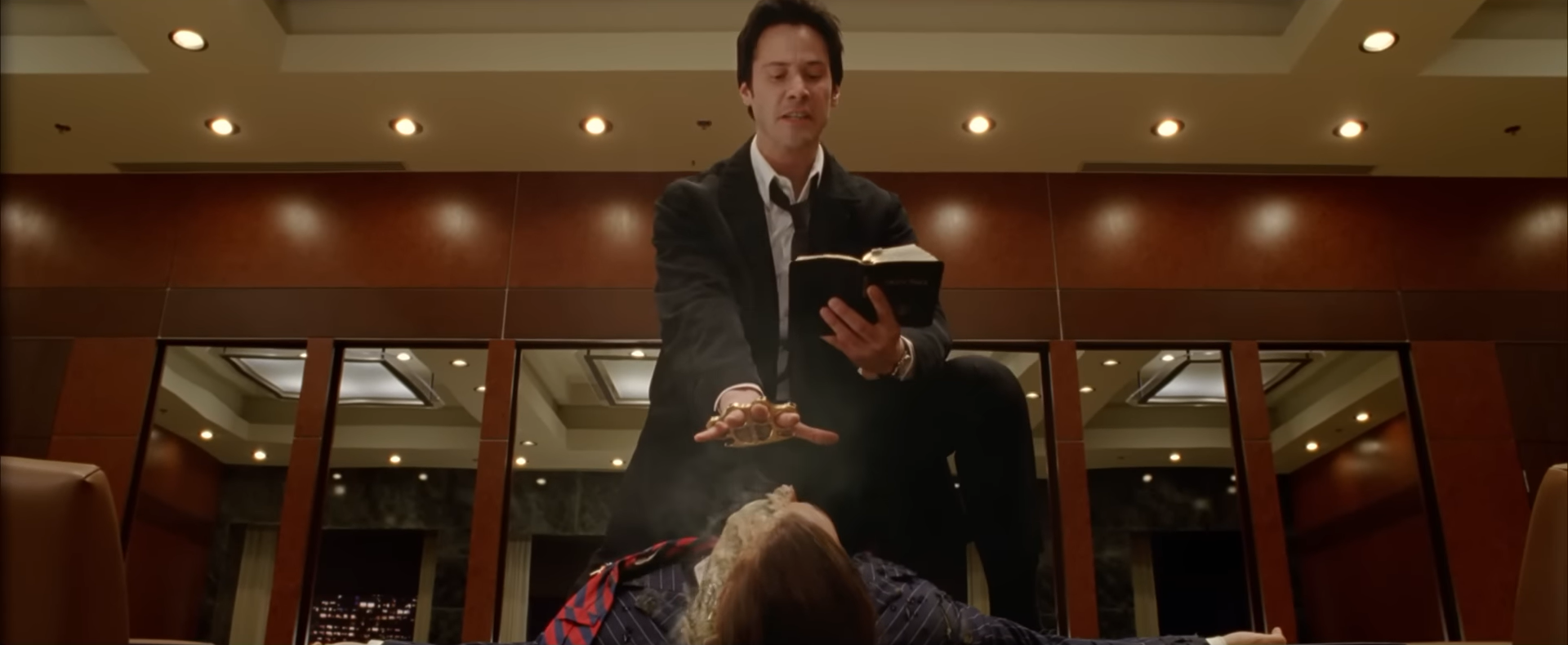
Shawn Levy – Deadpool & Wolverine (2024) – I am poor and I don’t intend to libel Shawn Levy. When people go to Heaven, they get there and St. Peter shows them a theater which just runs Akira Kurosawa and Toshiro Mifune movies on a loop for eternity. When people go to Hell, Cecil B. DeMille brings you to a refurbished porno theater that plays Free Guy and Deadpool & Wolverine on a loop.
Stephen Norrington – Blade (1998) – I’d be interested to see what Norrington might have done with more opportunities in the genre where he was allowed to use more than black, extra dark black, chrome, red, juicy red, and pyramid colors in his palette. (This is not a critique of Blade, which shouldn’t actually have any colors other than those. I’m just curious about how it’d look.) Blade has some of the most rewarding action of any superhero movie, using martial arts and swords and acrobatics that all seems about 80% of the way to real combat. Also, you can count the number of movies in this genre with an opening sequence as memorable as the Blade blood rave on one hand.
Matt Reeves – The Batman (2022) – Reeves makes a retro Batman in two important ways. One is making Bruce Wayne the kind of guy who would look right at home with Iowa or The Sickness blaring through his hi-fi, “Something in the Way” needledrop be darned. The other is that this Batman feels much more like the character as he was made in the 1930s than how he has been made in any movie in the past five decades. Batman was conceived of as a detective, but also as someone who has no pity for the criminal element. In his first comics appearance in Detective Comics 27, Batman figures out who’s killing some folks and then punches a guy into a vat of acid and intones, “A fitting end for his kind.” Reeves sees Batman in similar ways. One, Bruce is a detective first, using his skills and wealth as ways to open doors closed to others as he does to beat people to a pulp. And then, well, he really does beat people to a pulp in this movie in ways that I’ve never seen outside animated movies. More than any other live-action director currently working, Reeves belongs with the Brutes. When the sequel to The Batman comes out, we’ll see if that’s an allegiance he chooses to carry with him.
Paul Verhoeven – RoboCop (1987) – By the letter of the law, this is a superhero movie, although it’s so far afield from the average superhero movie (largely because of its satirical edge) that it’s tough to categorize. If anything, Verhoeven has tapped into the Superman who would have shown up in serials as opposed to standalone films, finding a superhero whose primary fight is not against a Zod or a Doomsday but against the wage thieves who exploit miners and factory workers. Verhoeven, in his own way, gets after the darkness of the superhero movie by approaching the origin of its maker not simply through some kind of trauma that leads to rebirth, but by eliminating much of the person who previously existed. If the superhero requires a secret identity, as many luminaries of the genre claim that it must, then maybe RoboCop isn’t a superhero movie. There is Alex Murphy, and then, after that, there is RoboCop.
 Seeing Things Secondhand