Dir. Jonathan Glazer. Starring Christian Friedel, Sandra Huller, Julia Polaczak
The United Kingdom took home its first ever victory in the International Feature Film category at the Oscars, the third nominee for a country which had sent two Welsh-language nominees up in the ’90s. This movie is in German, which is unusual, to say the least, for a British film. After Jonathan Glazer accepted the award, there might have been some folks in the Dolby and television audience alike who wished that, for the third time, a Spanish film would trump a British one in the category. Glazer has been misheard and misquoted so many times. To the best of my understanding, here’s what he said:
All our choices we made to reflect and confront us in the present. Not to say ‘look what they did then’ — rather, ‘look what we do now.’ Our film shows where dehumanization leads at its worst. It shaped all of our past and present. Right now, we stand here as men who refute their Jewishness and the Holocaust being hijacked by an occupation which has led to conflict for so many innocent people. Whether the victims of October 7 in Israel or the ongoing attack on Gaza — all the victims of this dehumanization, how do we resist?
At the time, I thought this was mild to the point of tastelessness, and that the lefty folks I follow on Twitter were reacting with whoops and cheers because lefty folks on Twitter want validation like the middle children they are. This does not have the rhetorical flair of Vanessa Redgrave’s infamous “Zionist hoodlums” acceptance speech back in 1978, for example, and it shows. There was no Paddy Chayefsky in this ceremony who castigated Glazer for this speech, and maybe that’s because no one has ever loved the sound of his own pontification the way Chayefsky did. It may also be because the speech was just…thin. You had to read more into this largely nonspecific speech to find it either offensive or praiseworthy. In this way, we have amusingly replicated the experience of The Zone of Interest itself, a film which is, despite no small amount of effort on the part of the people who made it, quite bland.
The film and its cheerleaders make a great fuss over the sound design, which of course also received an Academy Award. It’s very good work. I went into the theater expecting to be amazed by it and instead found it a little underwhelming; it did not feel as essential to the film as Ruben’s encroaching deafness was in Sound of Metal. You hear everything you want to hear, the screams, the boots, the machinery. It’s all there. It’s what you’d expect, frankly, in this setting; a film centering on commandant of Auschwitz and his family that didn’t have horror in the background would be surpassing strange. The Höss family has a highly cultivated garden, the brainchild of Hedwig (Huller) even if it is not really her labor that put it and the greenhouse together. You can see the people who come from the camp to move and carry, to clean boots of the grime and blood they’ve stepped in. The reason for a garden is not beautification, but to eliminate the worst of the smell from the concentration camp. When concentration camps were liberated, before anyone saw the places, they smelled them. There are visitors to the Hoss home, visitors coming on business, family visitors, attendees of a birthday party. No one ever comments on the smell. Either these flowers are made out of industrial strength Febreze, or there’s not a way to artfully diminish charnel stench in Oscar-winning ways.
Here’s a review from Demi Adejuyigbe, who is one of Letterboxd’s most popular users:
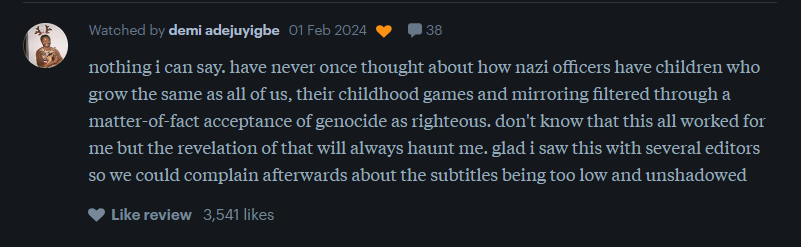
A review in which the first sentence truly underscores the next three, I’d say.
If you go into The Zone of Interest and your understanding of the Nazis is informed primarily by Steven Spielberg, then I suppose you might come to the conclusion that Adejuyigbe comes to here. After all, the Nazis of Raiders of the Lost Ark do not bring their children along to punch out Indiana Jones, and the Nazis of Schindler’s List do not bring their children to the liquidation of the ghetto or to Amon Goth’s balcony. How could we be expected to know, then, that such an enormous element of Hitler’s best-laid plans had to do with having children? The Zone of Interest works based primarily on expectations, or of prior knowledge of the Holocaust, and something that bothers me about it how obvious and tired it feels if you already know something of Auschwitz or Rudolf Hoss. If you can do more than identify the proper nouns going into the film, then the rest of it feels hollow. Profundity does not often stem from moving from the first stage of Bloom’s taxonomy to the second. If that is what The Zone of Interest is ultimately for (while I ultimately find the film a little shallow, I don’t think the film is naive), then it is a film aimed at the lowest common denominator. If it is a film aimed at the lowest common denominator, then the premise and execution of The Zone of Interest are complicated to the point of frivolity. The Zone of Interest is not made for the reaction that Adejuyigbe has to it, but perhaps it would be if Adejuyigbe had logged one of this film’s great influences, The Act of Killing.
The best of The Zone of Interest is in that spat which Rudolf (Friedel) and Hedwig have by the stream, one where she just absolutely loses her cool about the possibility of being uprooted from her happy home next door to the world’s most infamous concentration camp. It’s not an interesting scene because it’s ironic, or because her uproar is in some way odd. She’s obviously very happy there. She’s put her thumbprint on the place in the blood of many other someones. There’s no reason that she would want to leave this house which symbolizes her incredible social rise just to be plopped in some flat outside Berlin. The house and its little swimming pool, its formidable gardens, its greenhouse: all are status for Hedwig. Appealing to her officer husband about family or about the effort that has gone into the house are for naught. Rudolf may not like it either, but he does what he is told. So Hedwig appeals to her husband, who is a true enough believer to run the most infamous death camp in world history, through principle. I don’t have a lot of German, but my little ears pricked up for “Lebensraum.” It’s not a term that shows up very much in Holocaust movies; to give a single example from a well-regarded movie, it doesn’t appear a single time in Schindler’s List. The film addresses the idea of Lebensraum, takes it out of your AP Euro study guide and puts it in stark terms. Lebensraum is not just about finding space for the German volk to spread out and grow, and it’s not just a term used for annexing the Sudetenland. Lebensraum only sounds empty to us in the present because it did not permanently come to pass, but Hedwig doesn’t know that.
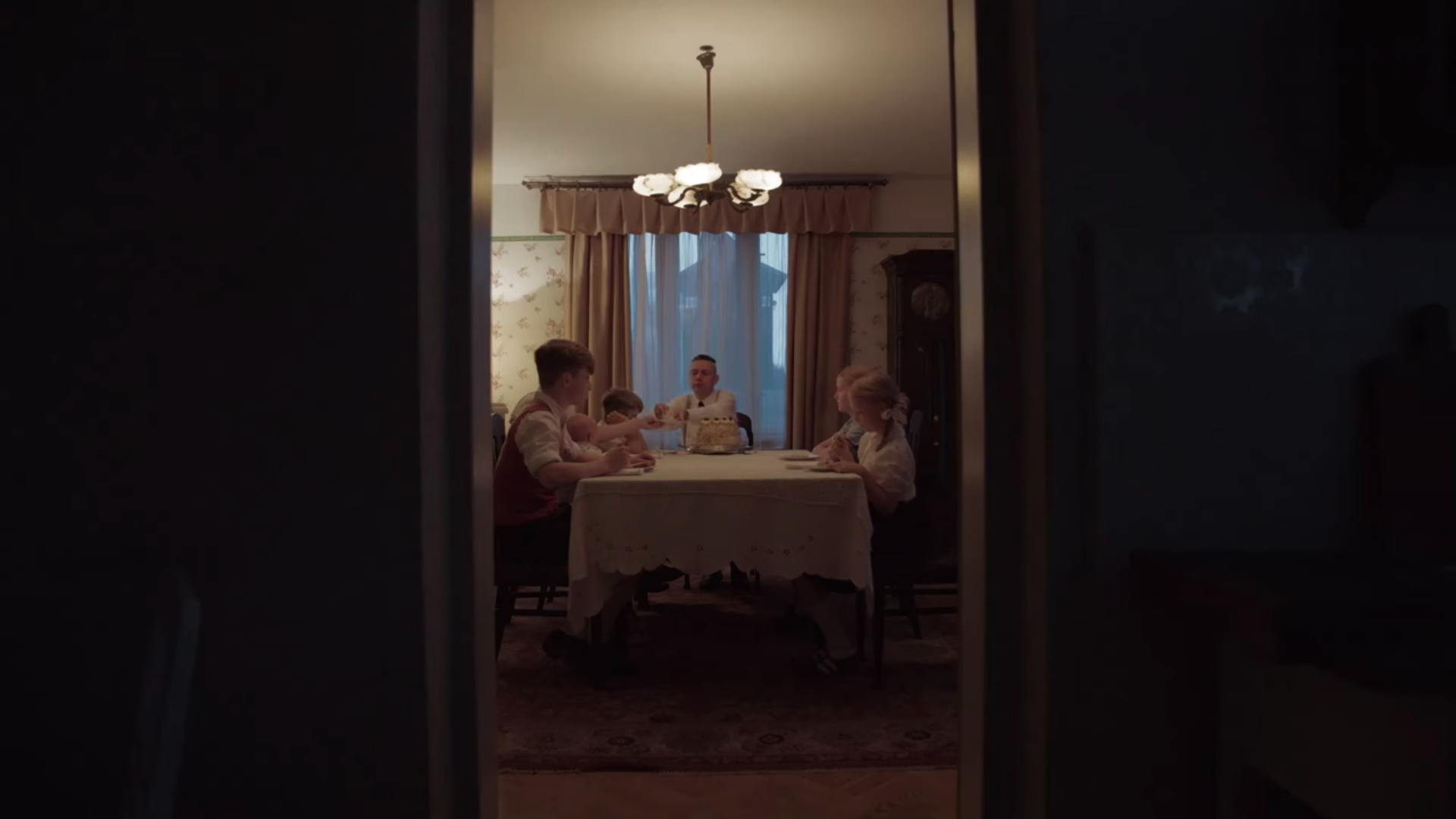
This is Lebensraum. Cutting up a cake on land that belonged to another people not long before and which is now in the clean hands of the Third Reich’s pioneers. Never being that far away from the people who have been conquered and now die at your hands, as much to command as the knife in Rudolf’s hand. Contrary to what we’ve been told by the Academy and a great number of critics and an even greater number of viewers, this is what’s new in The Zone of Interest. It is an answer to the question of why we are watching a story which “humanizes” the Hoss family and their friends and business associates, as if they weren’t human before. The Zone of Interest, when it is most successful, is focused on a single conversation between a husband and wife who are arguing about the future of their family, and using their family as a referendum of Hitler’s own plans and own theory. They have internalized Nazi political belief so much that they are now basing their decisions for themselves and their children on what they believe the Fuhrer wants them to do. This is not a clever conversation, nor is it presented in any special or unusual way. The Zone of Interest is a pretentious film, but it didn’t have to be in order to work.
 Seeing Things Secondhand