| Movie | Year | Director | Actor | Actor | Ranking |
| They Live by Night | 1948 | Nicholas Ray | Cathy O’Donnell | Farley Granger | 3 |
| All That Heaven Allows | 1955 | Douglas Sirk | Jane Wyman | Rock Hudson | 24 |
| Cane River | 1982 | Horace B. Jenkins | Richard Romain | Tommye Myrick | 54 |
| My Best Girl | 1927 | Sam Taylor | Mary Pickford | Charles Rogers | 62 |
| The Crimson Kimono | 1959 | Samuel Fuller | Victoria Shaw | James Shigeta | 99 |
In the European fairy tale, every Snow White or Sleeping Beauty or Cinderella is just the little girl hearing the story. She’s grown up some, and she’s more beautiful than she can dream of being, and maybe her voice is smoother or her movements daintier. Nevertheless it’s just her in a costume. In the American fairy tale, it’s much simpler. Mary Pickford is the heroine. Every girl aspires not to be some idealized version of herself, but with the ideal in front of her eyes, she chooses to fit into that ideal. Like the protagonists of the fairy tales, Pickford finds a way to marry well in these films, including the charming My Best Girl. The world is set up against her, you know, even though she bears it with some lightness before she falls in love. She’s a stockgirl at a department store, a position with some semblance of security, perhaps even a chance to rise to an upper floor and make a little more money and catch a few more eyes. The only chance that she needs to charm the man in question is a little gasp of air about the waterline, a presentation for a customer who turns out to be her future husband. A Cinderella need only walk into the ballroom at the palace to catch the prince’s eye; even if she’s a department store nobody, all she needs is that single opportunity to put the hammer between the scion’s eyes.
In a world where Maggie and Joe belong in the same social stratum, she wastes no time ensuring that she’s got the upper hand over this handsome, clueless beau. It is impossible not to smile as Maggie decides to test how much Joe likes her one day while she’s hitching a ride on the back of a truck to her place on the wrong side of the tracks. She has a little bag that she drops over the side of the flatbed multiple times; by the third or fourth go-round, she’s not even disguising the real purpose of her all-thumbs adroitness. Joe picks up the bag, chases down the truck, slows down again, see the bag on the ground, picks up the bag, chases down the truck. Eventually he does what she was aiming for him to do the whole time and returns himself along with the bag. But there is a world where Maggie knows that Joe comes from wealth that will not admit her to its bosom, the world where Joe’s father has tracked her down and made his disapproval known with one of those checks for thousands of dollars and a memo reading “Get the **** out of my family’s business. In that world, another performance is required of the girl from the department store basement, a shaky and teary dance to what must have qualified as hot jazz before the Crash, the sloppy application of lipstick she’s never worn quite like that before. In the end there’s a happy, chaotic conclusion which requires a mad dash to an ocean liner, but My Best Girl is a Cinderella story which does not even allow its smudgy heroine the dignity of a family of means or the memory of a father who was worth a cuss. A little luck and a lot of bootstrap-pulling propel Cinderpickford to a happily ever after in a romantic comedy where the only real conflict in the lovers’ lives comes from outside them.
In Hollywood cinema, romances are about personalities and not about stations. The issue with Rick and Ilsa is that not that she, in the words of Sally Albright, will become the first lady of Czechoslovakia while Rick will tend bar in perpetuity. The issue is that he showed her his vulnerability and tenderness and it takes him a lot of dour time to realize that she didn’t throw it back in his face out of some heretofore unprecedented cruelty. The issue with Rhett and Scarlett isn’t that he comes from old money and she comes from new money, but that the two of them are too stubborn to bend to each other outside of whatever violent sexual congress they share. Illness or infirmity will push the crowbar in between lovers, as in Love Story and An Affair to Remember or…Ghost, kind of? War will do it too, or politics. But social class not so much, and according to the AFI’s blindingly white list that I’m flicking here, not social class in Black communities. Enter Cane River, unsurprisingly an independent film, shot in Louisiana about Louisianans, a film so radical that it’s still hard to come up with another one quite like it.
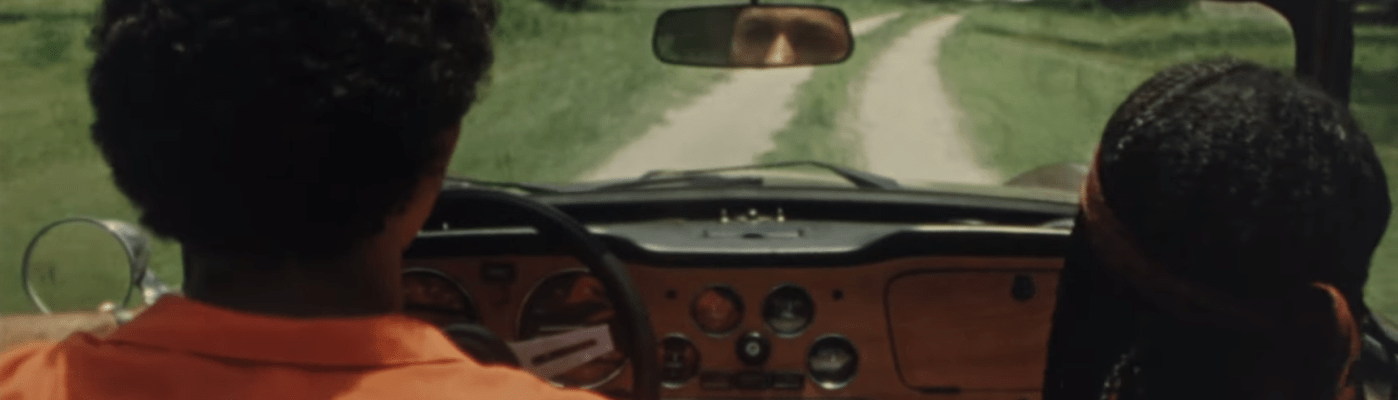
Once again, the man, Richard Romain’s Peter, is the one with the money, and the woman, Tommye Myrick’s Maria, is the one without it. Peter, who is returning home despite having recently been drafted by the New York Jets, comes from a family which has undisputed hegemony both personal and economic over what amounts to a fiefdom in northwestern Louisiana. It’s the South, and that kind of economic power comes from the same place in Peter’s family that you might expect it to come from in many other wealthy Southern families. Back in the 19th Century, that family had significant property, and that significant property included other human beings. This is another picture where the families get involved, standing in for their own segments of society that they’re upholding. The family that’s more against the budding relationship between Peter and Maria (who met on the grounds of the old plantation in the area) is hers, the one that has not looked about itself with benign neglect going back more than a century, but the one that has had to scratch and claw while other Black people kicked them down. (Her surname is “Mathis.” His surname is Creole, “Metoyer.” He’s light-skinned; she’s not.) There is a real dearth of trust in this relationship from the start, and that mistrust comes not from Peter, who is smitten with Maria, but from Maria, who seems entirely capable of handling her own life without this Nachitoches prince. Ultimately, the lovers of this film have to do what the lovers of My Best Girl have to do, and that’s to abandon the place where the rich man is a big shot. Peter was hailed like a victorious general from The Wars when he returned home, someone who has been successful in two of Louisiana’s primary fields, capitalism and football. Literally there is almost a parade to welcome him. Love can overcome quite a bit in these films. After all, this is America, and amor vinct omnia here. What it can’t overcome is the hostility bred into the land, the streets, the buildings which will always reek with the high-handed perfume of hereditary wealth. Maria enrolls at XULA in New Orleans, and when she does that she proves that she has the capacity to extricate herself from a place that refuses to give her the room to grow that she desperately wants.
There’s another social difference that seems like it ought to be the most fundamental in American cinema because it’s probably the most fundamental in American life, and that’s racial difference. Look back in history and look at contemporary rhetoric from their contemporaneous retrogrades, and the perceived threat of miscegenation is an essential piece to the garbage these people spew. Hollywood, which never met a Confederate perspective it couldn’t say howdy to, has largely been loath to address that consideration in any serious way. You’ll find it sometimes, as in The Searchers, where it’s parallel to what Ethan fears will happen if Debbie remains with the Indians. The King and I delicately sidesteps the awkwardness of what might happen if Yul Brynner has to pretend to be Thai while he bones Deborah Kerr. Speaking of Hammerstein musicals, it’s in Show Boat too, though it’s worth noting that there’s no movie adaptation of the original musical that approaches that concept with the clarity of the latter.
The Crimson Kimono was distributed by Columbia, which feels appropriate; of the Big Five studios, it’s probably the one that got into the grime of the 1950s best. As far as actual romance goes, the film is fairly light on kissy-kissy smoochie-smoochie. The films of Sam Fuller are no more made for the monogamous missionary position than a jackhammer is made for mincing onions, and The Crimson Kimono is no exception here. The film revolves around the slummy burlesques of Los Angeles, beginning with the murder of one of the girls and continuing with scenes in the gummy settings that Fuller loved to shoot. Virtually the only woman in the film who is not connected with that world is Christine, an art student who becomes the object of affection of a pair of cop partners, Joe and Charlie. The relationship between Joe and Charlie is the really important one in the film, if we’re being honest, and there’s a reason I’ve got this one ranked ninety-ninth on a list of one hundred films. Neither one of the cops has a really terrific spark with the art student, although Christine begins to warm to Joe more than Charlie once they’ve taken her into their apartment to keep her safe from the suspect she sketched. (If this sounds like a bad idea, well…) This sounds like a pretty entertaining setup, goofy enough that you can almost imagine it being the basis for an episode of Brooklyn Nine-Nine. Charlie, like Christine, is white. Glenn Corbett plays him, and plays him like the kind of jock stud that you’d expect this kind of cop to become. The reason this is not silly, aside from Fuller’s general disdain for pure levity, is that Joe is a Japanese-American. Jealousy seeps into what was previously an ideal relationship between these two bros being dudes, and distrust follows quickly. Charlie can see that Joe is getting on better with a woman he’s attracted to and isn’t used to striking out; Joe finds Charlie’s mounting hostility, expressed most pugilistically in a kendo match, to have a racist edge to it. Solving the case doesn’t fill the sinkhole between the two ex-best friends. Joe gets the girl (quite possibly the most radical plot point of any American movie that year) and loses Charlie because of the resentment between the two that they can’t entirely overcome. Both of them were wrong to assume something as deep-seated and ugly in the other as they did, but just because Charlie is less racist than Joe thought he was doesn’t mean the two of them can ever be close again. Racial animus takes a toll in The Crimson Kimono, where even a pair of open-minded men cannot continue to be friends once a white woman comes between them.
We Americans love frontiers. There’s a dauntlessness, a perseverance in that love which is the flower of so many good American values, and of course the root of any number of America’s sins come in the way that American colonists and then American citizens pushed from one seaboard to another. Why did people go west in the first place, your history teacher may have asked, and the right answer was something like “For the opportunity.” The flip side of that answer is that there was insufficient opportunity where the becoming pioneers lived in the first place. The problem with being from somewhere is that the other people from that somewhere tend to keep their notions about you. This is the heart of two of the great American filmic romances, They Live by Night and All That Heaven Allows, although the two of them are obviously quite different on the surface. All That Heaven Allows is about respectable people. The protagonist is a widow, Cary, with grown-up children and lots of friends at the country club, and while the well-heeled look askance at plant guru Ron’s hilariously Yankee contrarian streak, he’s not some kind of pariah. His father was respected, his business practice is respected, and he just happens to have to work with his hands for a living in the yards of people who make a point to never have to stay home. They Live by Night is about a pair who have to put their eyes to a telescope to see thirty years old, and even then they wouldn’t see themselves with dollars in their bank accounts at that point. Bowie and Keechie have the experiences of one place. Keechie knows the dank garage-shed. Bowie knows the inside of a jail. Whether one is a trapped widow or an escaped convict, the community has long decided on one’s social position. The world expects Cary to remarry, presumably to one of the widowers in the community, or, just as good, stay home and watch TV in a handsomely decorated mausoleum with two floors. The world expects Bowie to wither out of sight, and that he escapes from prison (not his idea) and goes on the lam is unacceptable.
The callousness in both films for their protagonists, both drawn into corners, is largely offhand. In They Live by Night, Bowie is nothing more or less than an escaped prisoner who was involved in a bank job. What harm could there be in tracking down such a man who obviously chose to plan and execute the robbery? In point of fact, the robbery was not Bowie’s idea, and more than that he goes along with a gun in his back, but of course that’s not the way the world views him once they hear about his misdeeds on the radio. There are lots of petty criminals in the backwater towns where They Live by Night takes place, and Bowie is another one to round up or shoot down. It doesn’t matter if someone loves him with her whole heart, or if he has that same tender feeling towards her. It’s as if he picked up a key one day, wandered around with it in his pocket, and by chance unlocked her some day later. The fit between them, in the back seat of a car under a coat or in the humid nights they get to know one another, is precise and soft. Bowie finds a repressed sweetness in Keechie and she pours it over him. Keechie is the first person who Bowie can be remotely safe with, and he follows her for that heat like a cat follows a beam of sun. The world that they hide from, dodge between dusks on buses and in remote motels, is one which cares little for Bowie’s legal predicament and still less for the flooding warmth of his first and last love affair. Escaped convict he was, escaped convict he will remain. He will always be fanged and forktailed Bowie of the Bowers Gang and never Arthur Bowers, the shy kid who gets off a bus and gets married.
If anything, the callousness directed at Cary is even more troubling because she has to face it from people she sees every day and who want to say these cheerfully off-putting things to her face. In her pristine New England town, any sign of personality (which is to say individuality, which is to say the flickering of a human soul) is viewed with the utmost suspicion. To not simply settle down again with some similarly middle-aged man and be his forever date to social functions where the martinis are a little too dry to be tasteful is to be a heretic. At least in the olden days in New England, they hanged the heretics with the efficiency we’ve come to expect from our judgmental, non-rhotic brethren where they actually have autumn. There’s ceremony to the ritual of breaking someone’s neck for disagreeing stridently, drama. The same is not true for Cary, who becomes a pariah at remarkable speed for offenses no worse than developing an interest in a younger man from a different tax bracket. The disapproval spreads with the same kind of dirty celerity that characterizes pinkeye or lice, and it seems no one in “Stoningham” is immune from some form of that filth. (A word to the wise: if your city of residence sounds like it could be half of an investment firm or the favorite brand of gin that the boys at the investment firm like, run like hell.) Her children strike closest to her heart because she hoped that they might have some sympathy for the woman who raised them, might recognize that their mother is a person and not merely some obligation they’re ready to sacrifice to Sid Caesar. What’s significantly more annoying is the carping from the crowd that takes a real bitch eating crackers approach to Cary’s affection for Ron. According to Stoningham, Cary died when her husband did, and only Cary is rude enough not to have understood that.
 Seeing Things Secondhand
[…] The Society Cliché […]