| Movie | Year | Director | Actor | Actor | Ranking |
| Make Way for Tomorrow | 1937 | Leo McCarey | Beulah Bondi | Victor Moore | 1 |
| Mississippi Masala | 1991 | Mira Nair | Sarita Choudhury | Denzel Washington | 9 |
| Claudine | 1974 | John Berry | Diahann Carroll | James Earl Jones | 60 |
| Lovers and Lollipops | 1956 | Morris Engel and Ruth Orkin | Lori March | Gerald S. O’Loughlin | 97 |
| Smilin’ Through | 1932 | Sidney Franklin | Norma Shearer | Fredric March | 98 |
You’re not just marrying me, s/he says. You’re marrying my family too. And in practical terms, that person is absolutely right. Even if you don’t grant that you’re going to spend time with your partner’s family at any point, then certainly you’re still marrying the influence that family has had on that partner. The parents are almost always the roadblock in these cases; many lovers and spouses never know their boo as long as boo’s parents knew them. A parent finds it easier to inculcate a fear of roaches or a fear of God in a person than a lover does. A person may be marble as an adult, where a child is putty whose parents leave fingerprints all over them. “You’re marrying my family, too” is mostly advice, but it’s never not a threat.
In Lovers and Lollipops, an independent film from the ’50s, we see one of the most straightforward versions of “You’re marrying my family, too,” and one which must have felt eminently relatable. A widowed mother, still fairly young and attractive and likely to fall in love again, does just that. Ann hits it off with Larry, who has been working outside the country for some years; he knew Ann before she was Peggy’s mother. Now that the two of them have reunited and have begun falling for each other, their courtship very rapidly turns into the silent audition. It’s not as if there’s no discussion about getting Larry and Peggy closer together if he’s going to be her stepfather (and presumably her adoptive father as well), but Larry understands as we do that he’s entering a package deal. He tries to get Peggy to like him by associating himself with gifts and daytrips and toys. This is not Dan Needham in A Prayer for Owen Meany, who meets his lover’s child and tells the boy that he must not open a package with a secret inside. Dan’s armadillo frightens Johnny, and the novelty of the gift’s presentation (to say nothing of the spark of fear it touches off inside the kid) makes Dan stand out. Larry is like Tabby’s previous dates in that novel; he knows that some present is necessary for the child, but hopes that the mere giving of the present will win the child over as if a child’s loyalty can be purchased as simply as the gift was. From our perspective, it’s obvious that the gift that Peggy wants from Larry, not that she could express it, is forgiveness. Over and over again, Peggy does things to demand attention or sympathy from her mother and her mother’s unfamiliar boyfriend, neither of whom are terribly patient with each other. Peggy hides from Larry in the parking lot, but an adult who isn’t vexed with her disappearance or panicking with it can see that she wants to be found without putting herself out there. She wants to bring her baby carriage to the beach even though both adults warn her that she won’t be able to push it on the sand, which of course she can’t. Ann and Larry find their way to each other in the end despite Larry’s run of failures with Peggy, which ends when the dude shows up with a puppy for her. Lovers and Lollipops is undecided about what will happen with this family; it’s uneasy about the prospects of the trio once the puppy gets to be old news.
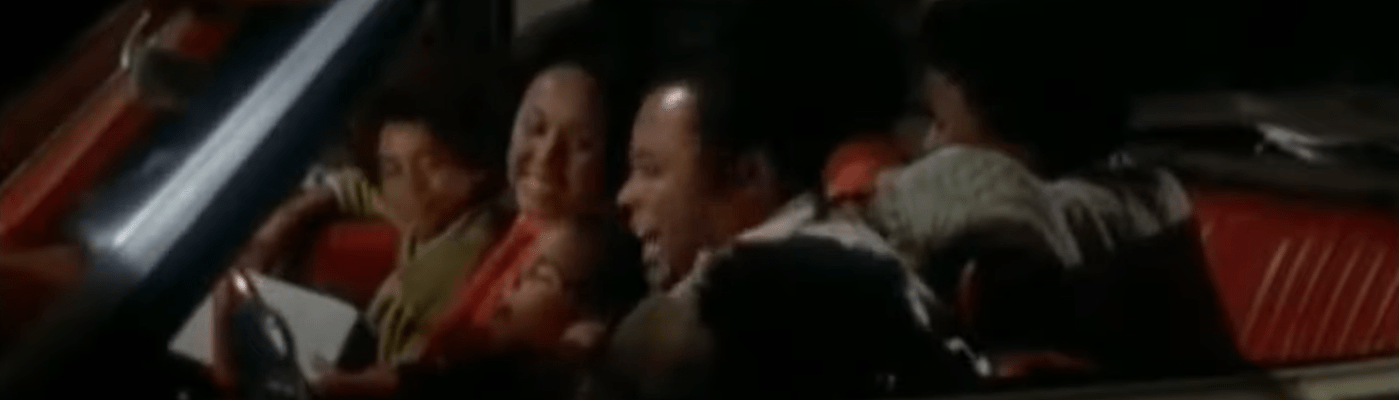
Claudine is working on a similar principle to Lovers and Lollipops down to the New York setting, although what’s straightforward in Lovers and Lollipops is exacerbated here. We have another single mother, although where Ann had one child, Claudine has six. Where that one child is young, Claudine has kids ranging from adulthood to younger than Peggy. Where Ann’s husband is dead, Claudine’s previous spouses are alive, unseen, and useless. Where Ann seems to be making out okay on her own, Claudine and her kids are working the welfare system for all it’s worth. (This is the year before Frederick Wiseman’s Welfare, which approaches the failures of the welfare bureaucracy with an iron empathy. Claudine is serious about welfare too, but lets us in on the joke that the inspectors from the office can be duped by seven people who know how to stow items away in their apartment like they’re members of the French Resistance. It’d make a great double feature: take that, Barbenheimer.) And where Larry is childless and begrudging, Roop has his own kids and doesn’t walk into Claudine’s apartment clueless. Claudine is a studio film, too, distributed by Fox, directed by a filmmaking veteran who’d gotten his name named by Edward Dmytryk, and starring a bona fide celebrity in Diahann Carroll. It feels more like a studio film, down to the snap in the dialogue. Lawrence Hilton-Jacobs, playing Claudine’s eldest and most radical child, Charles, gets some of the best of it. An engrossing argument about the feasibility of radical action as a Black man under the eyes of the cops ends with Charles telling his mother to take a look at his sister’s bosom, but not as nicely: “Good night, Grandma!” There’s a fabulous bit in here early on where Claudine hears that some of her younger kids have been pulling for Tarzan on television no matter how much his enemies might look like him: “Yeah, kick the shit out of ’em, Tarzan!” Roop falls for Claudine first, and the movie doesn’t make their falling for each other into some kind of federal case. He has to push fairly hard to get her to pay attention to him, but Roop has two cards to play that make him an effective suitor. The first one is an ability to handle her kids, which is not nothing. He is able to win them over, but he’s also able to fend them off, which is more necessary for him at the start. And the second is a trump card. He is the only person in Claudine’s life who wants things from her without needing things from her first. He marries her family too, just as Larry does, but James Earl Jones brings a much deeper and twistier romance to the table.
One of the least apt names for any film I’ve ever seen is Smilin’ Through, which sounds like it should be a relatively cheerful little number for Norma Shearer and Fredric March. In actuality, this movie (named after a song sung in the film) is a real bummer of a movie. Here’s a picture where it just seems like everyone is on the verge of tears, and not just because it seems especially damp in the corner of England they’re inhabiting. There’s some clever double-casting and past-casting in this film that makes it stand out among other studio melodramas. Shearer is pulling double duty as Leslie Howard’s murdered fiancee as well as his beautiful young niece, Kathleen; March plays the jilted man who killed, ahem, Moonyean, as well as his descendent who is currently chasing after Kathleen. Howard is only John Carteret, young and old alike, although in Howard’s hands that’s almost a form of double-casting in itself. Smilin’ Through isn’t going after the full Cloud Atlas thing. We’re not a multitude of drops in an ocean here. We’re just MGM and we know where our bread is buttered. Smilin’ Through overstates its case a little bit; there are two good reasons to separate our lovers, and the film only needs one. In the final third or so of the picture, Kathleen and Kenneth are kept apart because he’s going to World War I. This he does so he can be adequately maimed and thus too ashamed to accept her love or countenance his own for her, and it’s about as compelling as you’d expect. Much more interesting is John’s insistence that Kenneth and Kathleen be kept apart because of his own longstanding and understandable prejudice. “The heart has its reasons” is a poetic way to explain away prejudices like those that John keeps with him for the whole of his adult life, but it hardly makes those prejudices more justifiable. Kathleen and Kenneth are adults; Kenneth is an American who doesn’t even know his father; John has made his grief his entire person. So it is that his niece and her lover must sneak around, going to tea shops where they’re wanted rather than taking tea in a parlor. World War I steals years of happiness from the pair, as it stole eternities of happiness from couples less fortunate than these fictional two. But World War I did not raise Kathleen and impressed no sense of responsibility on her; it is John alone who hacks at the green trunk of a love affair because his was uprooted decades before. A couple years later, Sidney Franklin once again directed Shearer and March in a romance where one person’s legs don’t work so good. In The Barretts of Wimpole Street, she as Elizabeth Barrett and he as a hopped-up Robert Browning must face down the imperious rigidity of Charles Laughton as her father, Edward. Oaky Charles Laughton could have eaten twiggy Leslie Howard, and perhaps he might have if he were given half a chance, and his performance is much more intense and memorable than Howard’s here. Yet the romance between the two poets is much tamer and felt less deeply than it is in Smilin’ Through. The way that John opposes the attachment between Kathleen and Kenneth is more distant and reedier, and so the two of them have more leeway to grow alternately giggly and despondent together.
Perhaps Mississippi Masala is a better example of a community, or a pair of communities beadily eyeing one another, rising up against an undesired love affair. The Indian community in Greenwood does not care much for Mina going out with Demetrius. It’s an affront to the insular, committed group that has had to pull together from the first. The Black community does not understand nor encourage Demetrius as he courts Mina. It’s an affront to a community that’s stuck between a history of white supremacy and a future of feeling pushed out by an immigrant group. Over and over again, people outside their immediate families work to separate the two of them, tattling to those families and trying to give their well-meaning, basically racist speeches about what the couple is doing. (How anyone has the physical ability to scold Sarita Choudhury and Denzel Washington when their jaws should be on the floor because of how hot they are together is totally beyond me.) But their passion is so real, and their feeling so authentic, that you can imagine the two of them deciding to forsake all others in order to stay together in a perspiring cocoon of sultry walks on the beach or randy nights in motels. Adults split off from their groups sometimes. It’s much harder for children to do the same thing with their families, even if they’re grown up. The single greatest impediment to Mina and Demetrius is her father, Jay. Like John, Jay has been badly hurt in his past and is no longer attempting to tend to his wounds. Like John, one man is basically responsible for taking away Jay’s happiness. Unlike John, the man in question is not a romantic rival but General Idi Amin Dada, who expelled Indians from Uganda. The remnant of Jay’s hurt is proportional to the size of the evil committed, and likewise the intensity of his prejudice. One man hurt John, and so he intends to hurt one man in return. Jay reads his situation as Black people hurting him through hate, and so he intends to hate the group at large in America as he was not given the opportunity to in Uganda. Even by the standards of racism, his reasoning is pretty shaky, and it requires a 16,000 mile round trip for him to appreciate how wrong he is about his daughter’s Americanism and his own racism. That she has long since decided to run off with Demetrius is the result of his own failings more than it is the failings of Demetrius’s people or the racial groups of Greenwood.
I’ll give the AFI this much. On their most recent top 100 films, they included Nashville. On their list of the greatest stars of classic Hollywood film, they included Jimmy Stewart. Even if you’re of the opinion that like, Schindler’s List is America’s great film and Joan Crawford America’s great star, they’ve got you covered there too. More often than not they make layups. Not including Make Way for Tomorrow is like missing a layup while tripping over one’s own feet and throwing the ball into the rafters. Maybe it doesn’t feel obvious to the people over there, and compared to Casablanca maybe it isn’t. It’s not a movie with sex, because Victor Moore and Beulah Bondi play Bark and Lucy like they’re going to be in the grave pretty soon. It’s not a movie with the lovers in conflict with each other, because they spend so much of the film away from each other. And it’s a movie with old married people, about old married people, and that’s not a subject that you see often enough in the pictures anyway. Make Way for Tomorrow stands out, which is why it’s not included on the 100 Passions list and why it is so much better than the 100 Passions list. Children get in the way of romance, and parents get in the way of romance. Make Way for Tomorrow finds that adult children getting in the way of romance are the cruelest combination.
When Make Way for Tomorrow was made, Ida May Fuller was still years away from receiving that famous first Social Security check. There was no safety net for old folks except for the one that they might have tried to knot together during the early lives of their children. When Bark and Lucy lose the house, they don’t have much choice other than to throw themselves on the mercy of their four relatively local kids and their families, and the mercy they receive is a twenty-four hour reprieve on death row. The two of them, when they’re with one another, are the dream that any married person (happily or otherwise) must imagine. They love each other. There is still want there that has not been stripped or eroded by decades of need. Responsibility is not at the center of that love, but choice. Bark and Lucy continue to choose each other, and at the first sign of trouble, their children refuse to honor that rare affection. Pearls, swine. We know from their final day together that those two still love each other. They don’t care about each other or rely on each other; they love each other. They walk and talk and remember and even goof off like people who are in love after all this time. “As Time Goes By,” which was not even ten years old in 1937, wisely said that “the world will always welcome lovers.” The world does just that for the elderly Coopers, even in New York City and even among people with so much more than they have. People in a rush slow down, from salesmen to musicians. People who might more efficiently spend their time courting wealthier clients, like the hotel staff and management, go out of their way to honor this old couple. The world may welcome lovers, but their children will not. The children separate their parents for a short time like they might separate puppies they’re fostering. Then they choose to do it forever. Lucy says goodbye to her husband at the train station, even as he tells her he’ll find work out in California and send for her. Everyone knows Anna Karenina in their veins; he’s as likely to see her in California as he’d be to see her under the wheels of the train. In these other films, family and romance ultimately come together, making peace with one another. In Make Way for Tomorrow, there can be no peace.
 Seeing Things Secondhand
[…] The Family Cliché […]